Tag Archives: Reality checks

Ignoring 9 Out Of 10

I realize I’ve spent the first couple of posts this week on the topic of companies being less than responsive to customers. I was chatting about this with someone yesterday and they asked me if I really thought the two cases I cited were the norm.  After all, he said, how can companies really expect this kind of behavior to remain quiet when every person is a publisher?
Sprout Social

Sprout Social

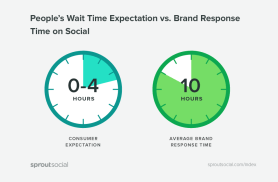
Precisely my point, but since when does common sense prevail?  In fact, companies are getting worse at being responsive.  Maybe it’s just the increase in volume, maybe it’s the ease with which customers can reach out, but the common sense solution of staffing up and training to handle the increased load is nowhere to be found.  Since we believe in fact-based statements here, these facts are from Sprout Social:

90% of people surveyed have used social in some way to communicate directly with a brand. What’s more, social surpasses phone and email as the first place most people turn when they have a problem or issue with a product or service, according to Sprout’s consumer survey. Following this trend, The Sprout Index shows that the number of social messages needing a response from a brand has increased by 18%over the past year. In spite of the high volume of messages that require a response, brands reply to just 11% of people (a number that’s been stuck in neutral since 2015).

11%, meaning brands are ignoring 89% of the messages sent to them as consumers reach out. I guess they’re too busy misusing social media and other responsive channels as megaphones (so 1995) since the research found that brands send promotional messages out 23 times as often as they respond to a customer message. It’s not just social that requires our attention.  August 2015 research from Nice Systems and Boston Consulting Group (BCG) found that internet users in major metro areas worldwide used an average of 5.6 customer service channels.

I can hear you rubbing your temples as the headache comes on.  How will you support your customers in those places when you might be ignoring 9 out of 10 customer interactions now?  Beats me, but the question needs to be answered, and the organizations that do so will be the ones that win.  Make sense?


Leave a comment

Filed under Consulting, Huh?

Kicking The Curb

The government is one of everyone’s favorite punching bags. It really doesn’t matter where on the political spectrum you fall. The government is the target of an angry rant and/or much headshaking at some point. Today’s topic is a great example of that and it’s instructive to business as well. No, I haven’t reconsidered my self-imposed ban on politics in this space. This has nothing to do with politics and a lot to do with things such as management, customer service, and accountability.

English: A flat automobile tire. Français : Un...

(Photo credit: Wikipedia)

The town in which I live just installed new curbs on Main Street. The new curbs, which meet federal and state standards, are made of granite for their durability (lots of salt and snow plows on the roads here in New England). They also have really sharp edges which, as documented in this article from a local blog shows, have been shredding tires. No, driving on the curb isn’t normal here, but parallel parking is, and apparently there have been many cases of the curbs cutting down tires as the tires bump into them.  The government’s response?

The granite curbs used on Main Street are the same material and construction that is used throughout Connecticut and meets state and federal specifications.  Because it is cut stone it does have a sharper edge than asphalt or concrete. It is a chosen material because of it hardness and resilience to salt. It can stand up to New England winters with routine snow plowing and application of salt. The curb is not intended to be driven upon and will not damage a tire on routine contact.

In other words, not my problem.  We’re following the rules and despite the fact that the rules have caused the citizens (read customers) whom we serve to suffer flat tires, it’s your fault.  Quit hitting the curb. Rather than thinking about how to round the edges and to solve the problem, the government official is thinking about how to blame the victim.

You might be shaking your head about this (as you should) but business does the same thing. Rather than fixing customer problems we look to shift blame.  We do things such as ask customers to sign lengthy agreements written in legalese in which they waive rights.  We impose hidden fees which are only clearly disclosed when someone complains. I can’t wait to hear the Downtown Merchants Association (a local business group), who will lose business as customers choose other places to park (and shop) weigh in on the topic of how the nicer new curbs have “helped” make downtown more attractive to business.

I happen to believe there is a valuable role for government to play in our lives (so do you every time you call a cop or report a fire or drive on a road). I don’t think there is a place for any business – government included – to ignore its customers nor to leave obvious problems unsolved.  You?

Leave a comment

Filed under Huh?

Crappy jobs

One summer when I was in college I found myself without gainful employment. I had spent many other summers as a camp counselor but I had decided not to spend 8 weeks locked in a bunk with a slew of six-year-olds and hadn’t really found anything to do that didn’t require an investment of cash (like an ice cream truck route). All the “good” jobs were taken, and while a buddy and I were offering our services out to paint houses, I really needed to do something to generate cash. That’s how I ended up with a crappy job for which I am still thankful.

My crappy job involved going door to door selling encyclopedias. I’m not kidding. For the younger readers out there, printed encyclopedias were pretty popular (think analog Wikipedia) nearly half a century ago. Every day I would drive my car into some neighborhood and walk the streets knocking on doors. The case I carried was not light, even to my younger, in-shape self. I got rejected nearly every time, at least when someone was nice enough to actually open the door, hear my spiel, and not threaten me with a dog. I also made a few bucks in the process, but calling it a crappy job is an understatement.

I learned a tremendous amount from my crappy job. First and foremost, I learned patience and what is commonly called sticktoitiveness.  I didn’t quit; well, at least not until my painting partner convinced someone to let us paint their house, which was 8 weeks into the summer.  I learned cold-calling and how to qualify leads.  I learned not to fear speaking to strangers. I learned that, just as is baseball, it’s possible to fail 6 times out of 10 and still be an all-star. Most importantly, I gained perspective.  Nearly any other job seemed great by comparison, and I could mentally return to knocking on doors any time things got bad at some subsequent job.

Many years later, “tell me about the worst job you ever had” became one of my standard interview questions.  I looked for people who had a crappy job at some point and we always talked about why it sucked and what they learned. I always leaned toward candidates who had done the worst jobs.

What crappy job have you had? How did it change you?

Leave a comment

Filed under Growing up, Helpful Hints, Thinking Aloud