Tag Archives: management

Getting Elected Isn’t The Win

The big news at the end of last week had to do with the withdrawal of a bill that would have changed the laws regarding health insurance in this country. If you’ve been here in the screed before you know that we don’t do politics, so I’m going to refrain from any commentary for or against what happened. There is, however, a pretty good business (and life) lesson to be taken from Friday’s activities.

One thing you heard over and over was that the folks who wanted to change the existing law had 7 years to come up with a plan that would be better. It took them 7 years to control both Congress and The White House, thereby assuring that their plan would become law, assuming, of course, that it was palatable to the members of their party. It wasn’t, and so it hasn’t (become law, that is).

What can we learn from this? That it’s easier to win an election than it is to find the consensus you need to run the government. Winning is easy; governing is hard. The same thinking applies to managing a business. Becoming a manager is easy; managing the business is hard.

I met with a potential client last week who had recently been promoted into his job. He’s a smart, young highly motivated guy. In the course of our conversation, he mentioned that he was having some trouble adjusting to his new role and was finding it difficult to get things done as quickly and efficiently as he wanted. I told him that I had suffered from the same thing 35 years ago when I was handed my first department to run. Getting the job was a lot easier than doing the job.

What does that mean for you? If you’re looking for that next promotion, you might want to focus on the challenges of preparing to do the actual work rather than the challenges of getting a promotion. Trust me: the powers that be will appreciate your focus on execution and that will increase the chances of that promotion.

If you’re running your own business, a focus on execution is a good thing as well. Satisfied customers are more important that finding lots of new ones. There are tons of studies that show that using resources to keep existing customers happy is more profitable that spending resources on finding new customers (it costs 5x more to find a new customer than to retain one!).

Getting elected or promoted to a position isn’t really the win. Getting stuff done, whether it’s in your cubicle or on the floor of Congress, is the real test, don’t you think?
Leave a comment

Filed under Helpful Hints, Reality checks

Sampuru

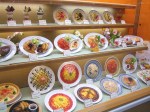
This Foodie Friday, the topic is sampuru. No, you probably don’t call anything by that name but you’ve seen it. It’s the fake food you often see in the lobby or window of Japanese restaurants. Great sampuru is incredibly realistic and can negate the need even to look at a menu. Like many seemingly simple things (such as making the rice for sushi), sampuru artists require years of training.

Typically for this space, as I was thinking about sampuru, a business thought came to me. Fake, plastic food has its business counterpart although they’re not called sampuru. I call them empty suits, but I’m not sure we should limit the term to people.

Your typical empty suit, like great fake food, gives the appearance of being real and nourishing. The reality is that they look great but can be toxic if ingested. In fact, I think they’re easier to spot than great sampuru. Ask an empty suit for an opinion and it will either be the same as either the boss’s or of whomever in the room they’re trying to please if they have an opinion at all. You see, empty suits rarely have enough knowledge about a topic to give a well-reasoned opinion about anything. They may rattle off a number of industry buzzwords but if you try to dissect what it is they’re saying it becomes obvious that, as Gertrude Stein said about Oakland, there’s no there there.

Oddly enough, I think entire businesses can be sampuru. Coincidentally, I ate at a Japanese restaurant the other evening that I would call an empty suit. It looked fine – a sushi bar, teppanyaki tables, etc., but the food was nondescript, the service was lackadaisical, and the teppan chef I saw was just barely going through the motions. It was a sampuru – a plastic model of a business that looked like the real thing but wasn’t even close to being it.

We need to make sure our businesses don’t fall into the trap of being sampuru – of looking like we’re fresh and flourishing when, in fact, we’re dead and toxic. As executives, we need to stay informed and not be afraid to offer our own opinions about things. We’ll be wrong sometimes but by being true to ourselves maybe we’ll also advance the conversation to new, more profitable ground. You with me?

Leave a comment

Filed under food, Thinking Aloud

Foaming At the Mouth

This Foodie Friday, let’s talk about foams for a minute. Food foams, that is, and not the thick ones such as whipped cream, marshmallows, or even cake. I mean the foams that have come out of molecular gastronomy and are made out of mushrooms or parmesan cheese or just about anything else. Throw some stabilizing agent (agar, lecithin,etc.) into a liquid, grab the old immersion blender and voila: foam.

Let me give you two prominent cooks takes on them. The first is Gordon Ramsay:

If I want foam I will stick to my bubble bath after the end of a long week. Watching foam sit on a plate and 30 seconds later it starts to disintegrate and it starts to look like toxic scum on a stagnant pool of crap. I don’t want to eat foams. It’s not good.

Then there is Alton Brown‘s take:

Don’t think you can replace cooking technique with throwing a bunch of flavors on top of something. Any more than you can making it into a caviar. Or making it into a foam. If I live the rest of my culinary life without a seeing another foam, I’ll be OK. I’m sick to death of foam. What does foam do? Cover our bad cooking, by and large.

I must admit that I’m not particularly a fan of foams on my plate but I find the above two quotes of interest to us today because each also contains a business point. Chef Ramsay rightfully points out that when customers purchase a product they expect it to perform and endure. If you have kids, you know the experience of toys being destroyed by lunch time on Christmas. It’s almost as if the toy makers never put the thing into the hands of a 4-year-old to test endurance. But many of us have had the same experience with tech toys and other products. We need to build our products and services to last.

The second quote points out that customers aren’t easily distracted. A nicely flavored foam can’t hide a poorly cooked protein underneath it. It’s great that we design digital products and physical products to look nice but consumers value substance over style in the long run. Just as diners order the protein and not the foam, consumers are focused on the main promise the product is making and not on how pretty it is.

Foams add flavor without adding substance. I think we all need a lot more substance in this world. You?

Leave a comment

Filed under food, Thinking Aloud