Tag Archives: Foodie

Searing Off The Truth

Our Foodie Friday Fun this week revolves around searing meat.  One thing I was told early on in my cooking education was to sear off meat before using it in a dish.  This would have the effect of locking in the juices so that the meat doesn’t get dry during cooking.  I guess this was cooking “knowledge” that had been put forth a hundred or so years before I heard it.  If you’ve ever heard the term “cauterization” you’ll understand the thinking.  Just as a doctor can cauterize a wound, burning the flesh to seal it shut, so too did a cook lock in juices by searing off the meat, creating a barrier that kept the meat moist.  
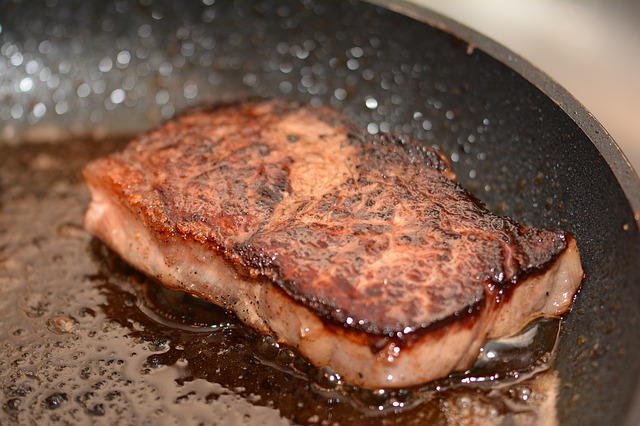
If you go back in cooking history, you hear this “truism” repeated over and over.  As you can tell from my use of quotation marks, the truism isn’t remotely true.  No, this is not going to be another screed about not trusting all the so-called truths, especially not in a world where everything you knew yesterday might not be true today.  Instead, I’d like us to think about how a food scientist named Harold McGee figured out that the “truth” wasn’t.

I’ll quote from a book called The Food Lab (which, by the way, is quite a wonderful read if you’re a combination of geek and cook):

You’d think that with all that working against him, McGee must have used the world’s most powerful computer, or at the very least a scanning electron microscope, to prove his assertion, right? Nope. His proof was as simple as looking at a piece of meat. He noticed that when you sear a steak on one side, then flip it over and cook it on the second side, juices from the interior of the steak are squeezed out of the top—the very side that was supposedly now impermeable to moisture loss!

In other words, he looked at the facts and came to his own conclusion about things.  He didn’t rely on what others had to say on the matter; he gathered his own information and came to his own conclusions based on what he could observe with his own eyes.  The answer was staring him in the face.

That’s how we all need to be doing things in business (and, with an election looming, in the non-business world too!).  We need to be open to the answers that become obvious as we look into things ourselves.  Who knows – we might lose some intellectual baggage while gaining valuable insight.  Worth a shot?

Leave a comment

Filed under food, Helpful Hints, Thinking Aloud

The $1,500 Sandwich

I can’t think of anything more appropriate for our Foodie Friday fun this week than the tale of the $1,500 chicken sandwich. Did you hear about this? As reported in Consumerist (and a number of other places):

A DQ Crispy Chicken sandwich

 (Photo credit: Wikipedia)

Andy George of the “How to Make Everything” YouTube channel posted a video about his efforts to make all of the ingredients he’d need for his entirely homemade sandwich, including: growing his own vegetables and pickling his own pickles, making salt from ocean water, milking a cow to make cheese and butter, harvesting wheat and then grinding it to make his own flour, collecting honey and yes, killing a chicken himself. So how was the ultimate homemade sandwich? Eh.

You can watch the entire video here.  I look at this story as the absolute reason we’re in business: to provide value.  After all, chicken sandwiches aren’t typically sold for $1,500, nor do they require you to think ahead six months when you decide to have one.  Instead, there are businesses performing each step – making salt, baking bread, etc. – and adding the values of quality and time so we don’t have to.

That’s really the question each of us needs to answer: how am I providing value to my customer?  How is what I am giving them in return for the money they’re giving me more valuable to them than doing it themselves?  Of course, one wouldn’t expect consumers to, say, build their own cars.  That’s way more complicated than a chicken sandwich, after all.  Then question then becomes how am I providing a better value to my customer than anyone else trying to solve the same problem for them.

We sometimes hear people (generally, unhappy people) muttering “if you want something done right you need to do it yourself” to themselves.  Our job is to convince them that expression is wrong.  When $1,500 chicken sandwiches become an attractive option, we’re all in trouble!

Leave a comment

Filed under Consulting, food, Reality checks

Disparaging Non-disparagement

More silliness from the restaurant world this Foodie Friday.  Today we have the tale of Grill 225 in Charleston, which is a well-reviewed steak and seafood place.  They do many things right.  According to most of what I can find,  the food is delicious and the service is attentive.  They are the #8 restaurant in Charleston, according to Trip Advisor, which is no small feat in a very competitive restaurant town.

In addition to being good at what they do in the restaurant, the management appears to be very good at social and other media.  Many of the Trip Advisor comments have a reply from the restaurant in the thread.  Not only does the writer thank the customer but they manage to turn each of their posts into a subtle commercial for some aspect of the restaurant (our USDA Prime steaks, so glad you enjoyed your famous Nitrotini).  Smart!  Which is why I was surprised to read about them doing something seriously dumb that has blown up and is instructive to the rest of us.

Like many popular places, Grill 225 asks for a credit card when you make a reservation.  If you are making a reservation for a party of 5 or more, they send you a “dining contract” which notifies you that should you cancel all or some of the requested seats within 24 hours of the party’s arrival, they will hit you with a $50 per seat fee.  If someone gets sick and doesn’t show, the same fee applies (so if your party of 8 becomes a party of 7 because your pal got hung up at the office, you’re out $50).  Many restaurants have a similar policy, although most will tell you they never actually charge the fee.

Where Grill 225 failed is what else they added to the agreement.  As the local paper reported it:

The terms set out by Grill 225 aren’t unusual. To curb the costs associated with empty tables, an increasing number of restaurants are threatening to charge miscreants. But Grill 225’s contract includes an additional clause: “By agreeing to these terms and conditions, the guest(s) and their party agree that they may be held legally liable for generating any potential negative, verbal or written defamation against Grill 225.” In other words, if someone in your group kvetches online about the restaurant enforcing its stated rules, a lawsuit may follow.


Leave a comment

Filed under food, Helpful Hints, Huh?