Tag Archives: Food industry

Is All You Can Eat Bad Business?

Foodie Friday, and this week I had a number of food related items from which to choose.

SpiceMarket Buffet American food

(Photo credit: Wikipedia)

One thing I noticed this week kept popping into my brain, however, and so that will be our topic today.  This was the item:

Starting January 2, 2014, you’ll want to head to your local IHOP® restaurant because “All You Can Eat Pancakes,” a perennial favorite among guests, is back for a limited time.

I preface what I’m about to say with an acknowledgment that there are few things more obnoxious than a reformed anything ramble on about their former addiction.  Like many folks, mine was sugar and carbs.  With that disclaimer, I think we all know there is an epidemic of obesity in this country.  Each of those (quite tasty) IHOP pancakes is roughly 150 calories and 22 net grams of carbs.  That’s as many calories as a large York Peppermint Patty and as many carbs as two Reese’s Peanut Butter Cups – the big ones.  As a once in a while indulgence, they’re a treat.  As an “all you can eat” incentive, they’re deadly.

Besides the ranting, I do have a business point to make.  IHOP isn’t alone in the food business in using the promise of low prices or vast quantities of food for the money to attract business.  I suppose this seems like a customer-centric way to market.  Dollar menus and all you can eat buffets are staples of our food culture.  However, while these promotions seem customer friendly, I would ask how friendly it is to kill off the customers sooner.  So much for average lifetime value!  How friendly is it to promote something that can lead to serious health issues?  It’s interesting to me that we forbid cigarette advertising and put warning labels on the packs but unlimited calories, carbs, and fat are all seen as virtuous offerings.

The food business isn’t the only one at fault in terms of promoting one thing and delivering another.  Anything that’s presented as all you can eat often has strings attached.  Take “unlimited” data plans.  Some wireless carriers won’t sell them any more.  I have one grandfathered in, although I know once I get to some point each month the speed gets cut back.  Some ISP’s throttle back speeds or charge more once certain limits are hit despite that usually being buried in the fine print.  Consumer centric?  I’ve seen ads for “unlimited” green’s fees for one price at golf courses only to find that a cart fee is due every round. False advertising?

I don’t think businesses need to “nanny” their customers.  If someone chooses to eat a lot of unhealthy food, so be it.  There is nutrition information on the walls of most quick service and family restaurants and I’ve never seen a line waiting to read it.  I’m not sure, however, that we ought to be in the business of encouraging it nor making it the center of our marketing.  I also think the marketing needs to be clear about what “unlimited” means.  What do you think?

Enhanced by Zemanta

Leave a comment

Filed under food, Huh?

Stews Leonard’s And The Thumbtack In The Chowder

Today’s tale ended up providing a good business lesson but began as a potentially lethal bit of negligence.

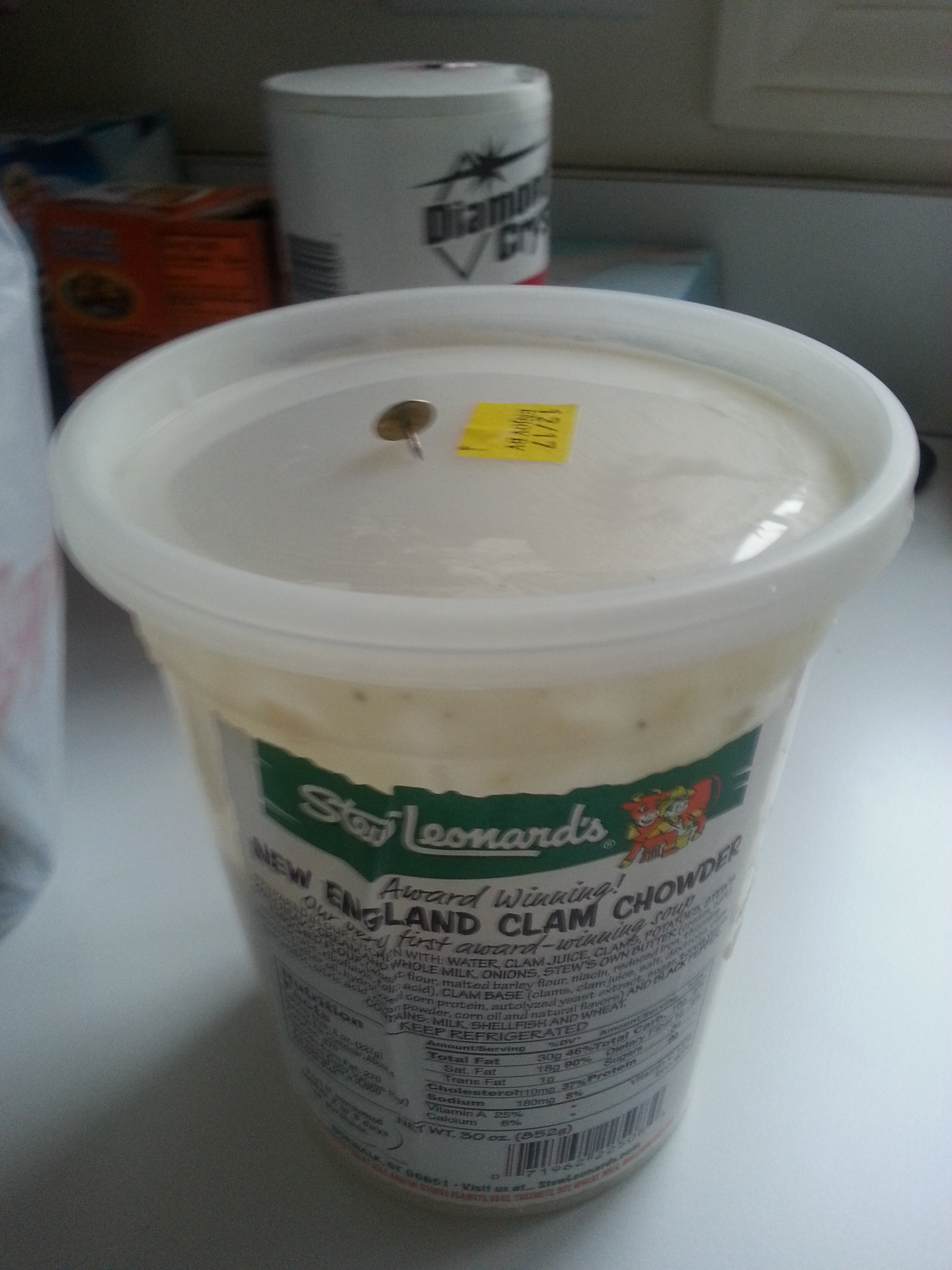
Oyster crackers are better with this than thumbtacks!

Oyster crackers are better with this than thumbtacks!

I went to see my folks the other day and my Mom had something interesting to show me. On her counter was a container of clam chowder from the Stew Leonard’s store down the street from their house.  She had purchased the soup the day before.  On top of the container was a thumbtack as you can see in the photo.  I don’t know about you, but my Dad prefers crackers with his chowder and doesn’t ever consider thumbtacks as a condiment.  However, that is exactly what he found as he ate.

How the tack got in the chowder is a serious problem but not our focus today.  Obviously the commercial kitchen should not have small, sharp, unsterile objects anywhere near food but let’s put that aside and focus on what happened when I returned to the store.   Stew’s is known for great customer service.  At the front of the store here in Norwalk is a big stone that says:

We’ve been going to the Norwalk store for 30+ years and have always found that they practice what they preach.  However, we’ve never had an issue like this.  In any event, I took the tack and the chowder to customer service at the Danbury store and explained the problem.  The young woman didn’t ask for a receipt nor question me in any way.  She just apologized, asked me if I had other shopping to do and to please come back to see her when I had finished.  Upon my return she waved me to the front of the short line, asked for the new clam chowder I had picked up, tagged it as paid and refunded the price in cash.  I gave the soup to my folks along with their refund and they were happy.

We get opportunities in business to take bad experiences and make them worse or to make them better.  This was the latter which I think is a model about handling a customer problem.  Address it immediately, admit blame, tell the customer how you’re going to solve the problem, make restitution, and see if that resolves it.  I suppose if I had carried on about wanting gift cards or something more I might have got it but I wasn’t there to take advantage( I realize some customers are!).  They could have asked me for my parents’ email to send them an apology (about the only improvement I would have made).  They were being adult about it – I thought I’d reciprocate.

Many places would have denied there was a problem (that’s impossible, sir, maybe you dropped it in while you were heating it up).  Many would have demanded a receipt (maybe you were storing someone else’s chowder in one of our containers).  Some would have made me solve the problem (so what do you want me to do about it) instead of offering a solution themselves.  They did none of those things and so what could have been a series of horrible posts on social media are, instead, a blog post that praises them.

How would you have handled it had your customer found the tack?  Any differently?  Could this have been handled any better?

Enhanced by Zemanta

Comments Off on Stews Leonard’s And The Thumbtack In The Chowder

Filed under food, Helpful Hints

Skills

Something a little different here on Foodie Friday.

Film poster for Napoleon Dynamite - Copyright ...

(Photo credit: Wikipedia)

We’re going to start with a movie which leads us to food which of course leads us to business. Kind of a prix fixe, three-course menu!  The movie even has the name of a pastry in its title: Napoleon Dynamite. I love this film, and in particular I love the sequence in which Napoleon is bemoaning his lack of talent:

Napoleon Dynamite: I don’t even have any good skills.
Pedro: What do you mean?
Napoleon Dynamite: You know, like nunchuku skills, bow hunting skills, computer hacking skills… Girls only want boyfriends who have great skills.

Funny thing is, kitchens only want them as well, Napoleon, and it’s becoming rarer for those skills to make appearances as the nature of our food chain changes.  Outside of the top restaurants in any given city (and maybe not even there), many basic kitchen skills have…well…disappeared.  No, I’m not talking about the ability to chiffonade or brunoise with eye-blinding speed.  Those skills won’t ever be lost.  It’s more the ability to do things such as recognizing various species of fish, knowing how to tell they are fresh, knowing how to skin and fillet them.  Today, cooks order what they want from suppliers and they often come broken down and portioned.

The same can be said about meat.  Cooks know cryovac, not  the different cuts of meat, much less how they are butchered and how they need to be cooked.  Even home cooks can get any ingredient and there are no “seasons” per se, but professionals should understand native ingredients, their seasons and  how they are grown.  All of the above are skills – basic skills in my book – if you want to run a professional kitchen.  Dealing with fresh, unprocessed ingredients recognizing quality, understanding what works with respect to taste and flavor are the underpinnings of the kitchen. Dealing fairly and responsibly with suppliers and  running a business are the underpinning of the enterprise.

It’s not much different in the broader business world.  Any manager will tell you that recruitment and retention of skilled staff is a major challenge. The pressure to retain promising people sometimes means that they’re being promoted too quickly, which means they don’t have the experience to deal with certain critical situations.  Younger staff learn to rely on spell checks and miss contextual spelling errors.  They don’t learn the differences between online writing and formal business writing.  They have difficulty listening in a world that encourages selfies.

Skills will never go out of style, even in a world where the ingredients come pre-portioned.  Those who succeed will be the ones that know how to break down a primal cut – learning grammar and speaking skills in the office sense.  That’s my take.  Yours?

Enhanced by Zemanta

Leave a comment

Filed under food, Thinking Aloud