Tag Archives: advice

Food For The Ages

Celebrating my dad’s 90th birthday got me thinking about age and why some people live so long. As a happy coincidence, I read some things the other day that represent this week’s Foodie Friday Fun. They had to do with some of the oldest living humans and to what they attribute their long lives. As it turns out, foods of various sorts are involved, as is an excellent business/life lesson.

The NY Post reported on a Brooklyn woman who is 116 and eats bacon, eggs, and grits every day. In fact, she has been known to eat bacon throughout the day and claims that the secret to living a long and happy life involves surrounding yourself with positive energy and bacon helps to do that. Not to be outdone in attributing long life to consumption of pork products, there is a woman in China that is 117. She has eaten twice-cooked pork three times a day and says pork is the secret to her longevity.

Then there is the woman in New Jersey who is 110 and attributes her long life, in part, to the three beers she drinks each day along with a shot of whiskey. Since researchers say centenarians typically show such characteristics as a steady routine and avoidance of stress, a few beers and a shot to keep one happy can’t hurt alleviate the stress.

Pork not your thing?  Well, there is a woman who is 116 years young in Japan who says the secret food is sushi, particularly mackerel on vinegar-steamed rice, and she has it at least once every month.  “Eat and sleep and you will live a long time,” she said in a message to The Telegraph. “You have to learn to relax.”

While these women can’t agree on which food is the secret, they do agree on being happy and relaxing.  I suspect that those things are not high on many folks’ lists as they deal with the daily stresses of business.  Wouldn’t the odds of generating long-term profits increase if we were around to help make that happen?  So get some rest this weekend, eat some bacon, have a beer, and relax.  It will all be there on Monday!
Leave a comment

Filed under Helpful Hints, Thinking Aloud

Searing Off The Truth

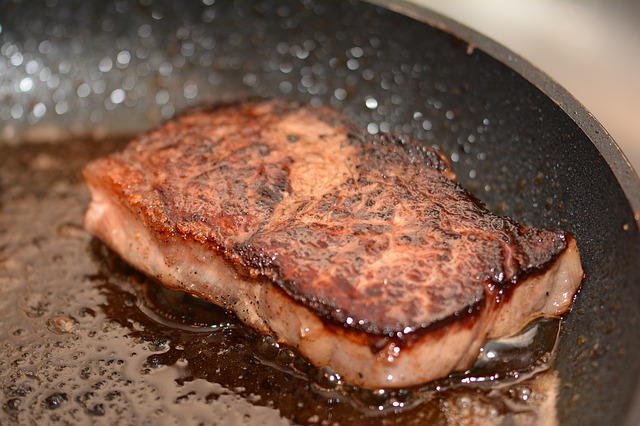
Our Foodie Friday Fun this week revolves around searing meat.  One thing I was told early on in my cooking education was to sear off meat before using it in a dish.  This would have the effect of locking in the juices so that the meat doesn’t get dry during cooking.  I guess this was cooking “knowledge” that had been put forth a hundred or so years before I heard it.  If you’ve ever heard the term “cauterization” you’ll understand the thinking.  Just as a doctor can cauterize a wound, burning the flesh to seal it shut, so too did a cook lock in juices by searing off the meat, creating a barrier that kept the meat moist.  

If you go back in cooking history, you hear this “truism” repeated over and over.  As you can tell from my use of quotation marks, the truism isn’t remotely true.  No, this is not going to be another screed about not trusting all the so-called truths, especially not in a world where everything you knew yesterday might not be true today.  Instead, I’d like us to think about how a food scientist named Harold McGee figured out that the “truth” wasn’t.

I’ll quote from a book called The Food Lab (which, by the way, is quite a wonderful read if you’re a combination of geek and cook):

You’d think that with all that working against him, McGee must have used the world’s most powerful computer, or at the very least a scanning electron microscope, to prove his assertion, right? Nope. His proof was as simple as looking at a piece of meat. He noticed that when you sear a steak on one side, then flip it over and cook it on the second side, juices from the interior of the steak are squeezed out of the top—the very side that was supposedly now impermeable to moisture loss!

In other words, he looked at the facts and came to his own conclusion about things.  He didn’t rely on what others had to say on the matter; he gathered his own information and came to his own conclusions based on what he could observe with his own eyes.  The answer was staring him in the face.

That’s how we all need to be doing things in business (and, with an election looming, in the non-business world too!).  We need to be open to the answers that become obvious as we look into things ourselves.  Who knows – we might lose some intellectual baggage while gaining valuable insight.  Worth a shot?

Leave a comment

Filed under food, Helpful Hints, Thinking Aloud

A Lesson On Sorry

You have probably heard of The Ryder Cup even if you’re not a golfer.  The women’s version of that competition is called The Solheim Cup and it was contested over the weekend.  During the run of play, an incident occurred between one of the European golfers and an American.  I’ll explain it in a second (with minimal golf jargon – you’re welcome) but it’s what has happened afterwards that’s instructive to all of us in business.

Solheim Cup

(Photo credit: Wikipedia)

The cup competitions are match play.  The total score you shoot is immaterial; you just need to have a better score than the person you’re playing on any particular hole to win that hole.  Most holes won wins the match.  Unlike the tournaments you’re used to seeing on TV, a golfer doesn’t have to putt out – finish the hole – if their opponent concedes that the next putt will be made.  Most short (2 feet and under) putts are conceded since at this level, golfers rarely miss anything that short.

What happened was that an American missed a long putt and had an 18-inch putt coming back.  The Europeans walked away from the hole and the green, so the American assumed they had conceded the putt and picked up the ball.  At that point, one of the very experienced European golfers informed her that they had not conceded the putt and the US just lost the hole at a critical point in the match.  Everyone was stunned at this bit of gamesmanship.  While she was correct with the rules of the game (you can’t assume the concession and just pick up your ball), it is way out of line with the spirit of these competitions and how the game is played.

I’m sorry for that long introduction, but it’s what has happened since that’s instructive.  In two words: she apologized.  You can read her heartfelt apology here, and it is a model for how any business or businessperson should act when they have screwed up.  It shows the difference between “I’m sorry” and the far too common “I’m sorry but…” or “I’m sorry if I offended anyone”.

This is how she begins:

I am so sorry for not thinking about the bigger picture in the heat of the battle and competition. I was trying my hardest for my team and put the single match and the point that could be earned ahead of sportsmanship and the game of golf itself! I feel like I let my team down and I am sorry.

She goes on to acknowledge each of the offended parties and to ask for forgiveness, promising to earn back each party’s faith and trust.  The next time I need to say I’m sorry for something, this will be my model.  You?

Leave a comment

Filed under Helpful Hints, What's Going On