Category Archives: Helpful Hints

Searing Off The Truth

Our Foodie Friday Fun this week revolves around searing meat.  One thing I was told early on in my cooking education was to sear off meat before using it in a dish.  This would have the effect of locking in the juices so that the meat doesn’t get dry during cooking.  I guess this was cooking “knowledge” that had been put forth a hundred or so years before I heard it.  If you’ve ever heard the term “cauterization” you’ll understand the thinking.  Just as a doctor can cauterize a wound, burning the flesh to seal it shut, so too did a cook lock in juices by searing off the meat, creating a barrier that kept the meat moist.  
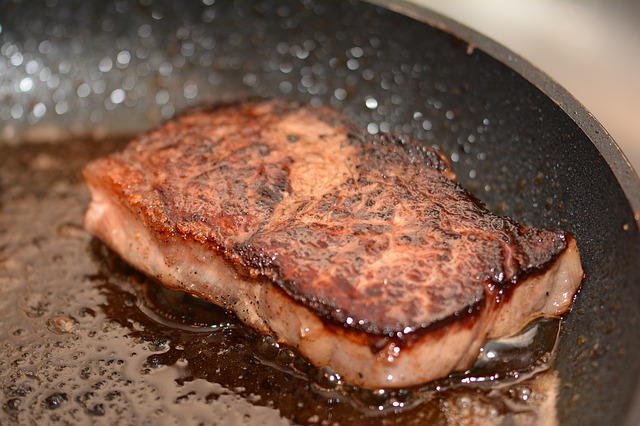
If you go back in cooking history, you hear this “truism” repeated over and over.  As you can tell from my use of quotation marks, the truism isn’t remotely true.  No, this is not going to be another screed about not trusting all the so-called truths, especially not in a world where everything you knew yesterday might not be true today.  Instead, I’d like us to think about how a food scientist named Harold McGee figured out that the “truth” wasn’t.

I’ll quote from a book called The Food Lab (which, by the way, is quite a wonderful read if you’re a combination of geek and cook):

You’d think that with all that working against him, McGee must have used the world’s most powerful computer, or at the very least a scanning electron microscope, to prove his assertion, right? Nope. His proof was as simple as looking at a piece of meat. He noticed that when you sear a steak on one side, then flip it over and cook it on the second side, juices from the interior of the steak are squeezed out of the top—the very side that was supposedly now impermeable to moisture loss!

In other words, he looked at the facts and came to his own conclusion about things.  He didn’t rely on what others had to say on the matter; he gathered his own information and came to his own conclusions based on what he could observe with his own eyes.  The answer was staring him in the face.

That’s how we all need to be doing things in business (and, with an election looming, in the non-business world too!).  We need to be open to the answers that become obvious as we look into things ourselves.  Who knows – we might lose some intellectual baggage while gaining valuable insight.  Worth a shot?

Leave a comment

Filed under food, Helpful Hints, Thinking Aloud

A Lesson On Sorry

You have probably heard of The Ryder Cup even if you’re not a golfer.  The women’s version of that competition is called The Solheim Cup and it was contested over the weekend.  During the run of play, an incident occurred between one of the European golfers and an American.  I’ll explain it in a second (with minimal golf jargon – you’re welcome) but it’s what has happened afterwards that’s instructive to all of us in business.

Solheim Cup

(Photo credit: Wikipedia)

The cup competitions are match play.  The total score you shoot is immaterial; you just need to have a better score than the person you’re playing on any particular hole to win that hole.  Most holes won wins the match.  Unlike the tournaments you’re used to seeing on TV, a golfer doesn’t have to putt out – finish the hole – if their opponent concedes that the next putt will be made.  Most short (2 feet and under) putts are conceded since at this level, golfers rarely miss anything that short.

What happened was that an American missed a long putt and had an 18-inch putt coming back.  The Europeans walked away from the hole and the green, so the American assumed they had conceded the putt and picked up the ball.  At that point, one of the very experienced European golfers informed her that they had not conceded the putt and the US just lost the hole at a critical point in the match.  Everyone was stunned at this bit of gamesmanship.  While she was correct with the rules of the game (you can’t assume the concession and just pick up your ball), it is way out of line with the spirit of these competitions and how the game is played.

I’m sorry for that long introduction, but it’s what has happened since that’s instructive.  In two words: she apologized.  You can read her heartfelt apology here, and it is a model for how any business or businessperson should act when they have screwed up.  It shows the difference between “I’m sorry” and the far too common “I’m sorry but…” or “I’m sorry if I offended anyone”.

This is how she begins:

I am so sorry for not thinking about the bigger picture in the heat of the battle and competition. I was trying my hardest for my team and put the single match and the point that could be earned ahead of sportsmanship and the game of golf itself! I feel like I let my team down and I am sorry.

She goes on to acknowledge each of the offended parties and to ask for forgiveness, promising to earn back each party’s faith and trust.  The next time I need to say I’m sorry for something, this will be my model.  You?

Leave a comment

Filed under Helpful Hints, What's Going On

The Bright Side

I have a confession: I am an unrepentant optimist. I’m told that I can find a silver lining in almost any circumstance, and while I’m not a complete idiot with respect to denying reality, I also don’t fall into the trap of seeing only the negative. Anyone who knows me will tell you I have a skeptical side (bordering on cynical), but I think they’d also recognize my generally optimistic nature. What does this have to do with your business?

It has to do with how new concepts are perceived by optimists.  You probably hear about new ideas all the time. Sometimes those ideas make waves, and sometimes they bring storm warnings with respect to the future. It is easy to dismiss them. It’s also easy to find fault with them. You might ask yourself if whatever is being proposed is going to work. That is the wrong question in my mind since inherent in that question is the skeptic’s point of view. You assume there is a chance, maybe even a good chance, that it won’t work.  You dismiss the idea and the possibility of any of the circumstances that might eventuate thereafter.

Optimistic little me doesn’t ask that question. I tend to think about what might happen if the new idea does work, however unlikely that might be. What next? How is my business different? What new competitors or markets emerge?  Even if they don’t, by not having dismissed the new thinking out of hand, I’m better prepared to deal with whatever happens.

I tend to look on the bright side of life, as the song (below) suggests.  Putting aside the positive mental outlook I think optimism provides, from a business perspective using the optimistic perspective would have allowed you to be ready for many of the changes of the last 30 years.  So sing along with the Pythons and tell me if you don’t feel better!

Leave a comment

Filed under Helpful Hints, Thinking Aloud