Tag Archives: planning

Pivoting From Cocktails To Cleaning

Happy Foodie Friday! This week our food-themed screed takes us to the land of alcohol, a place that I have a feeling many of you have visited several times over the last few weeks as a scenic detour in your home confinement. Like many of you, part of my very limited activities over the last little bit has been the often quixotic search for hand sanitizer and toilet paper. The good news is that toilet paper seems to be much easier to find of late while sanitizer remains elusive.

There are many small distilleries near where I live which make everything from vodka to rum to moonshine (hey, it is the South!). Many of them have converted their processes over to produce hand sanitizer which is after all, alcohol-based. One place nearby is selling their sanitizer by the gallon at prices which are reasonable, thereby doing both their shareholders and our community a service. Why the shareholders? Because many of their customers, along with those of their competitors, happen to be restaurants and bars, which are closed except for carry-out. Booze sales are confined to beer and wine in the carry-out world for the most part. That’s our thinking point today.

These businesses have managed to pivot from making one in-demand product to another. This pandemic has caused many other businesses to rethink how they do things as well and to make some changes. For example, I represent a number of companies that run after-school programs. With no school (and no gatherings allowed), most of them have pivoted to providing those programs online. When things calm down, they’ll return to their old model but most indicate they’ll keep the new, online model as well since it seems to be working quite well.

Another example. Companies are cutting down on non-essential costs.  They are reallocating their budget from physical in-person processes such as travel, conventions, etc. into digital or virtual tactics. If your primary sales channel is trade shows, are you ready to pivot to some other model since consumers might be wary of large gatherings such as home shows and business buyers may not be allowed to travel to whatever conventions remain?

Has online commerce been an afterthought for your business? My guess is that many brick and mortar firms are rethinking how they approach digital. Yes, all retail sales have dropped. Consumers are restricting their purchasing to essentials, understandably. But it won’t be this way forever. As CNBC quoted one analyst,

“Major retailers who sell goods outside of apparel and furniture – two of the hardest-hit categories – will likely weather the downturn, along with many direct-to-consumer brands that were doing well before the pandemic. Instead of bulldozing the entire retail market, the pandemic is more likely to accelerate the decline of the “boring middle of retail,” such as Sears, J.C. Penney, Macy’s and Kohl’s.”

Those are companies that didn’t invest in the online space before and who can’t keep up with the big guys or the specialty online brands. They can’t pivot.

Being able to pivot is going to be critical as the new world emerges. Can you turn your booze into sanitizer without missing a beat or will you have to rip the whole business down and start over?

Leave a comment

Filed under food, Helpful Hints, What's Going On

We’re Trucked

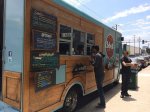
Believe it or not, it’s Foodie Friday again (I know, you can’t keep track of what day it is). Obviously, we’re not dining out here and I’m pretty sure you’re not either. We are, however, bringing in for from some of our regular haunts in an effort to support them during this difficult time. In a couple of cases, the restaurants are moving closer to us by rolling out their food trucks into various places nearby.

Food trucks are one of the businesses I represent along with dozens of other food franchises. I can tell you that the cost to open and operate one of these beasts is significantly less than for almost any other type of food place. I haven’t pulled any of the Franchise Disclosure Documents to check out the operating and earnings claims for trucks vs. brick and mortar but I’m thinking that the trucks probably have better margins.

Margins in the restaurant industry are notoriously small. While you might expect your margin in any other type of business to be north of 25%, in the restaurant world they run 3–9%. Not much room for error and definitely no room for the type of catastrophic business environment in which they’re trying to operate. Having a truck to roll out, either in lieu of or in addition to operating the brick and mortar joint for takeout might just be a lifesaver.

I could spend the rest of today’s screed talking about why the margins are so bad and what can be done about it. The two-word solution is “charge more” but I’ll leave that for another post. What I want us to think about today is how we can “food truck” our businesses. How can we find some other way to operate, maybe even in a more efficient, consumer-friendly manner once we get to whatever the new “normal” will be?  How will you calm your customers’ frayed nerves? How does your business have to change to mirror the changes in society, media consumption, supply-chain and each of the other factors and constituencies that make up your enterprise?

I find I’m spending more time talking to people about businesses that can operate out of the home.  I also remind them that no matter what business they’re evaluating, the process will take time. 2 months for a non-retail business and maybe as long as 5 months if you’re outfitting a store/salon/restaurant etc. The time to be planning and beginning the process is now. Borrowed money is cheap, there will be a glut of real estate, and you want to be ready when the new normal eventuates.

So how are you food-trucking your business?

Leave a comment

Filed under Consulting, food, Franchises

Posts Of The Year – 2019 #4

I hope you all had a great Christmas holiday. It has become a tradition that I use the week between Christmas and New Year to recap the most-read posts that were written this past year. Today is the fourth most-read post. I published it last April 8 after seeing a photo of an old friend’s dad. While I have many great memories of his father, the one I wrote about is probably the most indelible. Enjoy.

My friend posted a picture of his father on social media the other day. Outside of my own father, he was probably the most influential male in my life as I was growing up in many ways. Aside from wondering why he’s aged and I haven’t as I saw the photo (that’s a joke, kids), it made me recall one thing that he did to teach my friend and me to be better baseball players: hitting curveballs.

My friend’s dad was no ordinary dad when it came to imparting that little piece of baseball knowledge either. He had tried out with the Yankees and the family lore is that had my friend’s mom not told him that she would walk on the marriage, he would have been signed and playing in Yankee Stadium. Obviously, when this guy tells you he’s going to teach you about curveballs, you listen.

For those of you that have never stood in against a pitcher with a lively curve, the pitch starts by heading at your head and breaks down and away from you. That’s what my friend’s father threw at us – pitches that started at our heads and broke in over the plate. Of course, once he felt we were getting complacent about standing in against the curve, he’d toss the odd pitch right at our heads to teach us to look for the rotation of the ball and to duck if it wasn’t going to curve. A fastball at your skull gets you focused very quickly!

Almost every player who makes the majors can hit fastballs. It’s the ones who can hit breaking pitches – sliders and curveballs – who become stars. It’s true in business as well. When things are going along according to plan and not diverging from the track they’re on, things are relatively easy to manage. Even if something appears dangerous (like a fastball heading for your ear) it’s relatively easy to get out of the way if you can see where things are heading.

Learning to hit business curveballs is something that you need to do if you’re going to elevate your game. You need to prepare for them by planning and recognizing that they’re going to show up from time to time. Your team needs to be ready, and you need to think about who can handle curveballs as you’re assembling that team.  People who are regimented and can’t deal with it when events start tracking differently are probably not your priority hires.

Mostly, you need to expect things to go wrong. After bailing out and hitting the dirt a couple of times, I realized that some attempted curveballs don’t break even when the rotation makes it look like they’re trying. It’s better to have to wash your uniform than to repair your skull. Your team needs to recognize that bailing out might be the smartest option when things begin to go awry. Watch out for those curves, learn to hit them out of the park, and your team can’t be beaten. Right?

Leave a comment

Filed under Uncategorized