Tag Archives: life

Old Food

Our Foodie Friday Fun this week is centered on aging. I realize that the topic of “old food” might not seem very appealing, but the reality is that you want some things to be old. OK, I guess “aged” seems a nicer way to put that.

Very few red wines, for example, are meant to be consumed “young.” Spare me the lecture on how winemakers these days can regulate the tannins to make reds drinkable not long after vintage. Really good reds need some time to mellow and develop flavor.

English: A glass of red wine.

(Photo credit: Wikipedia)

You’d rather eat “old” (read aged) beef. Most great steakhouse dry-age beef. They expose big cuts to air so dehydration can further concentrate the meat’s flavor. It’s expensive: the meat loses weight from dehydration, and it also must be trimmed of its completely dried exterior before cooking. The process develops flavor and allows enzymes naturally present in the meat to break down the muscle tissue.

We eat “new” cheese – there is nothing better than fresh mozzarella di buffala. That said, one cheese place I go asks you what you’re doing with the mozzarella (eating it as is or cooking with it) so he can give you the cheese of the correct age. Older, drier mozzarella is better for cooking, after all.  You wouldn’t want to eat most other great cheeses right after they’re made.

So why all the thinking about old food? Because there is something to be learned from it that can be applied to business. We live in a time when things happen really quickly.  There are tons of new ideas that become new businesses.  There is a lot to be said for letting those ideas age a bit before acting on them.  I realize that sometimes there is a limited window of opportunity, but think about how often we put out version 1.0 of something (and I mean that in a broader sense than software) only to realize we could have made it better or found more bugs.  Had we let the product age, it probably would have been better.

We do that with people too.  We cherish the new (read young). Speaking as a veteran (aged!) executive, we tend to have broader perspectives that have been formed through both success and failure.  While it’s often said that one business or another is a young person’s business, most of those young people have older advisors, especially in their early and mid stages.

I know that foods have expiration dates and that they become unpalatable if not inedible.  A little aging – a little time – does, however, seem to help most foods and ideas.  Let that thought age a bit…
Leave a comment

Filed under food, Thinking Aloud

Searing Off The Truth

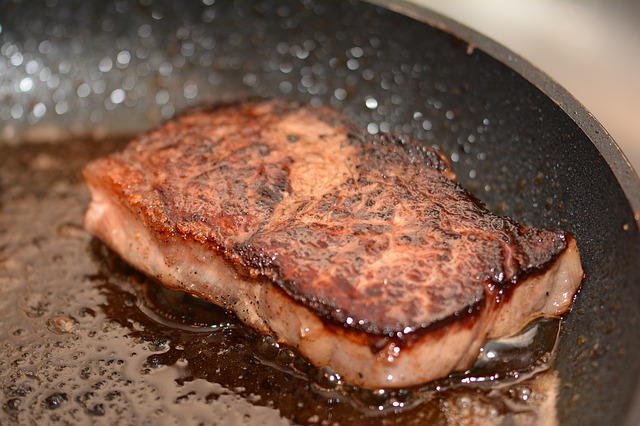
Our Foodie Friday Fun this week revolves around searing meat.  One thing I was told early on in my cooking education was to sear off meat before using it in a dish.  This would have the effect of locking in the juices so that the meat doesn’t get dry during cooking.  I guess this was cooking “knowledge” that had been put forth a hundred or so years before I heard it.  If you’ve ever heard the term “cauterization” you’ll understand the thinking.  Just as a doctor can cauterize a wound, burning the flesh to seal it shut, so too did a cook lock in juices by searing off the meat, creating a barrier that kept the meat moist.  

If you go back in cooking history, you hear this “truism” repeated over and over.  As you can tell from my use of quotation marks, the truism isn’t remotely true.  No, this is not going to be another screed about not trusting all the so-called truths, especially not in a world where everything you knew yesterday might not be true today.  Instead, I’d like us to think about how a food scientist named Harold McGee figured out that the “truth” wasn’t.

I’ll quote from a book called The Food Lab (which, by the way, is quite a wonderful read if you’re a combination of geek and cook):

You’d think that with all that working against him, McGee must have used the world’s most powerful computer, or at the very least a scanning electron microscope, to prove his assertion, right? Nope. His proof was as simple as looking at a piece of meat. He noticed that when you sear a steak on one side, then flip it over and cook it on the second side, juices from the interior of the steak are squeezed out of the top—the very side that was supposedly now impermeable to moisture loss!

In other words, he looked at the facts and came to his own conclusion about things.  He didn’t rely on what others had to say on the matter; he gathered his own information and came to his own conclusions based on what he could observe with his own eyes.  The answer was staring him in the face.

That’s how we all need to be doing things in business (and, with an election looming, in the non-business world too!).  We need to be open to the answers that become obvious as we look into things ourselves.  Who knows – we might lose some intellectual baggage while gaining valuable insight.  Worth a shot?

Leave a comment

Filed under food, Helpful Hints, Thinking Aloud

Teshuva

It’s Yom Kippur, the holiest day of the Jewish year.  This was a post from several years ago.  As I read it over, looking for inspiration for something to write on the subject of change and business based on the holiday, I realized that I had expressed my thinking pretty well in the earlier post.  Those of you who celebrate the holiday are probably not reading this until sundown (I scheduled this yesterday in keeping with the spirit of not working on the day). Whether you do or don’t celebrate, I hope you’ll take a moment to reflect.

Yesterday was Yom Kippur, the holiest day of the Jewish year. For those of you unfamiliar with the holiday, it concludes the 10 day period at the start of the Jewish calendarRosh Hashanah – head of the year – during which all Jews are supposed to reflect upon the past year and examine how they’re going to change their lives going forward. One also seeks forgiveness from those against whom he has transgressed – both those of this earth and higher powers. There is a lot of other imagery connected with the period – inscription in the Book of Life being a big one – but I think there’s something each of us can take as a business lesson in a non-denominational way.

We all get off track.  Sometimes it’s in little ways like eating badly or drinking too much.  Sometimes it’s in big ways like alienating our families or hurting friends who love us.  The concept in Judaism of repentance is called Teshuva  which means “return”.  I love the notion of coming back to one’s self as well as to the basic human tenets that are common to all religions and peoples.

We can take a period of reflection and “return” in our business lives as well.  The most obvious way is for us as individuals   Whom have we alienated this year?  What client have we taken for granted?  But it a bigger opportunity.  How has the business diverged from the mission?  Why have we stopped getting better and are just marching in place?  What can we be doing to grow our people but are ignoring?

We ask those kinds of questions from time to time, but I guess I’m suggesting that it become a more formal process.  Set aside a period every year for “return” thinking.  A period of repentance?  Maybe, in some cases.  But in all cases a chance to change.  A chance to regret past bad actions and to vow not to repeat them.  Most importantly (this is true in the religious sense as well), to correct the transgression.  To apologize.   To make restitution.  Whatever is right and lets everyone move forward with a clear conscious and a vow to do better.

Sound like a plan?

Enhanced by Zemanta

Leave a comment

Filed under Thinking Aloud, What's Going On