Tag Archives: Food

A Rose By Any Other Name

It’s Foodie Friday! Today I want to discuss grilling since I’m told that July is National Grilling Month (who knew). An article in AdWeek tipped me to that fact, along with the fact that how to grill steak is the most researched topic on YouTube, followed by grilling pork, chicken, and ribs.

I’m gratified that they used the term “grilling,” because, in a lot of places, the grill is known as the barbecue, as is what you’re doing when you cook on it. Barbecue, of course, is a very different food. It’s smoked, not grilled, over low heat. Grilling generally involves a high heat, either directly or indirectly applied to the food. Nevertheless, I have friends and family who ask if we’re going to “barbecue” some steaks. I made the error of saying I wanted to fire up the barbecue in front of some Southern friends and they wondered out loud if we were going to be eating in 5 or 6 hours, a reasonable amount of time for anything to be real ‘cue.

There is a business point in this. Often we say one thing without realizing that the people to whom we’re saying it are interpreting it as something entirely different. “Dressing” to my Yankee friends is something you put on a salad; in the South, it’s a bread-based side dish (like what we’d call stuffing). “Greens” up North are the base of a salad; down South, they’re usually cooked collards.

Part of being a good businessperson (and a great manager) is making sure not only that what you’ve said has been heard but also that the meaning you intended to convey is the meaning assigned to your statement. Lawyers tend to be very good at this, sometimes painfully so. There’s a reason why they’re as precise as they are, though, as our examples show.

I’ll grill something this weekend. I might barbecue as well (although it tends not to be a verb down South). I know the difference and will be sure that anyone to whom I mention what I’m cooking does as well. See the difference?
Leave a comment

Filed under food, Helpful Hints

No Water, No Friction

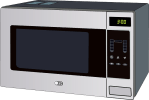
Foodie Friday, and today we’re going to have a think about what microwave ovens can tell us about our business. I don’t know about you, but I use my microwave all the time. I tend to have a fair amount of leftovers around and it seems that my morning coffee gets cold before I can finish it. Both get a quick warm-up in the microwave. But let’s think for a moment about how a microwave actually works.

A microwave is less of an oven than it is a radio transmitter. The thing heats food by causing water molecules in whatever is being heated to vibrate as it sends out electromagnetic radiation. As they vibrate, the molecules rub against one another and it’s the friction that causes heat. If the thing being hit with the radiation contains no water (glass, ceramic, etc.), there is nothing to vibrate and, therefore, no heat created. That’s why the part of the bowl or plate you’re heating up that’s above/outside the thing being heated stays cool (at least until the heat from the food spreads outward). No friction means no heat.

I like to think of a business that way. A big part of what we want to do as businesspeople is to eliminate friction. We often talk about “frictionless” transactions. Business, after all, is built upon transactions between two parties, usually a buyer and a seller. It takes something – marketing of some sort, generally – to get some momentum going towards the conclusion of the transaction, but once that’s happened our job is to remove any impediments that create friction as the deal moves towards a conclusion. It can be a long line a the checkout, it can be unknowledgeable salespeople, it can be a lack of inventory. In short, we want to keep everyone “dry”, since no water means no friction, right?

Ask yourself what “dampens” your process. Where are the friction points? When the deal microwave is switched on, what begins to vibrate and create the heat that too often accompanies a deal?

Microwave ovens aren’t ideal for all forms of cooking but they excel when they’re used properly. Understanding how they work helps us use them appropriately, and we can take advantage of their speed and efficiency. Applying the “no water, no friction” thinking that makes a microwave work to our businesses can help us do the same thing there.

Leave a comment

Filed under food, Thinking Aloud

Burgers And Dogs

It’s Foodie Friday, and we’re heading into what I hope is a long Fourth Of July weekend for you. At some point, hopefully, your plans include firing up a grill of some sort and cooking some hot dogs and hamburgers. Simple? You bet, but this is a weekend for leisure time and not getting all sweaty in front of a grill. Besides, you never know when your crew will get hungry, and burgers and dogs can be ready in no time. And what meal could be more All-Amercian (even if both foods come to us from German origins)?

It wouldn’t be the screed if we didn’t use the simplicity of burgers and dogs as a jumping off point for some business-related thought, right? As I was musing about that, it came to me that there are, in fact, a lot of possibilities with either of those basic dishes, even if you’re not stuffing your own hot dog casings or grinding your own meat for the burgers (I do the latter; the former is well beyond my patience). Think about the almost endless variations on the hot dog. I used to patronize two very fine establishments who were renowned for their extensive takes on various dogs. You can change up the meat (all beef, beef and pork, etc.), you can change the dressings and roll (compare the classic Chicago dog with a classic Detroit Coney Island, a chili dog and onions), but the thing is still a boring old hot dog (not).

It’s the same with burgers. I have a few different burger books in my cookbook collection, and while the dressings, meats, and buns vary a lot, it’s still some form of ground meat shaped into a patty and grilled. Heck, you can even taste the difference (if you’re brave) between a simple burger from McDonald’s vs. one from Burger King (cooking on a grill vs. a griddle). It doesn’t take much to change the dish.

The business point is this. Even if you’re in a very crowded space, your business can distinguish itself. You do this by becoming a brand – something that is instantly recognizable for the promise to the customer it contains. You can do this through great service, great value, smart marketing, or any other number of ways.  What makes a Chicago Dog unique are the sport peppers, the poppy seed bun, and the celery salt. What makes you unique? How does your vision differ from all the other people in your business area?

Enjoy your Fourth and your cookout. Just remember that even if it’s plain old burgers and dogs, you’re the secret sauce that can make everything unique, both on the grill and in the office.

Leave a comment

Filed under food, Thinking Aloud