Tag Archives: business thinking

Buy Less, Get More

I recently bought a Chromebook that has a touchscreen. I’ve been using a MacBook Air for half a dozen years as my primary computer but it has slowed to a crawl and work was taking much longer to get done. I debated replacing the Mac but then I took a hard look at what functions the laptop served. Over the last few years, nearly everything I have been doing is done in the cloud and having a device that’s basically a glorified web browser actually seemed like a good idea. I moved my accounting to a cloud-based system and started using the Google suite of office programs (Docs, Sheets, etc.) in lieu of the programs on my Mac. I’ve been a lot more productive and I got a large Android tablet out of it to boot (the Chromebook flips around to be a tablet!).

There are a few other things that I noticed. First, this device reminds me of the Mac when I first got it. The thing just works. It updates itself, it’s safe from malware, battery life is good, and it’s easy to add extensions to customize it to my liking. I can run any Android app the will run on a phone (admittedly, that’s often a so-so experience) and that opens up a ton of additional software on a bigger screen than my phone.

This isn’t a screed to get you to buy a Chromebook. The point, rather, is to get you to think about why you buy, build, hire, or otherwise add to your organization. Another Mac would have been overkill based on what I needed the device to do. I saved money (the Chromebook cost about half of what a new MacBook would have cost) and I’m more productive. We often spend our precious resources on unnecessary things and that’s bad management.

Some examples. Most of the people who buy Microsoft Word have no clue how to use most of its features. The same with Excel. They are both wonderfully powerful programs but there are so many features that they become difficult to use and simple tasks can become daunting. There are free programs out there, and there are some great alternatives to the Office suite that have 99% of what most of us will ever need. You buy less and get more.

Another one. I worked with some managers over the years who would always put new positions into their budgets. Did they need them? Nope, but since other departments were growing, they felt as if they had to grow too. A corporate form of keeping up with the Joneses, I guess. We can’t manage our businesses to impress other people or out of jealousy. We can’t spend on a Rolls Royce when all that’s called for in order to get the job done is a Volkswagen.

Buying less can often get us more. It certainly did in my case. Give it a try?

Leave a comment

Filed under Helpful Hints, Reality checks

A Rose By Any Other Name

It’s Foodie Friday! Today I want to discuss grilling since I’m told that July is National Grilling Month (who knew). An article in AdWeek tipped me to that fact, along with the fact that how to grill steak is the most researched topic on YouTube, followed by grilling pork, chicken, and ribs.
I’m gratified that they used the term “grilling,” because, in a lot of places, the grill is known as the barbecue, as is what you’re doing when you cook on it. Barbecue, of course, is a very different food. It’s smoked, not grilled, over low heat. Grilling generally involves a high heat, either directly or indirectly applied to the food. Nevertheless, I have friends and family who ask if we’re going to “barbecue” some steaks. I made the error of saying I wanted to fire up the barbecue in front of some Southern friends and they wondered out loud if we were going to be eating in 5 or 6 hours, a reasonable amount of time for anything to be real ‘cue.

There is a business point in this. Often we say one thing without realizing that the people to whom we’re saying it are interpreting it as something entirely different. “Dressing” to my Yankee friends is something you put on a salad; in the South, it’s a bread-based side dish (like what we’d call stuffing). “Greens” up North are the base of a salad; down South, they’re usually cooked collards.

Part of being a good businessperson (and a great manager) is making sure not only that what you’ve said has been heard but also that the meaning you intended to convey is the meaning assigned to your statement. Lawyers tend to be very good at this, sometimes painfully so. There’s a reason why they’re as precise as they are, though, as our examples show.

I’ll grill something this weekend. I might barbecue as well (although it tends not to be a verb down South). I know the difference and will be sure that anyone to whom I mention what I’m cooking does as well. See the difference?

Leave a comment

Filed under food, Helpful Hints

No Water, No Friction

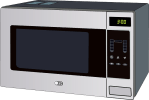
Foodie Friday, and today we’re going to have a think about what microwave ovens can tell us about our business. I don’t know about you, but I use my microwave all the time. I tend to have a fair amount of leftovers around and it seems that my morning coffee gets cold before I can finish it. Both get a quick warm-up in the microwave. But let’s think for a moment about how a microwave actually works.

A microwave is less of an oven than it is a radio transmitter. The thing heats food by causing water molecules in whatever is being heated to vibrate as it sends out electromagnetic radiation. As they vibrate, the molecules rub against one another and it’s the friction that causes heat. If the thing being hit with the radiation contains no water (glass, ceramic, etc.), there is nothing to vibrate and, therefore, no heat created. That’s why the part of the bowl or plate you’re heating up that’s above/outside the thing being heated stays cool (at least until the heat from the food spreads outward). No friction means no heat.

I like to think of a business that way. A big part of what we want to do as businesspeople is to eliminate friction. We often talk about “frictionless” transactions. Business, after all, is built upon transactions between two parties, usually a buyer and a seller. It takes something – marketing of some sort, generally – to get some momentum going towards the conclusion of the transaction, but once that’s happened our job is to remove any impediments that create friction as the deal moves towards a conclusion. It can be a long line a the checkout, it can be unknowledgeable salespeople, it can be a lack of inventory. In short, we want to keep everyone “dry”, since no water means no friction, right?

Ask yourself what “dampens” your process. Where are the friction points? When the deal microwave is switched on, what begins to vibrate and create the heat that too often accompanies a deal?

Microwave ovens aren’t ideal for all forms of cooking but they excel when they’re used properly. Understanding how they work helps us use them appropriately, and we can take advantage of their speed and efficiency. Applying the “no water, no friction” thinking that makes a microwave work to our businesses can help us do the same thing there.

Leave a comment

Filed under food, Thinking Aloud