Tag Archives: Business and Economy

Braces

A female mouth with braces.

(Photo credit: Wikipedia)

I went to the dentist last week for a cleaning. Despite having worn braces when I was a kid some of my lower teeth have shifted as I’ve aged and the dentist said I should think about having them straightened out (again). Having endured braces long ago, I told him that unless there was some reason beyond the need to be extra diligent as I brush and floss I would pass. It did, however, get me thinking about braces and I think there is a business lesson here.

Braces work by putting steady pressure on misaligned teeth. Over time, the pressure moves the teeth into the correct position. Orthodontists use rubber bands or springs to exert specific pressure to push the teeth in the proper direction. The trick is that there is constant pressure, and any of you who remember sleeping with the extra pressure of that contraption they had you wear at night will agree that while the pressure isn’t overwhelming it’s quite noticeable.

As managers, we need to act like braces. Organizations often have parts that are misaligned and which need to be moved back into place. As with teeth, one can’t just remove and replace the misaligned elements, at least not until all other options have been exhausted. It’s too traumatic. Figuring out how things ought to line up and applying steady pressure is what we ought to be doing.

The same goes for dealing with people. Really excellent people often have a flaw that can be fixed with time and patience. It’s identifying the problem, applying the corrective devices, increasing the pressure in a helpful but not painful way, and waiting that is the key.  The steel railroad ties of my youthful brace experience are long gone, replaced by barely noticeable orthodonture.  That’s how managers need to think as well – using a light, barely noticeable hand can be just as effective with the right pressure and design.

How are you fixing things today?

Leave a comment

Filed under Consulting

It’s Not Just The Burger

This Foodie Friday, the topic is Fast Food. Specifically, we’re going to see what we can learn from the rankings of fast food chains in the latest Temkin Ratings Report. What the heck are the Temkin Ratings?

English: McDonalds' sign in Harlem.

(Photo credit: Wikipedia)

The Temkin Experience Ratings are based on consumer feedback of their recent interactions with companies. We asked consumers to rate three components of the experience, Success, Effort, and Emotion, on a 7-point scale. For each component, we take the percentage of consumers that gave a rating of 6 or 7 and subtract the percentage that gave a rating of 1, 2, or 3. This results in a “net goodness” rating for each of the three components. The overall Temkin Experience Rating is an average of the three “net goodness” percentages.

In other words, they’re measuring if customers could do what they wanted to do, how easy it was to complete the interaction and their overall feelings about the interaction. In this case, it might be if the chain had the food item you wanted or prepared it the way you asked, was there a long wait or other impediment to you getting you food, and how pleasant the experience was.

Here is the business paradox and perhaps a learning. McDonald’s and Burger King didn’t do very well. In fact, as one site reported:

McDonald’s ranked dead-last among fast-food restaurants in the report, but there must be a masochistic streak among American consumers. Though the restaurant remains one of “the most commonly disliked fast-food establishments” in the U.S., last month Nation’s Restaurant News reported that McDonald’s is also the most-visited chain in the country.

So here is the question.  McDonald’s has placed a lot of emphasis on improving the menu – healthier items, more organic ingredients – and they now offer their popular breakfast items all day.  Sales are much better, and revenue and profits are two critical boxes on the scorecard in business.  I get that.  However, maybe they should have been spending more time improving the customer experience.  I can’t imagine that there is any sense of loyalty here.  The ratings seem to indicate that consumers go to McDonald’s either because it’s cheap or convenient and not out of any sense of enjoyment.  I don’t see that as a formula for long-term customer retention.

The thing for us to remember is that customers aren’t looking at your balance sheet.  They look at the product or service as well as the totality of their interaction with you.  If you’re not measuring and taking those things into account as you compile the financials, you’re probably missing a critical part as you analyze the health or your business.  Make sense?

Leave a comment

Filed under food, Huh?

Ignoring 9 Out Of 10

I realize I’ve spent the first couple of posts this week on the topic of companies being less than responsive to customers. I was chatting about this with someone yesterday and they asked me if I really thought the two cases I cited were the norm.  After all, he said, how can companies really expect this kind of behavior to remain quiet when every person is a publisher?

Sprout Social

Sprout Social

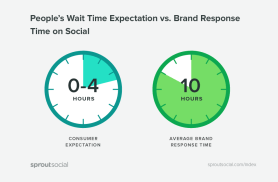
Precisely my point, but since when does common sense prevail?  In fact, companies are getting worse at being responsive.  Maybe it’s just the increase in volume, maybe it’s the ease with which customers can reach out, but the common sense solution of staffing up and training to handle the increased load is nowhere to be found.  Since we believe in fact-based statements here, these facts are from Sprout Social:

90% of people surveyed have used social in some way to communicate directly with a brand. What’s more, social surpasses phone and email as the first place most people turn when they have a problem or issue with a product or service, according to Sprout’s consumer survey. Following this trend, The Sprout Index shows that the number of social messages needing a response from a brand has increased by 18%over the past year. In spite of the high volume of messages that require a response, brands reply to just 11% of people (a number that’s been stuck in neutral since 2015).

11%, meaning brands are ignoring 89% of the messages sent to them as consumers reach out. I guess they’re too busy misusing social media and other responsive channels as megaphones (so 1995) since the research found that brands send promotional messages out 23 times as often as they respond to a customer message. It’s not just social that requires our attention.  August 2015 research from Nice Systems and Boston Consulting Group (BCG) found that internet users in major metro areas worldwide used an average of 5.6 customer service channels.

I can hear you rubbing your temples as the headache comes on.  How will you support your customers in those places when you might be ignoring 9 out of 10 customer interactions now?  Beats me, but the question needs to be answered, and the organizations that do so will be the ones that win.  Make sense?


Leave a comment

Filed under Consulting, Huh?