Tag Archives: advertising

Influencers

Have you ever heard of influencer marketing?  You might not have used the term but I’m pretty sure that it’s a familiar concept.  Simply put, influencer marketing is getting people who hold sway over other people’s decision-making to endorse your product or service.  On a really basic level it might be the audiophile friend you consult before purchasing your new speakers.  Maybe there is another person you know who is very into tech and can help you choose a new phone.

Influencer roles throughout the decision process

(Photo credit: Wikipedia)

If you take that from the realm of your personal friends to more prominent people – journalists, celebrities, experts – you’re moving to more broad influencer marketing.  To a certain extent, influencers are simply people within a subject area who already have established trust with an audience.  Finding them and messaging them in the hopes that they will say nice things about what you’re selling is influencer marketing.

There are some big plusses with this tactic, the biggest of which is that there is a demonstrable effect on sales.  According to a Burst Media study, advertisers who implemented an influencer marketing program in 2014 earned $6.85 in media value on average for every $1 they spent on paid media for such programs.  That’s an excellent return.  Obviously, it’s not easy to find market specific influencers, especially as you drill down to the consumer level but there are firms that do this.  I could write a few hundred words more on how you can work your own data to do so but that’s not my thought today.

Instead, I have a couple of caveats should you be considering – or currently doing – influencer marketing.  The first is that there is a tendency to get fixated on quantity and not quality.  Maybe you identify someone who has a large social audience – lots of friends on Facebook, hundreds of thousands of Twitter and Instagram  followers.  That person may have  a large megaphone but very little influence.  One mom who can get her 5 close friends to buy your product is better than a mommy blogger that’s widely read but mostly ignored.

More important is that there are a lot of fake important people out there.  I can point you to several people who claim to have large followings and, therefore, great influence.  Having run their accounts through the tools that identify fake followers it’s pretty obvious that they’ve bought hundreds of thousands of them.  When 97% of your 1,000,000+ followers are fake, that’s not an accident.  Don’t get fooled!

Influencer marketing isn’t new – some people trace it back to the 1940’s.  As with so many things these days, the tools have changed but the marketing smarts that drive their use haven’t.  Stay smart!
1 Comment

Filed under Consulting

You Could But You Shouldn’t

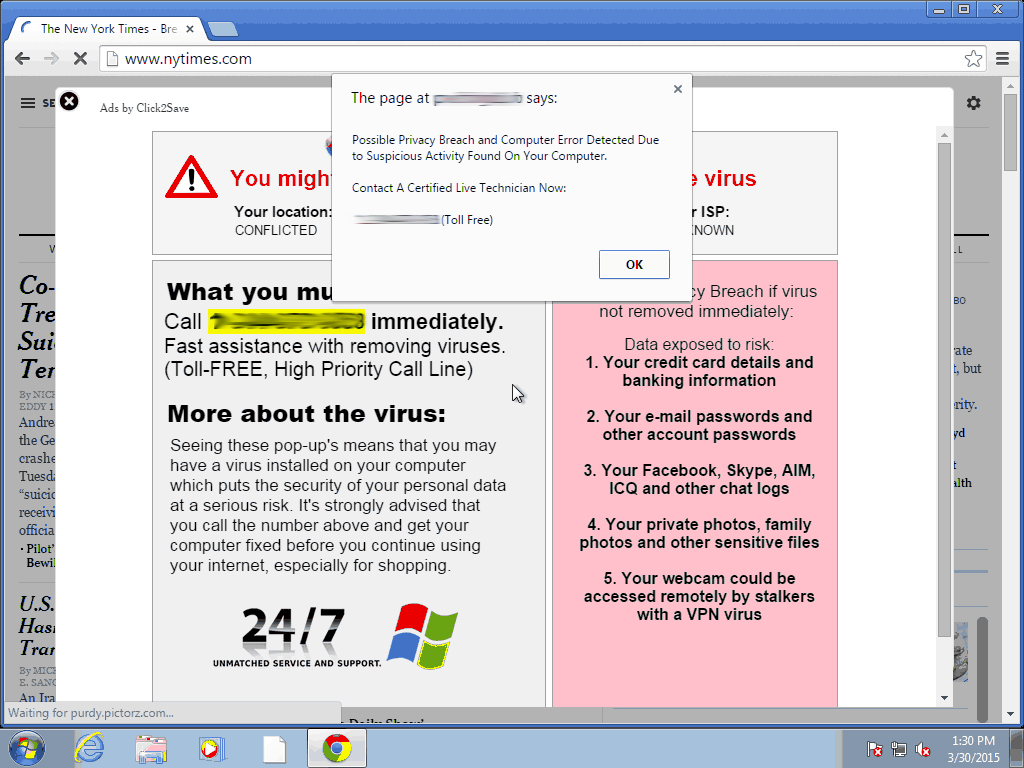
You might have missed an item last week although you might very well have been the subject of the report.  Do you know about ad injectors?  I’ve written about them before, most recently when some genius at Lenovo thought purchasers of their laptops would want to have Superfish bundled with their machines.  Besides being a massive security risk it was annoying as hell, as a plethora of ads cluttered up users’ screens.  Well, it turns out that Lenovo doesn’t have a patent on either stupidity (at best) or maliciousness (more likely).  To wit:

More than 5% of Google site visitors have at least one ad injector installed. Of those, half have at least two injectors installed, and nearly one-third have at least four installed, per a study Google conducted with researchers at University of California Berkeley.

In other words, millions of people have code installed that will insert new ads, or replace existing ones, into the pages those people read.  You may be one of them.  How did this happen?  Generally, some miscreant bundled the ad injector with some other desirable piece of software which the user installed.  Tool bars (don’t install them!) and certain software download sites (download.com, for one) do this routinely.  As the Google Security Blog put it:

Unwanted ad injectors aren’t part of a healthy ads ecosystem. They’re part of an environment where bad practices hurt users, advertisers, and publishers alike. People don’t like ad injectors for several reasons: not only are they intrusive, but people are often tricked into installing ad injectors in the first place, via deceptive advertising, or software “bundles.”…Ad injectors are problematic for advertisers and publishers as well. Advertisers often don’t know their ads are being injected, which means they don’t have any idea where their ads are running. Publishers, meanwhile, aren’t being compensated for these ads, and more importantly, they unknowingly may be putting their visitors in harm’s way, via spam or malware in the injected ads.
So why does this happen?  Because it can and because some executive doesn’t have the moral courage to say “no” to an easy buck.  Any of us in business make choices like this all the time.  We could do things that are evil but profitable but most of us choose not to.  We should not be afraid to point out and shun those who do.
Business is hard.  Making the right decisions is part of what makes it so.  We don’t do some things just because we can.  Besides being immoral it’s myopic and as Lenovo found out the backlash can be worse than the original problem.  Make sense?

Leave a comment

Filed under Consulting, Huh?

Misplaced Problem Solving

A new week and another bit of news that has me shaking my head.  Today it comes from the folks at thePlatform which is a widely used video streaming service.  thePlatform announced that it has been working on a feature to defeat ad blockers and they have something that protects against ad blockers, making it easier to get ads onto new devices with minimal client work.

Diagram of Unicast Streaming

(Photo credit: Wikipedia)

I like thePlatform and have worked with them so please don’t misconstrue what follows as anything but me trying to a little wider perspective.  I’ve written before about the challenge of ad blockers for the ad-supported digital community.  To quote one article on the subject:

There are stats out there that say nearly 28% of users have some sort of ad blocker installed, a percentage that has spiraled by nearly 70% in a year. Ads that are blocked, combined with all the other ads that aren’t seen because of viewability issues, makes for pretty bad business.

Indeed.   In this case, thePlatform is looking out for the businesses that support their services.  I applaud them for that even though it’s a misplaced solution that doesn’t cure the underlying problem.  It’s fine to defeat some of the ad blockers for a short time and to help your clients with generating advertising revenue.  However, when you have 70% annual growth in something that runs counter to your business model, maybe the answer is to examine why people are using ad blockers in the first place.

Ad blocking is most popular with younger users – 41% of American internet users aged between 18 and 29 used ad blocking software, rising to 54% when only young men are counted.  Those are the prime years for developing habitual customers.  Yet rather than figuring out how to get product messages across without being annoying and intrusive the industry is figuring out how to thwart customers’ technology.  “We’ve been extremely diligent about making sure that ad blockers can’t find patterns in our URLs they can block on” says thePlatform’s CTO.  Hmmm…

I believe in the ad-supported business model.  I also believe that you can’t force-feed consumers.  Defeating ad blockers is a band-aid and a misplaced one at that.  We need to focus on how to make ads that don’t tax computer resources and crash web browsers.  We need to respect privacy, which is another reason people install blockers.  We need to stop producing band-aids and focus on real solutions.

That’s my opinion.  Yours?

Leave a comment

Filed under digital media, Reality checks, Thinking Aloud