Category Archives: Huh?

Looking In The Horse’s Mouth

As you might have read the other day, I had a birthday. It was lovely, thank you, and in addition to numerous phone calls, texts, and social media shout-outs, I received a bunch of emails from companies sending me “gifts.” Yes, in quotes.

I’ve written before (in fact, just a couple of months ago) about the gifts many companies “give” us. I also wrote about how nothing is free several years ago, so my rant today isn’t exactly new ground. However, I think it’s an important enough thought for those of us in business that it bears repeating. I also am happy to point out how two companies got it right.

The vast majority of the emailed birthday greetings contained an offer that generally read “Happy Birthday! He’s a gift of $15 off on your next order.” Sometimes it was a percentage discount but you get the idea. I had to spend money to take advantage of the offer, and I had a limited window in which to do so, generally 30 days.

Let’s unpack that. First, what if I don’t need your product or service in the next month? I mean, a discount on an oil change is fine but I just had my oil changed (at your shop, by the way – you should know that). You’re revoking my gift because I was just in? Second, what if my typical order is a lot more than your general average order value, something else you should know if you’re actually on top of your data and not just auto sending something based on a birthday you have on file. Shouldn’t I get a bigger “gift” since I’m a more valuable customer? I got one restaurant that I go to infrequently sending me a $15 “reward” on my birthday that I could redeem only by installing and using their app and dining there. That would be in the next 30 days, of course. To which party is that a gift?

I’m a believer that gifts need to be unconditional. You should be giving because you want to and not because you expect something in return. Two offers I received actually met this criterion. The good folks at the Alamo Drafthouse Cinema sent me a free movie ticket. That’s it. I’m not obligated to buy food or drinks, I don’t have to bring a friend. I can redeem it via their app but I don’t have to – just present some ID and my account information at the box office. The gas chain I use frequently sent me a coupon for 200 bonus rewards points. I just have to have it scanned the next time I visit and they will be added to my account. I can redeem those points along with the others in my account for free stuff – gift cards, food, etc. And 200 points is significant – it’s what you’d get from spending about $25 with them. No strings attached. Happy Birthday!

It’s nice (and important) that we surprise our customers with gifts, whether that’s content, discounts, or something else. We need to do so without strings because those strings are quite visible and will harm the customer’s opinion of us, not enhance it. As I wrote in June, A gift involves altruism. If there is an ulterior motive lying within, it’s not a gift, right?

Leave a comment

Filed under Helpful Hints, Huh?

False Inferences

This Foodie Friday, let’s give a round of applause to Burger King, A&W, White Castle, and all of the other burger chains who are beginning to serve Impossible Burgers. OK, throw in the donut chains who are serving the Beyond Meat “sausage” products too. Are they indistinguishable from their meat-based versions? I have no idea – I generally don’t go to QSRs when I want a burger although I might have to just to try one out.

The round of applause is not for taste but for trying to expand their customer bases to include vegetarians and vegans. My vegan daughter will (rarely) go to a QSR and get what amounts to lettuce and tomato on a bun (think a chicken sandwich without the chicken) although some of the chains offer truly vegan patties and sandwiches.

Burger King is not one of those – their veggie burger has both milk and eggs in it. However, they are one of the first chains to add the Impossible Burger to their offerings. As it seems with many things business-related, there is a dark lining to the silver cloud. It turns out, unless you specifically ask, the Impossible Burger is cooked with the same broiler as regular burgers and chicken. So much for vegan or even vegetarian. Burger King says that 90% of the people who ordered the Impossible Whopper during a trial run this spring are meat eaters, which means most diners may not care if their faux-meat patties are cooked alongside classic beef ones. In fairness, they don’t label the product as vegan either. Still, it raises a point I want to bring to the surface today.

Humans make inferences. We use our beliefs as assumptions and make inferences based on those assumptions. We do that because we can’t act without them. We have to have some basis for understanding and the only way for us to take action is to use our assumptions to make inferences. An assumption is something we “know” based on our beliefs or previous experience.

When Burger King offers a burger that is a vegan alternative to a meat-based product (something that’s known) you can see how a customer will infer it’s still vegan even when it’s not labeled as such.  If there is room for the customer to draw a faulty inference based on reasonable assumptions, I think we need to go out of our way to correct them. I also think that it’s way out of bounds to create those false inferences knowingly – having the customer see that something is 35% off and a good buy when you marked it up the week before with the intent of marking it back down.

The difference between “relaxing” and “wasting time” is all in the meaning we assign to what we’re doing, the inferences we draw. The difference between “selling” and “dishonesty” or “hyperbole” or even “grifting” is also based on inferences. Not allowing customers to draw a well-constructed line from their assumptions to inferences and meaning is bad business in the long run, don’t you think?

Leave a comment

Filed under food, Huh?, Thinking Aloud

Too Much Cabbage

I’m in South Florida this Foodie Friday celebrating my mom’s 90th birthday. While my mother is hardly a “foodie”, one food group that we both love is deli, and Jewish deli specifically. Living in North Carolina as I do has many wonderful food aspects but the availability of a good pastrami sandwich is NOT one of them. Because of that as well as my mom’s love of the genre, I’ve taken her (and my dad) out for lunch the last couple of days to get Jewish deli.

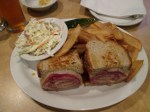
Yesterday I ordered a Reuben sandwich, having had my pastrami the day before. One thing really good deli is known for is overstuffed sandwiches. Even if you choose not to overeat and finish the thing, you always have something to bring home. The photo of the Reuben on the menu showed a typically large offering (the photo here is not the one from the menu since that’s probably copyrighted). What showed up reminded me of a great business point.

The photo isn’t my sandwich but it’s one from the same deli. As you can see, the Reuben was made by rolling the corned beef around the sauerkraut. The thing is served on toasted rye bread with Russian dressing. It’s hard to tell but when I picked the thing up it was immediately obvious that the bread was smaller than a typical loaf of rye which meant that there was less “there” there. More importantly, while rolling the meat around the sauerkraut like a meat and cabbage jelly roll was clever, it also meant quite a bit less meat was used in the sandwich. If you look closely at the photo you’ll see that unrolling the thing would yield about a half a dozen thin slices of corned beef, hardly something a proper deli would serve as an “overstuffed” sandwich. The meat in my sandwich didn’t fill the bread either – the roll stopped about halfway back on the bread. Most Reubens (or Rachels – a version of the sandwich made with pastrami) pile the sauerkraut on top of a stack of meat.  Is this presentation designed to hide the fact that there is far less meat than one would expect?

What does this have to do with your business? Customers do “unroll” the filling.  When they come up with too much cabbage and not enough meat they’ll find a competitor that really does deliver what they promise. I think overpromising and underdelivering is the biggest mistake any business can make. While this chain of delis does quite well (most of their other food is terrific and does deliver), they need to revisit the Reuben or delete the photo from the menu since it sets expectations that are not met. None of us can afford to do that, not if we want repeat business.

Leave a comment

Filed under food, Helpful Hints, Huh?