Category Archives: Huh?

Domo Arigato, Mr. Roboto

English: pizza) Polski: pizza

(Photo credit: Wikipedia)

I know what you’re thinking. Why does the Foodie Friday post have a song lyric as a title? Well, that’s the song that popped into my head as I read a piece about Zume Pizza, a food delivery startup.  The Ad Age article begins with this:

In the back kitchen of Mountain View’s newest pizzeria, Marta works tirelessly, spreading marinara sauce on uncooked pies. She doesn’t complain, takes no breaks, and has never needed a sick day. She works for free. Marta is one of two robots working at Zume Pizza, a secretive food delivery startup trying to make a more profitable pizza through machines. It’s also created special delivery trucks that will finish cooking pizzas during the journey to hungry customers…

Ouch.  Putting aside yet another human or three being replaced by a machine, I have other issues with this which are captured nicely in the Styx song:

The problem’s plain to see, too much technology
Machines to save our lives. Machines dehumanize.

Business needs to be about people.  When I eat, I want to taste the cook’s soul. I like the imperfections and that my pizza is different from how it will be the next time I order it. I enjoy personal service and the quirks of every individual with whom I deal no matter what the business. We need to be responsive to each customer in a human way. It’s why customer service agents reading from a script are just as bad as automated menu trees in my book. Who doesn’t prefer speaking with an unscripted human?

Do I think the hungry stoner calling for a pizza at midnight cares? Nope, and I suspect this startup will do well. I guess this is just the cranky old guy in me bemoaning yet another little bit of dehumanization in business. It’s right up there with programmatic media buying and selling and push-button espresso makers. Let’s stay human, people. Less efficient? You bet, but gloriously personable. You in?

1 Comment

Filed under food, Huh?, Reality checks

Going Backward Is Dumb. Looking Backward Isn’t.

There was a story in this morning’s paper that had me shaking my head once again. Seems as if it’s a daily occurrence, I know. This one got me thinking about the things we can take away from the subject and apply to business, which is also a daily occurrence. The story was about our shared stupidity and our general refusal to learn. Let me explain.

Here is the headline: American Drivers Regain Appetite for Gas Guzzlers. I’ve linked to the story but as you can imagine it has to do with many people giving up their fuel-efficient cars to buy gas guzzlers as the price of gas has fallen. Of course, in addition to adding a lot of room to the passenger compartment, these vehicles also add a lot of greenhouse gasses to the atmosphere, and unless you’re one of the few who are ignoring virtually every scientist on the planet, that is creating a changed climate for us all.

I’m not ranting today about the politics of this. To me, it’s not very different from what a lot of managers do in their own businesses. The higher price of gas was a crisis. Many car owners adjusted by decreasing driving, buying more efficient vehicles or using mass transit if it was available. Most good managers do the same sort of thing in a crisis. They cut spending, focus on business development, eliminate inefficient product lines, and do all of the other things one can do to continue on until the crisis has passed. What the great managers do is to continue to operate with that mindset even after the crisis is long gone under the assumption that the same problem or another one is virtually certain to rear its head at some point. That doesn’t mean they fail to invest once conditions have improved. It does mean that they learn from the crisis and adjust and they don’t go back to doing exactly what they were doing before.

I own a hybrid and my family owns two others. I can’t see going backward with respect to fuel efficiency and greenhouse emissions no matter how cheap gas becomes. I try not to go backward in business either. Going backward is dumb. Looking backward and learning isn’t. Your call.

1 Comment

Filed under Consulting, Huh?

Killing It At The Source

Suppose you sit down at a restaurant and look over the menu.  Seeing a few things which seemed appealing, you place your order.  How would you feel if you found out that while the main course was cooked in-house, the starters and desserts were all made across the street and brought it?  I’d feel kind of cheated.  My expectation is that when I order off a place’s menu that they’re making what I’m served. They’re certainly taking credit for it.

As it turns out, that’s exactly what’s happening in the online publishing world and I think it’s suicidal. It’s called “sourced traffic” and this is an excellent definition:

The practice of sourcing traffic is essentially any means by which digital media publishers or vendors acquire audience (visitors) through third parties.  So, this is audience being sold by the vendor which is not occurring in the traditional advertising model (by which a publisher puts out content which attracts an audience and then sells ads to reach that audience).  In other words, sourced traffic is by definition not organic traffic to the publisher’s site.

In other words, publishers are selling audiences they don’t have just to add some audience to their delivery stats. The first issue I have is much the same as I might have with the aforementioned restaurant – taking credit for something that’s not yours. My guess is that most publishers – like most buyers – are very much focused on the numbers and not at all focused on the quality of what’s being delivered. I would be quite upset if I paid for a prix fixe meal and the quality of the parts not made in-house were substantially lower.

The bigger issue brings us right back to our old friend, fraud. A White Ops and ANA study of non-human traffic from 2014 found that while a direct audience is mostly human, sourced traffic is almost 90% attributable to bots. eMarketer reported this the other day about an ANA study:

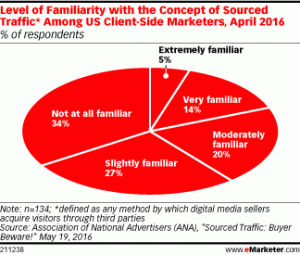
According to the data, 34% of respondents—also ANA members—said they were not at all familiar with sourced traffic. Meanwhile, 19% said they were very or extremely familiar. But perhaps more interestingly, the majority (54%) of those surveyed, said weren’t sure if any of their digital media buys included some form of traffic sourcing.

And we wonder why digital doesn’t receive as much weight in media buying as the audiences warrant?  All players – publishers, buyers, and clients – need to step up their game here and fix the sourced traffic problem.  Otherwise, who is going to want to eat in this restaurant?

Leave a comment

Filed under digital media, Huh?