Category Archives: Helpful Hints

Faulty Instrument Readings

I’m not a pilot (although I’ve played Flight Simulator a bunch). One of the things pilots are told is to trust their instruments because sometimes our eyes or other senses deceive us while flying. Things such as graveyard spins or spirals result, and I’m very sure that anything with the word “graveyard” is bad when using in conjunction with flying.

X-Plane 10 Flight Simulator Zero panel

(Photo credit: Wanderlinse)

Business analytics today are exactly the opposite of flying.  You see, there are so many things that can go wrong  – a misplaced space, code missing or in the wrong place – that going by what the “instruments” tell us alone can be fatal.  I’ll go back to a point I’ve stated before – we need to figure out what we’re trying to investigate and why before we ever look at the numbers.  That lets us process the information we’re going to receive in context so we can make decisions.  Knowing your web traffic is up is relatively useless.  What it should prompt is a response into both “why” and “what of it?”  That requires using your eyes and your common sense.  Let me give you an example.

You launch a campaign to increase sales using Search Engine Marketingpay-per-click ads to use a less-fancy term.  You’re smart enough to make sure you have conversion tracking installed – a method through which you can assess how many people who come to your store via your fancy new campaign actually buy something.  Your developers check the code and make sure it’s in the right place and that the beacon fires when the appropriate action is taken.  However, no one ever does what a real-world user would do – click an ad and place an order – to make sure that the “instruments” are picking up the action properly.  As a result, you think, based on the reporting, that the campaign was a tremendous waste of money since it resulted in no sales.  Your instruments just crashed the plane.

Had you used your eyes and common sense, you’d have seen that the ads generated a lot of traffic and based on your history, some percentage of that traffic that stayed on the site (non-bounced visits in tech speak) does convert to sales.  Since that didn’t happen here, maybe something is wrong.  Click an ad and place an order – did it register?

There is a tendency to trust the instruments but unlike the gauges on airplanes, the gauges we use in business are relatively new and far more prone to error.  We can’t let faulty instruments over ride the business acumen we’ve developed over the years.  That can be a fatal error.  You with me?

Enhanced by Zemanta

Leave a comment

Filed under Consulting, Helpful Hints

The Name On The Door

Today’s Foodie Friday Fun is about the business side of food, a restaurant, so if you’re here today for cooking tips I apologize. You probably know chef Gordon Ramsay from his incessant TV appearances and, if so, you’re aware of his obsession with quality and high standards. What’s happened here in New York to his Gordon Ramsay at The London restaurant is a great lesson for any business.

Ramsay at BBC Gardeners' World Live 2008

(Photo credit: Wikipedia)

The restaurant opened in 2006 and soon thereafter won two Michelin stars. For any of you non-foodies, suffice it to say that there are currently only 14 places in NY that are two or three stars – they’re hard to win.  Unlike the Zagat ratings, these are all done by professional inspectors who are totally anonymous.  That was 2008.  In 2009 Ramsay sold the restaurant to the hotel (he needed the money – that’s another story) and licensed his name as part of the deal.

Fast forward.  The new guide came out and both stars are gone.  In a year (he had the two stars last year).  That’s pretty unheard of and shows a significant decline in quality and standards.  The chef’s response (via Eater)?

“Gordon Ramsay is not involved in the day-to-day running of the restaurants or kitchens, as this is a licensing agreement, but is in communication regarding updates and changes at the restaurant.”

In other words, although my name is on the door I’m not involved.   We heard something similar out of Donald Trump when the Trump casinos went bankrupt (how the heck do you lose money running a casino?!?!):

“Other than the fact that it has my name on it – which I’m not thrilled about – I have nothing to do with the company.”

I’ve done licensing agreements and one thing that is always a part of them are the product standards.  Since it’s your name, you always have the right to examine the product and if it’s not up to your standards, to demand that it’s fixed or not sold.  You might shrug and say well, that’s the restaurant business but it’s your business as well.  If the quality of whatever product or service you’re providing – even through a third party – isn’t up to snuff, it’s your name and reputation, not the third party’s.  Given that many of Ramsay’s other places – where he is more hands-on apparently – have held on to their stars – his place in London has three! – it’s clearly not that the chef has lost his touch.  It that he was out of touch with the New York place.

If your name is on the product, you need to be involved and maintain the standards that warranted your name on it in the first place.  When people knock on your door, they see you, not the landlord, not the builder, not the cleaning crew, not even the people who actually do the work.  You.  I’m all for meeting the customer expectations that my name engenders.  Aren’t we all?

Enhanced by Zemanta

Leave a comment

Filed under food, Helpful Hints

Headlines And Half Empty

Part of how we approach business – and life, for that matter – is the spin we choose to put on things.  Some of how we make up our own minds is from the words others use to describe things.  For example, if I won the lottery, the headline might be “Man Wins Lottery, Set For Life.”  The headline could also be “Man Hit With Enormous Unexpected Tax Bill, Owes Millions.”  Far fetched?1379508733538

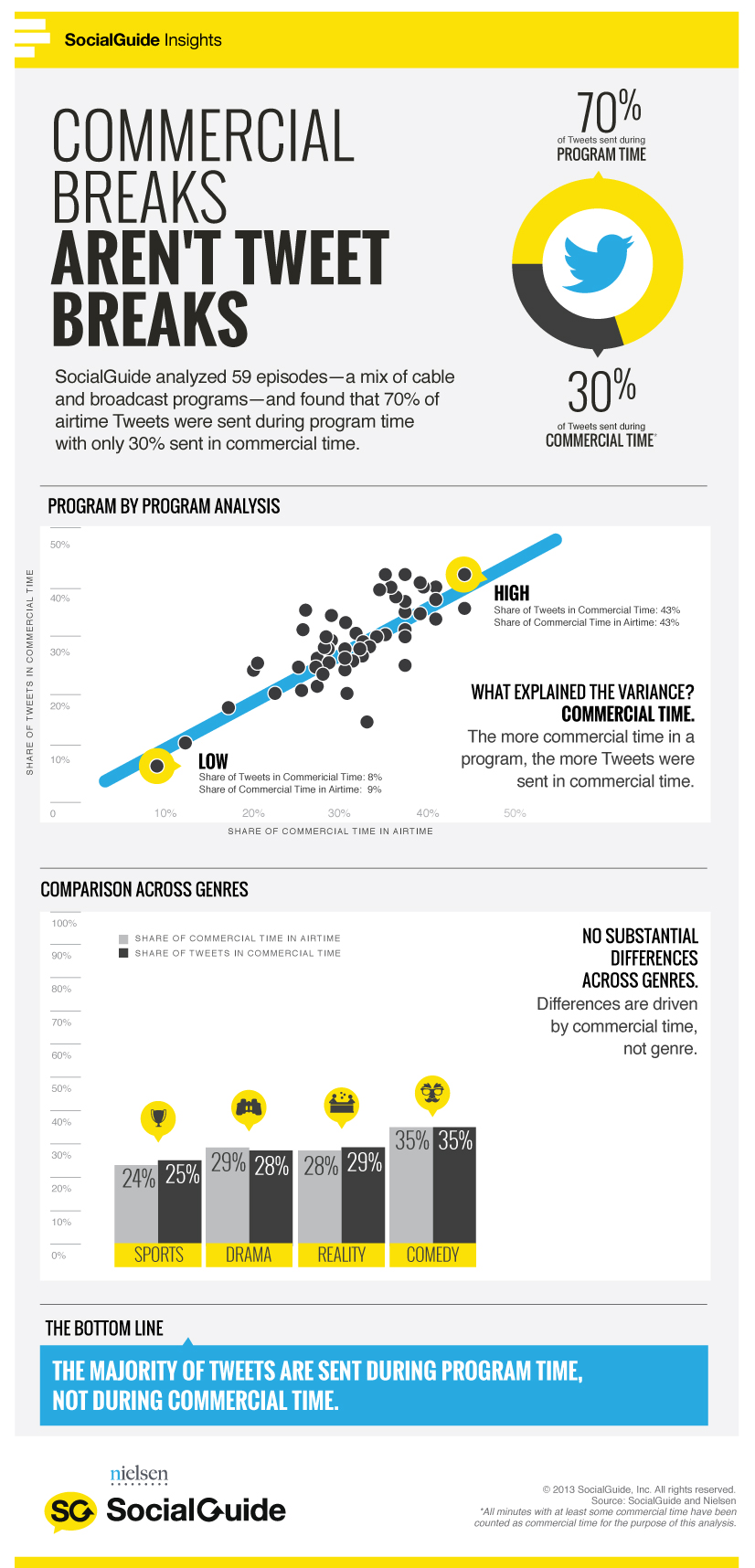
Let’s take how a single publication handled the reporting of one piece of information in two different articles.  I should state upfront that I have no issue with either of these headlines nor with the articles.  I’m using them to illustrate a point.  The publication is MediaPost, and I read almost a dozen of their newsletters each day – they provide great information.  The story was a study Nielsen did on viewers using Twitter while they’re watching TV.  You can read Nielsen’s own release on the topic by clicking through on this link.  You might be able to tell from the graphic how Nielsen portrayed their findings.

On to the two articles.  One was headlined “Tweeting Doesn’t Spike During Commercials” while the other stated “TV Viewers Use Twitter During Ads.” Same study, same publication, same day.  A quick glance at the headlines might make you think that viewers don’t break away during commercial breaks; the other might lead you to believe the opposite.  One article says

Good news for TV programmers: TV viewers use Twitter during their TV programming — showing lots of engagement, according to analysts. The bad news? Many are also tweeting during commercials.

while the other says

The takeaway is that viewers using Twitter as a second-screen platform are tweeting consistently throughout the airtime for programming and ads alike. TV advertisers might still prefer that viewers’ attention was fixed on the larger screen during breaks, but it’s not as if they signal the start of a tweeting blitz. All airtime is tweet time.

My point is that we always need to dig a little deeper into the facts before we draw conclusions and we should always get to the source material when we can.  In this case, the Nielsen study.  In other cases a sales report, a deal memo, or other things about which we often learn from others who will bring their own point of view as they report the “facts.”   Needless to say, the principle applies outside of the business world as well.

Make sense?

Enhanced by Zemanta

Leave a comment

Filed under Helpful Hints, Reality checks