Category Archives: Helpful Hints

Curating Frustration

I realize yesterday might have seemed as if it was Foodie Friday since the topic was food related.

English: Steacie Science and Engineering Libra...

(Photo credit: Wikipedia)

However, Foodie Friday the 13th is today, and I’m going to focus on an unlucky site’s marketing today. While I’m not going to mention their name, I’ll say upfront that it’s a site I generally find incredibly helpful. They curate recipes and do so with beautiful photos. Their emails are just as pretty and generally quite useful. Which is why I’m calling them out today and hopefully making a business point in the process.

This morning’s email was about side dishes which will “compliment your holiday spread.”  Of the 21 photos they used to tease me to click through, four were latkes, one was a noodle kugel, and two involved challah.  Since Hanukah has been over for a couple of weeks, that “holiday spread” is long gone.  In fact, many of the other recipes in the collection were not really appropriate for a winter holiday at all.  Grilled potatoes?

My point is this.  If you’re curating content, you’re supposed to be picking the best content that applies to a particular subject.  Relevance is a big deal, as is how the content is organized and presented.  This site generally gets high marks for the latter two but when a third of what you’re presenting is appropriate for a holiday that’s long gone, you’ve failed.

You might be thinking “well, this isn’t an issue for me since we don’t curate content.”  I’d be surprised if that was true, dear reader.  Almost every business is in the content creation and/or distribution business these days, either of your own content or that of others which you think might be useful to your audience.  Email, social channels, and your own website (not to mention advertising!) are all places where you’re publishing.  Being relevant and useful are critical.  Organizing it in such a way that readers can slice and dice it as they like is important.  It’s all part of listening to your customers and continuing the conversation.

Giving someone a great recipe for grilled anything while the grill is covered in snow not only isn’t useful, it’s frustrating.  Hitting them up with the right content at the right time in the right channel with an easy way to take action should they so choose is magnificent.  Which will you choose to do?

Enhanced by Zemanta

Comments Off on Curating Frustration

Filed under digital media, food, Helpful Hints

Stews Leonard’s And The Thumbtack In The Chowder

Today’s tale ended up providing a good business lesson but began as a potentially lethal bit of negligence.

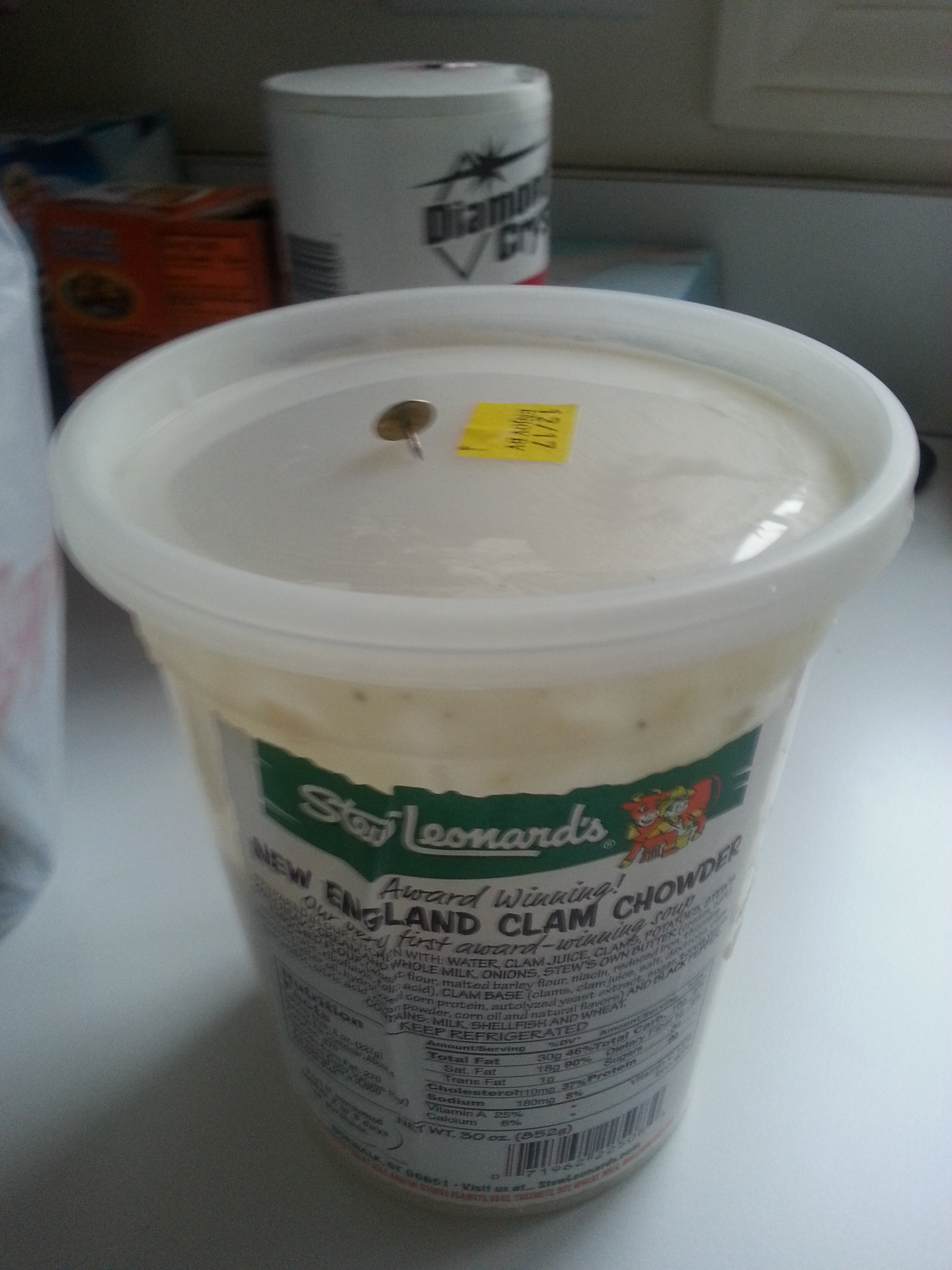
Oyster crackers are better with this than thumbtacks!

Oyster crackers are better with this than thumbtacks!

I went to see my folks the other day and my Mom had something interesting to show me. On her counter was a container of clam chowder from the Stew Leonard’s store down the street from their house.  She had purchased the soup the day before.  On top of the container was a thumbtack as you can see in the photo.  I don’t know about you, but my Dad prefers crackers with his chowder and doesn’t ever consider thumbtacks as a condiment.  However, that is exactly what he found as he ate.

How the tack got in the chowder is a serious problem but not our focus today.  Obviously the commercial kitchen should not have small, sharp, unsterile objects anywhere near food but let’s put that aside and focus on what happened when I returned to the store.   Stew’s is known for great customer service.  At the front of the store here in Norwalk is a big stone that says:

We’ve been going to the Norwalk store for 30+ years and have always found that they practice what they preach.  However, we’ve never had an issue like this.  In any event, I took the tack and the chowder to customer service at the Danbury store and explained the problem.  The young woman didn’t ask for a receipt nor question me in any way.  She just apologized, asked me if I had other shopping to do and to please come back to see her when I had finished.  Upon my return she waved me to the front of the short line, asked for the new clam chowder I had picked up, tagged it as paid and refunded the price in cash.  I gave the soup to my folks along with their refund and they were happy.

We get opportunities in business to take bad experiences and make them worse or to make them better.  This was the latter which I think is a model about handling a customer problem.  Address it immediately, admit blame, tell the customer how you’re going to solve the problem, make restitution, and see if that resolves it.  I suppose if I had carried on about wanting gift cards or something more I might have got it but I wasn’t there to take advantage( I realize some customers are!).  They could have asked me for my parents’ email to send them an apology (about the only improvement I would have made).  They were being adult about it – I thought I’d reciprocate.

Many places would have denied there was a problem (that’s impossible, sir, maybe you dropped it in while you were heating it up).  Many would have demanded a receipt (maybe you were storing someone else’s chowder in one of our containers).  Some would have made me solve the problem (so what do you want me to do about it) instead of offering a solution themselves.  They did none of those things and so what could have been a series of horrible posts on social media are, instead, a blog post that praises them.

How would you have handled it had your customer found the tack?  Any differently?  Could this have been handled any better?

Enhanced by Zemanta

Comments Off on Stews Leonard’s And The Thumbtack In The Chowder

Filed under food, Helpful Hints

Winter Driving Can Help Your Business

We had our first significant snowfall yesterday and it’s very cold (26 degrees as I’m writing this) here.

photo by mark(s)elliott on Flickr

It’s going to be cold and icy the next few days so it means switching into winter driving mode.  Unless you live in a place that’s warm year ’round, you should probably be aware of some winter driving tips offered by the AAA.   Of course, as I reviewed them, they seemed like pretty good business tips as well, particularly with respect to operating in adverse conditions.  Let’s see what you think.

Avoid driving while you’re fatigued. Getting the proper amount of rest before taking on winter weather tasks reduces driving risks.  How many of us come to work exhausted when we’re under the gun?  As much as we can we need to get away from work and recharge in times of crisis.  That might seem counterintuitive, but how much we don’t work in a crisis can impact how effective we are during it.

Never warm up a vehicle in an enclosed area, such as a garage. Many of us tend to shut down or closet ourselves away when stress hits.  Bad idea.  When we’re working quickly, a fresh set of eyes can help catch the errors we don’t.  Be open, seek help.

Make certain your tires are properly inflated.  How many times have you needed to get something done and a critical system such as a computer goes on the fritz?  The quiet times are when we need to make sure our support systems are working.  When was the last time you defragged that hard drive anyway?

Never mix radial tires with other tire types.  This is about team building.  Just as mismatched tires won’t function together to keep you safe, a team whose members are incompatible with one another won’t perform well under stress.

Keep your gas tank at least half full to avoid gas line freeze-up.  Little things like running out of printer paper can kill you.  Do the checking long before you need to print those 30 copies of the deck (unless you like a mad dash to Kinkos in the middle of the night…).

Do not use cruise control when driving on any slippery surface (wet, ice, sand).  Don’t assume that you can let your team, which has always performed well, run on their own during a crisis.  Conditions have changed.  You’re the boss – drive the car!

Always look and steer where you want to go.  That sounds silly – where else would you look?  But it’s imperative that we avoid distractions and stay on task in a difficult business situation.  Think about the last time you were in one and got off-track with a silly side issue.

Use your seat belt every time you get into your vehicle.  When conditions are becoming adverse, we need to be sure that we’ve protected ourselves before those protections are needed.  Lawyers would tell you that’s why you document everything, even with partners with whom you have great relationships.  I’d tell you that communicating with your team, making sure they’re trained, and developing accurate reporting systems are the business equivalents of seatbelts.  Use them!

What other winter driving tips can you think of that might help in a business situation?

Enhanced by Zemanta

Comments Off on Winter Driving Can Help Your Business

Filed under Helpful Hints