Monthly Archives: June 2016

This Is Disturbing

A little over a year or ago, Jon Mandel, who is a widely respected media maven, made a statement in front of an ad convention that kickbacks were rampant in the media and agency businesses. He alleged that agencies were receiving funds back from various media sources and these payments were never reported to the clients. It was such a widespread issue that he left a position as head of one of the biggest ad agencies in the US in part over it.

I worked with Jon in my past life and I’d certainly not cite him as one who is prone to rash groundless statements. Apparently, neither would the Association of National Advertisers (ANA), the trade group that represents marketers. They commissioned a security firm to conduct an investigation of the allegations and the report came out last Friday. It’s not pretty.

You can read the report here but some topline results found non-transparent business practices employed by agencies, some of which may or may not have been contract-compliant, included the following:

  • Cash rebates from media companies were provided to agencies with payments based on the amount spent on media. Advertisers interviewed in the K2 Intelligence study indicated they did not receive rebates or were unaware of any rebates being returned.
  • Rebates in the form of free media inventory credits.
  • Rebates structured as “service agreements” in which media suppliers paid agencies for non-media services such as low-value research or consulting initiatives that were often tied to the volume of agency spend. Sources told K2 Intelligence that these services “were being used to obscure what was essentially a rebate.”
  • Markups on media sold through principal transactions ranged from approximately 30 percent to 90 percent, and media buyers were sometimes pressured or incentivized by their agency holding companies to direct client spend to this media, regardless of whether such purchases were in the clients’ best interests.
  • Dual rate cards in which agencies and holding companies negotiated separate rates with media suppliers when acting as principals and as agents.
  • Non-transparent business practices in the U.S. market resulting from agencies holding equity stakes in media suppliers.

The response by the agency community?  Because the study did not name names, many of the big players seem to be denying there is a problem.  The 4A’s, which is the agency trade group said:

Without an opportunity for agencies to assess and address the veracity of information provided to K2, sweeping allegations will continue to drive attention-grabbing headlines; this does nothing to foster a productive conversation or to move our industry forward and could cause substantial economic damage to all media agencies.

It seems to me that the “productive conversation” needs to have happened quite a while ago.  When some media buying companies realized that they couldn’t make any profit executing buys, rather than have a heart to heart with the people paying their bills they chose, in essence, to cheat. Is it painting with too widespread a brush?  Probably, but one can imagine the lawsuits that would follow the publication of a list of the offenders.

It’s a good lesson for any of us in business.  Just as our clients’ problems become our problems, a healthy business relationship should foster open exchanges of the issues we face as well.  Labelling this problem as “unsubstantiated claims” and denying there is a problem doesn’t solve anything – ask the climate change deniers if ignoring the problem is making it go away. Transparency and good communication are high on any list of best business practices.  Are they on yours?
Leave a comment

Filed under Consulting, digital media, Huh?

Ali And Me

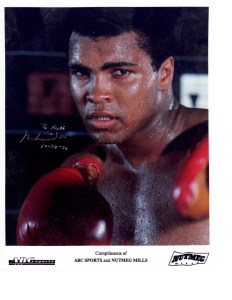
The passing of Muhammad Ali happened over the weekend. Another one of my boyhood idols gone, except this one was also a hero well into my later years. Those of you who know me in the offline world know that I’m rarely speechless but when I met Ali for the first time I found myself unable to utter even a single word for a few minutes. I was working at ABC Sports at the time and we had done a deal with Ali to license his name to a clothing line. He came to the office and the photo you see is the one he signed for me. I can still feel the man’s overwhelming aura.

Like most young sports fans of the late 60’s and early 70’s, I grew up watching Ali fight on free TV. I also watched as he stood up for his beliefs even at the expense of his career. We can argue about the Vietnam war or Ali’s commitment to nonviolence (odd for a boxer, perhaps) but there is no arguing about the man’s deeply held beliefs and his influence on society. The man was an artist in every sense and his legacy can be seen in nearly every modern athlete’s training and swagger.

I met Ali for the second time a few years later when I was at CBS Sports. Ali decided he wanted to come to the Final Four and even though he was now very visibly suffering from Parkinson’s, the brightness in his eyes hadn’t dimmed a bit. He hadn’t fought in a very long time and yet walking him through the dome where the games were taking place was like walking with Moses through the Red Sea. The crowd parted as “Ali, Ali” was whispered everywhere. I have walked through crowds with many other famous people.  No response was anything like the palpable adoration I felt the people had for Ali that evening.

Others have written about his influence on society as well as the large number of humanitarian acts he performed. I’d just like to add two things – what he taught me and what I think any business can learn from him. I learned when it’s wrong to keep quiet from him. Ali risked his name and his freedom to do what he felt was the right thing.  When he was vindicated, he continued his career but also continued to speak out and to do good works, not letting the adversity which had robbed him of the prime of his career to diminish his drive to be the best both in the ring and outside of it.  The final struggle of his life, Parkinson’s, which lasted for the last three decades also didn’t diminish his presence in the world nor his desire to help his fellow-man.

How many of us in business think the way Ali did?  How many of us speak up when we see wrongdoing?  How many of us use the bully pulpit of our business to change the world in a positive way for all of humanity and not just for our shareholders?  I’m quite aware that we have a responsibility to those shareholders but we also have a responsibility to our planet and the people who inhabit it, don’t we?   Maybe Ali’s memory can serve to inspire us to fulfill that responsibility.  He was the best in his business, winning the heavyweight title three times, but he was also the best in so many other ways.

Thanks, Champ.  You’ll be missed.

Leave a comment

Filed under Growing up, Thinking Aloud, What's Going On

Pimento Cheese (Again)

Our Foodie Friday topic this week is pimento cheese. Unless you live below the Mason-Dixon line in the US or are a regular attendee of the Masters Tournament, you might be unfamiliar with the stuff. My late father in law was from South Carolina and it was in his home that I received my introduction to it. Having grown up in New York, I had no clue that pimento cheese was, and is, a staple in most southern homes.

Jessica will have the recipe up shortly

(Photo credit: Wikipedia)

At its core, pimento cheese is just cheddar cheese, pimentos, and mayonnaise. That said, very few people I know who make the stuff make it that way. I’m partial to Craig Claiborne‘s recipe which incorporates two kinds of cheese, lemon juice, Worcestershire sauce, scallions, garlic, and hot sauce along with the basics. Other folks will argue for hours about which kind of mayo is best, Duke’s being the regional favorite. Bell peppers, sugar, cream cheese and other ingredients might make appearances as well.

It’s great to keep a tub of pimento cheese in your fridge for a quick snack.  You can also make sandwiches, slather the stuff on burgers, or use it as a dip.  It actually has an interesting history that dates back to the early 20th century.  As with barbecue, there are regional variations.  There are also dozens of pre-made brands sold in the supermarkets although I’m fairly certain one can whip up a batch in less time than it takes to go shopping for the inferior, premade product.  What’s the business point?

As with pimento cheese, there is no single right way to accomplish most business goals.  Very often, the route we choose is based on the resources we have, just as the final cheese product can depend on what’s lying around the pantry.  We need to keep open minds about proposed solutions and keep them as simple as possible.  One needn’t go to the trouble of making mayo or using fancy cheese in order to get a great result.  The best recipe is the one that gives you an outcome that pleases you the most, both in the kitchen and in business.

I wrote about pimento cheese a few years ago.  I ended that post by reminding us that our job as managers is to get everyone on the same page no matter which recipe we settle upon.  Good advice then as well as now, I hope.  Enjoy the weekend!

Leave a comment

Filed under Consulting, food