Monthly Archives: June 2016

Killing It At The Source

Suppose you sit down at a restaurant and look over the menu.  Seeing a few things which seemed appealing, you place your order.  How would you feel if you found out that while the main course was cooked in-house, the starters and desserts were all made across the street and brought it?  I’d feel kind of cheated.  My expectation is that when I order off a place’s menu that they’re making what I’m served. They’re certainly taking credit for it.
As it turns out, that’s exactly what’s happening in the online publishing world and I think it’s suicidal. It’s called “sourced traffic” and this is an excellent definition:

The practice of sourcing traffic is essentially any means by which digital media publishers or vendors acquire audience (visitors) through third parties.  So, this is audience being sold by the vendor which is not occurring in the traditional advertising model (by which a publisher puts out content which attracts an audience and then sells ads to reach that audience).  In other words, sourced traffic is by definition not organic traffic to the publisher’s site.

In other words, publishers are selling audiences they don’t have just to add some audience to their delivery stats. The first issue I have is much the same as I might have with the aforementioned restaurant – taking credit for something that’s not yours. My guess is that most publishers – like most buyers – are very much focused on the numbers and not at all focused on the quality of what’s being delivered. I would be quite upset if I paid for a prix fixe meal and the quality of the parts not made in-house were substantially lower.

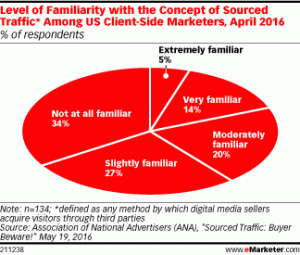
The bigger issue brings us right back to our old friend, fraud. A White Ops and ANA study of non-human traffic from 2014 found that while a direct audience is mostly human, sourced traffic is almost 90% attributable to bots. eMarketer reported this the other day about an ANA study:

According to the data, 34% of respondents—also ANA members—said they were not at all familiar with sourced traffic. Meanwhile, 19% said they were very or extremely familiar. But perhaps more interestingly, the majority (54%) of those surveyed, said weren’t sure if any of their digital media buys included some form of traffic sourcing.

And we wonder why digital doesn’t receive as much weight in media buying as the audiences warrant?  All players – publishers, buyers, and clients – need to step up their game here and fix the sourced traffic problem.  Otherwise, who is going to want to eat in this restaurant?

Leave a comment

Filed under digital media, Huh?

Make Up Your Mind

At the risk of compelling you to sound like Ronald Reagan (“There you go again”), I’m going to weigh in on a lesson learned from yesterday’s US Open Golf Championship. I promise not to get into a discussion of the rules of golf!

There was a moment when Dustin Johnson, who was leading the tournament, had his golf ball move a tiny bit while he was preparing to putt. He notified the rules official about what had happened and the official told him that since ball moved without Johnson doing anything to cause it, there would be no penalty. At some point, other US Golf Association officials notified the on course officials that they were going to review video of the indecent and that Johnson might be facing a one stroke penalty. What ensued was chaos, and is instructive for any of us in business.

Put yourself in the position of the golfers. At the time, there were several competitors within several strokes of one another. The on-course scoreboards might no longer be accurate and every walking official had been notified that Johnson’s score might be one shot lower than the scoreboards were reporting. Do the golfers play more aggressively? More conservatively? The point is that there was uncertainty and that uncertainty might not be resolved until after the round was over when more officials could chat with Johnson.

That’s the business lesson. Putting aside the complexity of the rules, the USGA should have made a decision immediately. No golfer can compete without knowing how they stand and neither can the folks who work in your business. I’ve worked in organizations where there were rumors of layoffs and/or budget cuts. It was paralyzing. Employees were focused on their jobs and not on their work. Partners were worried about both with whom they’d be dealing and if the business could live up to commitments it had made. I’ve found people can deal with almost anything except not knowing.

There is a corollary lesson here. If the scoreboards aren’t accurate, the golfers don’t know how they stand nor how they should operate going forward. If your data is incomplete or possibly inaccurate, neither do you. We need to make decisions and we need to have accurate, complete information as we do so.  Lesson learned?

Leave a comment

Filed under Consulting, Huh?

Just Nice Isn’t

Foodie Friday, and this week I learned something from going to lunch. I’ve written any number of times about how critical customer service is, both in the food business and everywhere else. I found out from my dining experience this week that there is a lot more to the equation. Let me explain.

I was out for a business lunch. We were seated in a section that wasn’t particularly busy and greeted by our server. Let’s call him Jim. He was as pleasant as could be. He asked about our drink preferences and said he’d be right back with the drinks as well as some water. When he came back 10 minutes later with our two glasses of iced tea, I thought maybe he’d had to serve another table. No water either, but not a big deal. He also left without taking our food order.

Upon his return, he apologized when he saw that he hadn’t delivered the water. He ran to get it. He must have run a 3K because it took another 10 minutes. Jim was still incredibly nice as he took our food order – charming, actually – but I was beginning to realize that his demeanor was much better than his competence. Other tables that had been seated after us we receiving food as we were still ordering.

The rest of the meal went on like this. Smilin’ Jim would interact with us every so often and we would have to wait. The customer service was abysmal, frankly, although it was hard to get really angry about it. That’s the lesson I learned.

Nice isn’t enough. Jim was about as good as it gets with respect to customer interaction but he was a total failure when it came to customer service. It’s not enough to train the people who service our customers to be nice. We must train them to produce results and those results must be customer focused. If I go back to this place (the food was actually quite good once it arrived) I’ll be sure that Jim smiles on someone else.  Service with a smile is great, but remember that “service” comes first in that sentence!

Leave a comment

Filed under food, Helpful Hints