Tag Archives: twitter

A Place We Can Call Home

Many of the questions I get asked these days revolve around social media.  You know the usual suspects: Facebook and Twitter.  Sometimes clients want to know about Tumblr or Google+ or Pinterest.  From there the discussions move on to “outliers” such as Vine, Instagram, and others.  We spend a lot of time going over the plusses and minuses as well as how to advance the client’s goals using these platforms.  It’s a valuable exercise but it points out something that I think is given short shrift and which is today’s topic.

The Homestead of Captain Alfred

(Photo credit: Wikipedia)

Every one of the aforementioned proprieties creates next to no content on its own.  Users generate nearly everything.  Unfortunately, everything users – and businesses fall into that category – put out there isn’t presented to the massive user bases these platforms have built.  So, as Facebook said in a New York Times interview:

On any given visit to Facebook, the average user could potentially see about 1,500 items, the company said, from wedding photos posted by a close friend to a mundane notice that an acquaintance is now friends with someone else.  Since no one has time to scroll through that many Facebook posts, items in the feed are ranked to put the most recent and relevant posts near the top.

In fact something like 85% of the people who “like” a page don’t see posts from that page in their news feed on a regular basis.  As a brand, you’re at the mercy of the news feed algorithm which is constantly changing.  So often in the effort to expand our reach to the broadest possible base, we give up control of the distribution in a platform that we don’t control.  We do, however, have something that we can do – and probably are doing – that should, in my opinion, be our tp priority: our own websites.

We own our websites.  They are our home base on the web.  We can control everything on it although as I’ve written before, if you’re permitting comments be judicious in your moderation and be sure you’re behaving in a way that prompts mostly positive user response.  We can be sure that the new visitor’s first encounter works just as well as the long-time fan who checks in every week.  The time and resources to support social are far greater than those required to support home base, and because the number of outlets is expanding, so too are the resources to support them properly.  But even if they were equal to those required for home base and it became an “either/or” choice, I’d advocate quality of encounter along with assured exposure over quantity and less control.

Don’t misunderstand.  I believe strongly that brands (and my clients) need to be in social channels.  Not, however, by letting their web homes get run down while they’re off in cyberspace doing so.  That’s my take – what’s yours?

Enhanced by Zemanta

Leave a comment

Filed under Consulting, digital media

Headlines And Half Empty

Part of how we approach business – and life, for that matter – is the spin we choose to put on things.  Some of how we make up our own minds is from the words others use to describe things.  For example, if I won the lottery, the headline might be “Man Wins Lottery, Set For Life.”  The headline could also be “Man Hit With Enormous Unexpected Tax Bill, Owes Millions.”  Far fetched?1379508733538

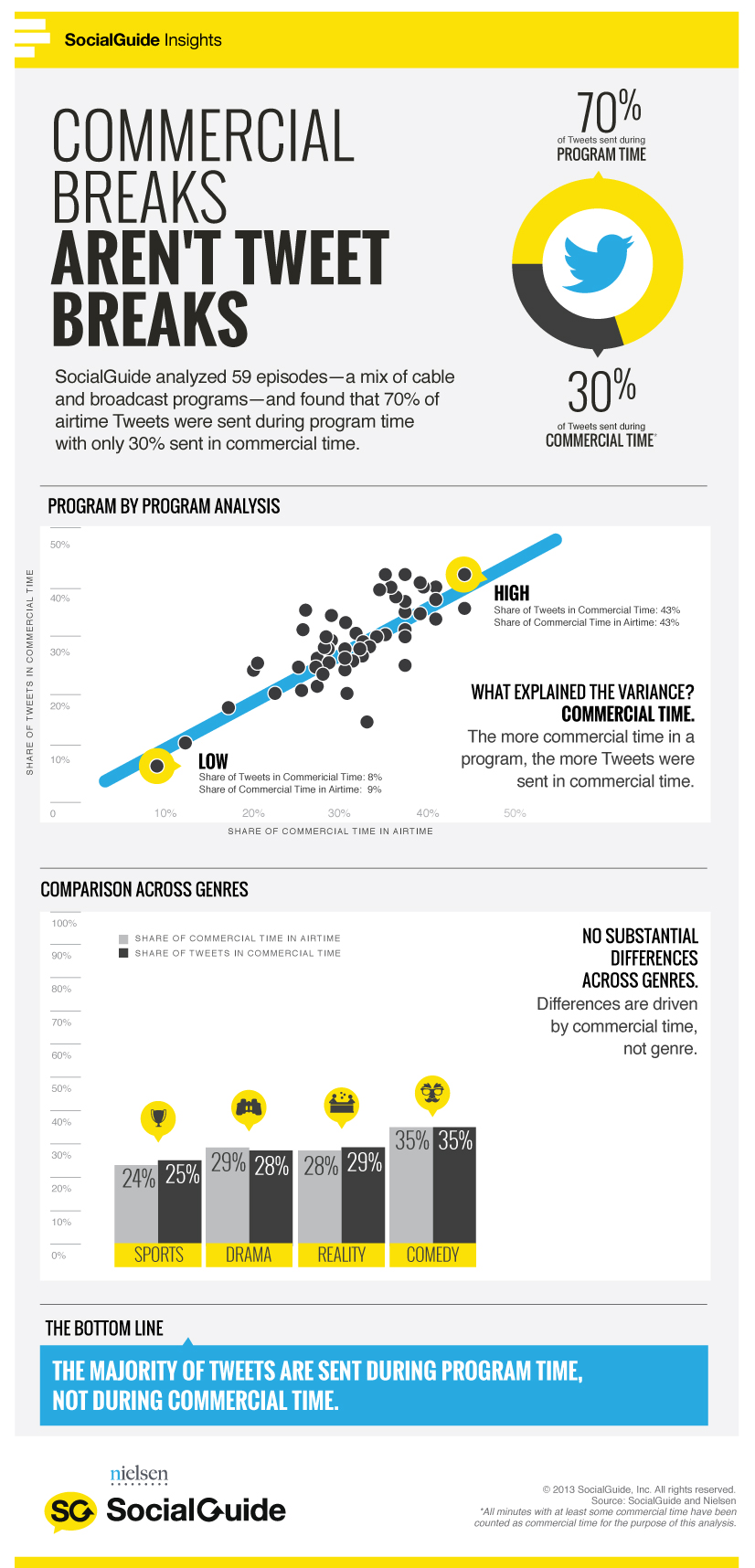
Let’s take how a single publication handled the reporting of one piece of information in two different articles.  I should state upfront that I have no issue with either of these headlines nor with the articles.  I’m using them to illustrate a point.  The publication is MediaPost, and I read almost a dozen of their newsletters each day – they provide great information.  The story was a study Nielsen did on viewers using Twitter while they’re watching TV.  You can read Nielsen’s own release on the topic by clicking through on this link.  You might be able to tell from the graphic how Nielsen portrayed their findings.

On to the two articles.  One was headlined “Tweeting Doesn’t Spike During Commercials” while the other stated “TV Viewers Use Twitter During Ads.” Same study, same publication, same day.  A quick glance at the headlines might make you think that viewers don’t break away during commercial breaks; the other might lead you to believe the opposite.  One article says

Good news for TV programmers: TV viewers use Twitter during their TV programming — showing lots of engagement, according to analysts. The bad news? Many are also tweeting during commercials.

while the other says

The takeaway is that viewers using Twitter as a second-screen platform are tweeting consistently throughout the airtime for programming and ads alike. TV advertisers might still prefer that viewers’ attention was fixed on the larger screen during breaks, but it’s not as if they signal the start of a tweeting blitz. All airtime is tweet time.

My point is that we always need to dig a little deeper into the facts before we draw conclusions and we should always get to the source material when we can.  In this case, the Nielsen study.  In other cases a sales report, a deal memo, or other things about which we often learn from others who will bring their own point of view as they report the “facts.”   Needless to say, the principle applies outside of the business world as well.

Make sense?

Enhanced by Zemanta

Leave a comment

Filed under Helpful Hints, Reality checks

Facebook Fadeout?

A basic law of gravity says that what goes up must come down and I suppose those laws apply to social sites as well. Witness MySpace, Zynga, and others. Now I don’t believe that social media is going anywhere. It’s become too important a communications channel and too ingrained into people’s lives. However, I do think that which social sites are the focus of social activity will continue to be an ever-changing landscape, particularly among the young and among early adopters.

I see far less activity on Facebook from my younger friends (by young I mean under 30 and under 25 in a number of cases) than I do on Instagram, Twitter, Vine, and other places.  You might have heard about the Piper Jaffray report stating, as TechCrunch reported,

that interest in Facebook seems to be declining heavily among teens. Though teens still dub Facebook their most important social network, Piper Jaffray reports that the numbers are down regarding how many teens see Facebook as the most important social media website.

What it more interesting to me is the report from the Pew Internet & American Life Project that found that even though 94 percent of teenage social media users still have Facebook, more and more are jumping ship to Twitter and Instagram because of what Pew found as “increasing adult presence, people sharing excessively, and stressful ‘drama.’”

Then there are brands who are trying to tap into that audience.  As usual, marketers tend to be their own worst enemies:

Retailers that push fewer posts, but better and more targeted ones, are gaining an edge over those that pursue volume when it comes to publishing Facebook content, new data suggests.

The 50 Social Retail Report from enterprise social media management company Expion analyzed 16,000 posts for the top 50 retail brands as designated by Interbrand. It found that as a whole, fan engagement and volume decreased for retail brands on Facebook, despite their increases in published posts – implying a need for more thoughtful earned and paid media strategies on the platform.

As we’ve discussed before, there really is something to be gained from listening and engaging rather than yelling and spamming.  Quality is demonstrably better than quantity.

All these reports tie together in my mind.  No matter how big a social site is, there are those who become bored and who move on to the next thing.  It’s like the old Yogi Berra quote about a place being too popular so no one goes there anymore.   Kids don’t want to be hanging out in cyberspace with their parents (or teachers or old guys like me!).  They don’t want to be deluged by massive amounts of marketing jetsam.  Is Facebook dying?  No.  But if you’re putting your marketing eggs in that basket in an attempt to reach the younger demo, you might be.

Thoughts?

Enhanced by Zemanta

Leave a comment

Filed under digital media, What's Going On