Take Me Away

It’s Foodie Friday and I have a little blast from the past today.  I’m a fan of the animated movie Ratatouille, the story of a rat who loves to cook.  If you’ve never seen it, take a few minutes this weekend and do so (as of this writing I see it’s available for streaming rental). The whole thing is pretty wonderful but there is one scene in particular which speaks loudly to me and I think has some business inspiration for us all. 

 

I’m going to risk spoiling the movie here but I need to explain the scene of which I’m thinking. It’s when France’s top restaurant critic Anton Ego, whose previous review cost the restaurant in which Remy, the rat, cooks one of its stars. Without spoiling it too much, Remy and the chefs cook Ego a dish of ratatouille which brings back an astonished Ego memories of his mother’s cooking. The graphic you see on the right is the moment when Ego takes a bite and that’s our business inspiration.

Every time a customer partakes of our product or service, we have the opportunity to make a positive emotional connection. I’m sure you’ve had the sensation of recalling a memory when you experience a particular smell or taste something. We see this all the time with, for example, scented candles. There is a difference between recognizing the smell of a pine tree and experiencing the feeling of being out in a snowy woods standing among them.  We’re trying for the latter because that emotional connection binds the consumer and the product. Actors use this all the time via affective memory or sense memory.

As with many things we discuss here on the screed, it’s not an easy task. The benefits are worth the effort, though. You can see it even in something as simple as the “Calgon, Take Me Away” campaign. Maybe we’re all in the transportation business?
Leave a comment

Filed under food, Thinking Aloud

Out Of Your Head

I’ve come to the conclusion that many, if not most, of our ills both in business and society are caused by not listening. It’s not that we’re deaf nor that we’re often failing to pay attention. The issue is that as we “listen” we’re focusing on our own thoughts and how we’re going to respond or react rather than on what it is the speaker is saying. That makes it difficult, if not impossible, to give fair consideration to the other speaker’s concerns.

This isn’t a brand new thought, I know. Maybe you’ve heard the term “emphatic listening.” Maybe you’ve heard it labeled “empathetic listening.” This is how Stephen Covey defined it:

When I say empathic listening, I mean listening with intent to understand. I mean seeking first to understand, to really understand. It’s an entirely different paradigm. Empathic (from empathy) listening gets inside another person’s frame of reference. You look out through it, you see the world the way they see the world, you understand their paradigm, you understand how they feel.

In other words, you need to get out of your head and into theirs.  You need to be quiet and listen.  REALLY listen. Don’t fidget with your phone nor check your computer screen. Give them your undivided attention and don’t judge as they are speaking. It’s also something that is way better if you’re face to face with them so you can read their body language. You ought not to respond immediately to whatever they’re saying as you THEN form your thoughts.  When you do, it’s often helpful to confirm that you’ve really heard them by playing back what they’ve said.

I can tell you from having tried to do this that many people are often quite rattled by it.  Most of us aren’t used to having someone get out of their own heads and listen. I think you’ll be surprised how the nature of conversations change as they become true dialogs.  Let me know, won’t you? I’m listening.

1 Comment

Filed under Helpful Hints, Reality checks, Thinking Aloud

Killing It At The Source

Suppose you sit down at a restaurant and look over the menu.  Seeing a few things which seemed appealing, you place your order.  How would you feel if you found out that while the main course was cooked in-house, the starters and desserts were all made across the street and brought it?  I’d feel kind of cheated.  My expectation is that when I order off a place’s menu that they’re making what I’m served. They’re certainly taking credit for it.

As it turns out, that’s exactly what’s happening in the online publishing world and I think it’s suicidal. It’s called “sourced traffic” and this is an excellent definition:

The practice of sourcing traffic is essentially any means by which digital media publishers or vendors acquire audience (visitors) through third parties.  So, this is audience being sold by the vendor which is not occurring in the traditional advertising model (by which a publisher puts out content which attracts an audience and then sells ads to reach that audience).  In other words, sourced traffic is by definition not organic traffic to the publisher’s site.

In other words, publishers are selling audiences they don’t have just to add some audience to their delivery stats. The first issue I have is much the same as I might have with the aforementioned restaurant – taking credit for something that’s not yours. My guess is that most publishers – like most buyers – are very much focused on the numbers and not at all focused on the quality of what’s being delivered. I would be quite upset if I paid for a prix fixe meal and the quality of the parts not made in-house were substantially lower.

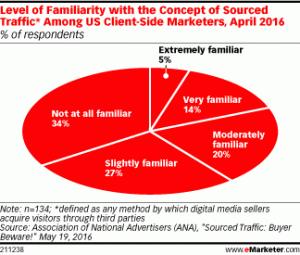
The bigger issue brings us right back to our old friend, fraud. A White Ops and ANA study of non-human traffic from 2014 found that while a direct audience is mostly human, sourced traffic is almost 90% attributable to bots. eMarketer reported this the other day about an ANA study:

According to the data, 34% of respondents—also ANA members—said they were not at all familiar with sourced traffic. Meanwhile, 19% said they were very or extremely familiar. But perhaps more interestingly, the majority (54%) of those surveyed, said weren’t sure if any of their digital media buys included some form of traffic sourcing.

And we wonder why digital doesn’t receive as much weight in media buying as the audiences warrant?  All players – publishers, buyers, and clients – need to step up their game here and fix the sourced traffic problem.  Otherwise, who is going to want to eat in this restaurant?

Leave a comment

Filed under digital media, Huh?