Tag Archives: Television

The Early Warning System Is Going Off

There’s always a scene in movies about some epic disaster during which an early warning system goes off.  A young scientist believes a comet will hit the Earth but the older scientists tell him he’s nuts.  A tsunami monitor goes off when there are calm seas and the woman watching it disregards the information.  You know the drill.  As the audience, we know that disaster is coming but those who have the information are blissfully unaware until disaster strikes.millennials-broadcast

I thought of that as I read a couple of articles the other day.  The first is from the good folks at Poynter who reported on some research the NY Times did.  Quite an eye-catching headline:

Thirty-four percent of millennials surveyed watch mostly online video or no broadcast television, new research from The New York Times says.

Now granted, the study was among 4,000 current users of online video so one could argue, like the woman watching the calm sea, that the sample is skewed.  The again, given the high percentage of young folks that are online video watchers, I’d listen.  After all, cord cutting is no longer dismissed as the rantings of some early adopter lunatics.  There are numbers that prove it’s for real, especially since we’re not talking about “cord-nevers” – young people who never had cable TV – just a broadband connection for streaming.  As one report had it:

While 3.2 million new U.S. households were set up in the last three years, the paid-TV industry only added 250,000 subscriptions in that same period.

Not so good.  And if that’s not a loud enough alarm, here comes the near-miss fireball from out of the sky that gets everyone’s attention, courtesy of our neighbors in the Great White North:

The Canadian government will soon require cable and satellite television providers to make it easier for customers to buy only the channels they want rather than pay for bundles, the country’s industry minister said on Sunday.

“We don’t think it’s right for Canadians to have to pay for bundled television channels that they don’t watch. We want to unbundle television channels and allow Canadians to pick and pay the specific television channels that they want”

Sound familiar?  It should, since it’s the same fight that’s been brewing here for several years and which intensifies each time your cable or satellite bill goes up.  Cable executive are rightly scared that their penetration into the household base will fall, making subscriber revenues drop and ad sales impossible.

Young people tuning out in droves.  The fundamental business model under attack.  Have we reached the end of the TV world?  Not yet.  But in my mind the early warning systems are howling.  What do you think?

Enhanced by Zemanta

1 Comment

Filed under digital media, Reality checks

Headlines And Half Empty

Part of how we approach business – and life, for that matter – is the spin we choose to put on things.  Some of how we make up our own minds is from the words others use to describe things.  For example, if I won the lottery, the headline might be “Man Wins Lottery, Set For Life.”  The headline could also be “Man Hit With Enormous Unexpected Tax Bill, Owes Millions.”  Far fetched?1379508733538

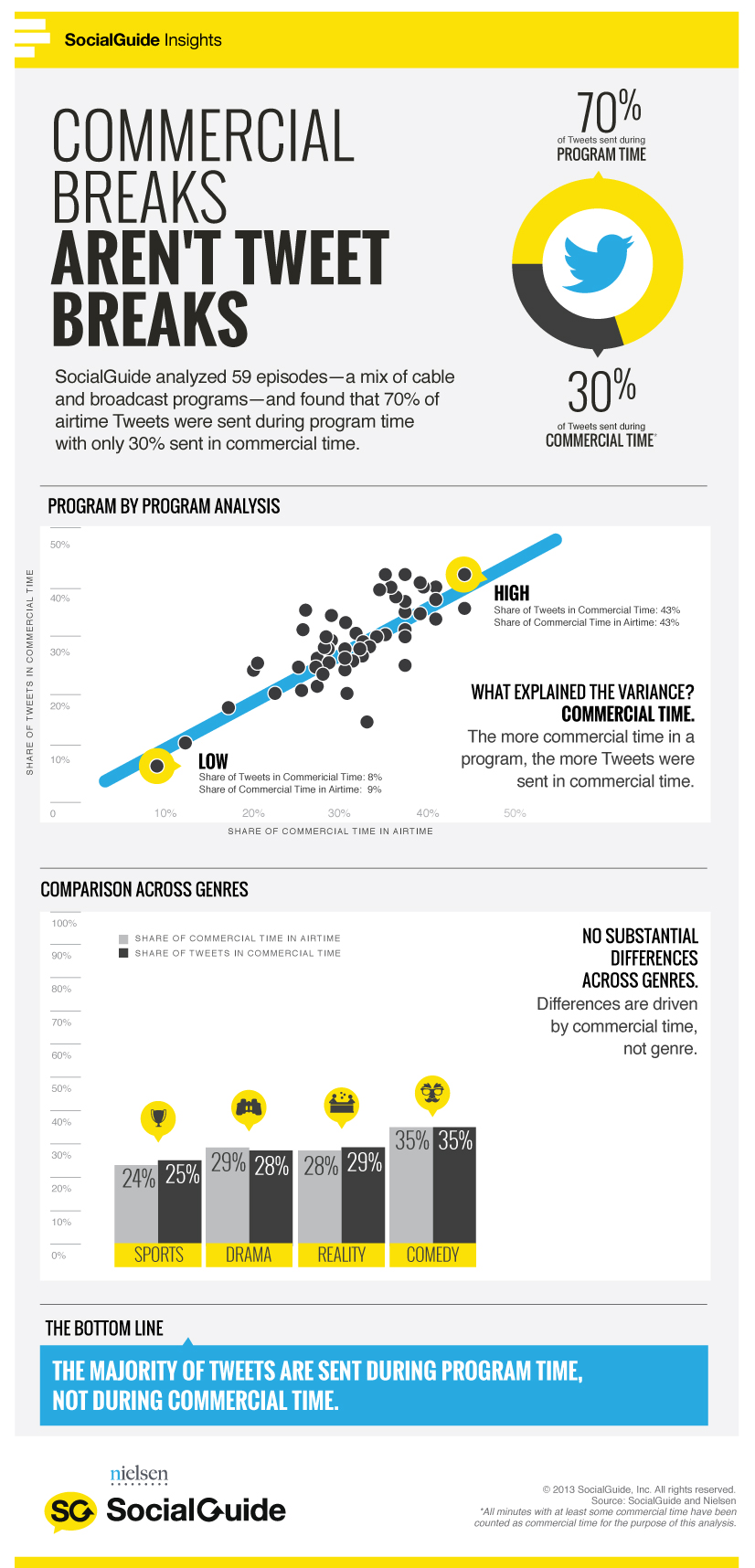
Let’s take how a single publication handled the reporting of one piece of information in two different articles.  I should state upfront that I have no issue with either of these headlines nor with the articles.  I’m using them to illustrate a point.  The publication is MediaPost, and I read almost a dozen of their newsletters each day – they provide great information.  The story was a study Nielsen did on viewers using Twitter while they’re watching TV.  You can read Nielsen’s own release on the topic by clicking through on this link.  You might be able to tell from the graphic how Nielsen portrayed their findings.

On to the two articles.  One was headlined “Tweeting Doesn’t Spike During Commercials” while the other stated “TV Viewers Use Twitter During Ads.” Same study, same publication, same day.  A quick glance at the headlines might make you think that viewers don’t break away during commercial breaks; the other might lead you to believe the opposite.  One article says

Good news for TV programmers: TV viewers use Twitter during their TV programming — showing lots of engagement, according to analysts. The bad news? Many are also tweeting during commercials.

while the other says

The takeaway is that viewers using Twitter as a second-screen platform are tweeting consistently throughout the airtime for programming and ads alike. TV advertisers might still prefer that viewers’ attention was fixed on the larger screen during breaks, but it’s not as if they signal the start of a tweeting blitz. All airtime is tweet time.

My point is that we always need to dig a little deeper into the facts before we draw conclusions and we should always get to the source material when we can.  In this case, the Nielsen study.  In other cases a sales report, a deal memo, or other things about which we often learn from others who will bring their own point of view as they report the “facts.”   Needless to say, the principle applies outside of the business world as well.

Make sense?

Enhanced by Zemanta

Leave a comment

Filed under Helpful Hints, Reality checks

Fading To Black?

Over the last couple of years I’ve written about cord-cutting and today I have another update of sorts.  As you know, this refers to people disconnecting from a “traditional” video provider such as a cable or satellite service and using only content delivered to the via “over-the-top” services – things that sit on top of a broadband connection.  These are services such as Netflix, Hulu, Amazon Video, and others.

Here is what caught my eye:

Thirteen of largest multichannel video providers in the U.S. — about 94% of the market (94.6 million subscribers) — lost about 345,000 net additional video subscribers in 2Q 2013 — down 0.4%, according to the Durham, N.H.-based Leichtman Research Group…The top nine cable companies lost about 555,000 video subscribers in second-quarter 2013, compared to a loss of about 540,000 subscribers in the second quarter of 2012…Bruce Leichtman, president and principal analyst for Leichtman Research Group, stated: “The multichannel video industry has leveled off, with major providers losing about 0.1% of all subscribers over the past year.”

OK, so not exactly a massive disconnect.  On the other hand, the trend is accelerating by most accounts, especially among younger people.  Now let’s think about the ongoing battle between Time Warner Cable and CBS.  No matter which side you’re on, it gives people the opportunity to seek alternatives, at least with respect to CBS and Showtime programming.  Once they figure out that much of the content is available elsewhere, cutting the cord becomes more viable.

Another anecdote.  This past weekend, I wanted to watch the Solheim Cup golf matches.  The place in which we were staying didn’t get the network carrying the matches and the live streaming via YouTube was not available in the US.  Solution?  I watched on a proxy server in Europe.  Not some sort of illegal torrent – simply a proxy server so they thought I was in France.  For those of us who are a bit more technically minded (and I think anyone under 30 fits the bill), this is a form of cord cutting behavior and negates the need for anything more that a high-speed connection to watch what I want on my own schedule.

Finally, some more research from STRATA shows that none of this is going unnoticed by the marketing community:

Focus on television advertising has hit a three-year low as the gap between TV and digital narrowed to its closest point ever, according to the most recent quarterly survey compiled by STRATA…TV advertising still remains the top advertising medium with 44% of survey respondents saying they are more interested in advertising on TV (spot TV/cable) than any other medium. While TV is still number one, this represents the lowest level of broadcast advertising interest seen in the STRATA quarterly survey in nearly three years. Gaining steadily on TV, digital is the second most popular medium at 35%…28% feel they will have a greater spend in Digital than Traditional in 1-3 years. 27% say they don’t ever anticipate a greater spend in Digital (down 45% and the lowest percentage ever).

Ad spending is a big part of the fuel that drives these businesses (and the Time Warner/CBS dispute points out the relatively new other piece – transmission fees).  If that piece shrinks, along with viewers and subscribers, the industry is in big trouble.  As the Chinese say, “interesting times”.

Your take?

Enhanced by Zemanta

Leave a comment

Filed under digital media, Reality checks, What's Going On