Tag Archives: social media

Ignoring 9 Out Of 10

I realize I’ve spent the first couple of posts this week on the topic of companies being less than responsive to customers. I was chatting about this with someone yesterday and they asked me if I really thought the two cases I cited were the norm.  After all, he said, how can companies really expect this kind of behavior to remain quiet when every person is a publisher?
Sprout Social

Sprout Social

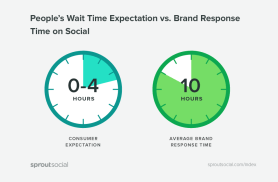
Precisely my point, but since when does common sense prevail?  In fact, companies are getting worse at being responsive.  Maybe it’s just the increase in volume, maybe it’s the ease with which customers can reach out, but the common sense solution of staffing up and training to handle the increased load is nowhere to be found.  Since we believe in fact-based statements here, these facts are from Sprout Social:

90% of people surveyed have used social in some way to communicate directly with a brand. What’s more, social surpasses phone and email as the first place most people turn when they have a problem or issue with a product or service, according to Sprout’s consumer survey. Following this trend, The Sprout Index shows that the number of social messages needing a response from a brand has increased by 18%over the past year. In spite of the high volume of messages that require a response, brands reply to just 11% of people (a number that’s been stuck in neutral since 2015).

11%, meaning brands are ignoring 89% of the messages sent to them as consumers reach out. I guess they’re too busy misusing social media and other responsive channels as megaphones (so 1995) since the research found that brands send promotional messages out 23 times as often as they respond to a customer message. It’s not just social that requires our attention.  August 2015 research from Nice Systems and Boston Consulting Group (BCG) found that internet users in major metro areas worldwide used an average of 5.6 customer service channels.

I can hear you rubbing your temples as the headache comes on.  How will you support your customers in those places when you might be ignoring 9 out of 10 customer interactions now?  Beats me, but the question needs to be answered, and the organizations that do so will be the ones that win.  Make sense?


Leave a comment

Filed under Consulting, Huh?

Home Base

I had a potential client ask me if having a website was still a big deal or if it was a good strategy to use the plethora of platforms to engage with consumers. I have a strong feeling about that, and it’s that digital homelessness is a really bad idea. Let me explain why.

I’ll deal with facts before I get into my opinion (as I’ve encouraged you folks to do many times here on the screed). Let me quote from a Digiday article of last November:

Referral traffic (desktop + mobile) to the top 30 Facebook publishers…plunged 32 percent from January to October, according to SimpleReach, a distribution analytics company. The more reliant the publisher on Facebook, the bigger the hit: Among the top 10, the drop was a steeper 42.7 percent.

Those results line up with those from social traffic tracker SimilarWeb. It found that The Huffington Post’s Facebook traffic fell 60.1 percent, Fox News’ dropped 48.2 percent, and BuzzFeed’s Facebook visits fell 40.8 percent. Across all 50, the biggest drop in traffic in the period took place from January to February, when publishers’ Facebook traffic fell an average of 75 percent. There was a smaller but also significant drop from March to April.

Maybe it was an algorithm shift, maybe it was that the publishers weren’t offering content that was click-worthy.  That proves my point – you can’t know.  If it was the former, you’re at the mercy of a gatekeeper.  I’m not singling out Facebook – Instagram just went to an algorithmically determined feed, as has Twitter.  The point is that without a home base you are at their mercy.  Why?  Because you can’t market for yourself.  “Like Us On Facebook” does a world of good for Facebook and little for you, in my opinion, because while a consumer might like you, they might never see you.

Yes, you can buy ads on any of the aforementioned platforms to drive traffic.  Is that any different from buying search ads?  I think it is.  Search is targeted differently and can be better integrate with site analytics than can any outside platforms.  Putting that aside, with so much in our business lives out of our control, why would we give up anything that can be completely ours?  Having a well-designed and maintained website – a home base on the web – is one of those things.  That’s how I see it.  You?

Leave a comment

Filed under Consulting, digital media, Thinking Aloud

A Thought About Budgeting

Where are you in your annual planning cycle?  The end of March always seemed to be a time when I would have to begin looking at marketing budgets for the upcoming fiscal, so I had a thought you might want to keep in the back of your mind if you’re entering the process now.  It will be worth thinking about if you plan later on as well.

This is a "thought bubble". It is an...

(Photo credit: Wikipedia)

Many of us spend a lot of time looking at the plethora of marketing channels available to us.  Mass media such as TV, more personalized media such as social, and very specific, time-based media such as search tend to dominate our thinking.  That’s the pattern I see with many of my clients at least, and it might be where you are as well.  It’s probably misguided thinking, however.  The reality is that how our customers want us to communicate with them is via email:

MarketingSherpa commissioned an online survey that was fielded August 20-24, 2015 with a nationally representative sample of U.S. consumers. We asked consumers, “In which of the following ways, if any, would you prefer to receive regular updates and promotions from companies that you are interested in doing business with? Please select all that apply.”

After summing up the numbers of consumers who prefer email at a frequency chosen by themselves and email at a frequency set by brand, email emerges as the most preferred way to receive updates and promotions (60%). Notably, subscribing to receive emails at a frequency consumers choose is twice as popular (49%) as subscribing to receive email at a company’s pre-determined frequency (24%).  Email is perhaps unexpectedly followed by snail mail (49%), leaving visiting the company’s website in third place (38%).

In other words, we need to stop thinking in terms of what’s new or what’s sexy and focus on our customers’ wishes.  While you’re spending your time trying to get them to follow you on social media (where the algorithms of the services will probably hide your message anyway), your customers are reading something meaningful.  You should be spending your time – and resources – on re-engaging your email database, building up open and response rates, not blasting out messages that fall on deaf ears.

Something to think about?

Leave a comment

Filed under Consulting, digital media, Helpful Hints