Tag Archives: Social media marketing

Why Can’t You Yell Fire?

I think we all know that you can’t yell “fire” in a crowded movie theater. It will cause a panic and someone will get hurt. At a minimum, the odds are that someone will also call in a false alarm that distracts the fire department. That is a common-sense limit to free speech. Almost 100 years ago the Supreme Court said that the First Amendment, though it protects freedom of expression, does not protect dangerous speech.

I thought of that the other day when Google and Facebook announced that they would take what I think is a great first step in purging themselves of fake news by cutting off the access those sites have to revenue-generating or promotional ads. As Reuters reported:

Google said it is working on a policy change to prevent websites that misrepresent content from using its AdSense advertising network, while Facebook updated its advertising policies to spell out that its ban on deceptive and misleading content applies to fake news.

As someone who is devoted to the First Amendment, you might wonder why I’m OK with what seem to be limits on free speech. Fake news – or outright lies – are a big source of the divisive atmosphere most of us recognize exists in our country. They’re not hate speech, which I’m actually OK with because it’s so obviously slanted. They’re worse because they wrap themselves in a cloak of truth. As we’ve discussed here many times before, many people – both in business and out – don’t bother to do the research to find out if what’s being presented to them in factual. The presence of these sites and their fabricated BS makes a very difficult search even more so. No, the Pope didn’t endorse Donald Trump and yet 100,000 people shared that story as if His Holiness did.

By removing the financial incentive to create and promulgate this crap, Facebook and Google are taking a positive step in helping those of us who want to make decisions based on factual material. It’s not censorship; it’s arresting the idiot who’s yelling “fire” for a profit. Hopefully, the next step is some method to annotate and fact check the sites that remain. I also see that Twitter is suspending the accounts of some alt-right leaders.:

In a statement, Twitter said: “The Twitter Rules prohibit targeted abuse and harassment, and we will suspend accounts that violate this policy.”

There is no question that Twitter has become a bit of a cesspool and they certainly need to take some actions that clean up the rampant trolling and harassment that goes on. This, however, doesn’t sit as well with me since it starts down the slippery slope of censorship. The difference is my mind is that the fake news folks are making stuff up for profit while the hate groups are expressing (in theory) their own beliefs, however misguided.

Interesting times, aren’t they?

Leave a comment

Filed under Huh?, Reality checks

How To Stay Engaged With Your Consumers

OK, so you buy into my thinking on the need to stay engaged with your customers and potential customers in a meaningful way. Now what? That’s a question my clients and I face all the time so let me share a few things we’ve done to promote that engagement. Feel free to borrow!

The first and most obvious thing you can do is to support listening via social media channels. If you haven’t set up a listening dashboard, I’d make that a top priority. Hootsuite is a good place to start, and it can also be useful in populating those channels with content. There are plenty of other tools out there for listening, but listening and responding when appropriate is what we’re after.

Part of what we’re after is to become a friendly subject matter expert in the eyes of consumers. There are plenty of channels in which to do so, but what’s important is that you not try to be in every single one. Unless you have a support staff of a dozen people, you’re going to have to pick the channel that is most meaningful to your customers and focus your efforts there. My guess is that it will be Twitter since it’s the most interactive.

Next would be a decision about some longer form content. This might be on your own website, a blog, maybe a post on LinkedIn or Medium. Try them all and see which drives traffic and engagement. Remember, there is no garbage can on the Internet so whatever you write for one platform is probably reusable on another.

What do you write about? Start with thinking about how many questions do customers ask you in a week. The answers to each one of those questions can serve as the basis for a post. Unless you’re a masochist like me, you needn’t write every day either. A couple of times a week is a lot for most folks. Write about your customers. Featuring a long-time purchaser rewards them and shows all the others that you’re grateful. Explain a common problem your customers have and how you’re solving it for them.

Ask yourself how you keep in touch with your best friends. Don’t treat consumers any differently and you’ll be on the road to a productive, engaged relationship. Make sense?

Leave a comment

Filed under Consulting, Helpful Hints

Quit Pushing Me

We discuss engagement in this space fairly often. I’ve made no bones about the fact that I’m a believer in The Cluetrain Manifesto and that markets are conversations. Think about a conversation you’d have at a bar or a party. You would listen at least as much as you spoke and you probably wouldn’t keep tossing random lines at people, especially if those lines are only about you. Now let’s look at a piece of research.

According to The Future of Content: Rethinking Content Consumption, a national survey report, consumers want to discover digital content on their own and are skeptical of brands pushing online ads through interruptive channels. Rapt Media, recently surveyed an audience of more than 1,000 consumers to understand how content discovery is driving the content personalization trend.

Insights reveal consumers want personalized content experiences that are meaningful, helpful and valuable to their specific needs and interests. But equally important is their empowerment in discovering it on their own. The younger millennial generation is especially mistrusting of brands pushing interruptive online ads.

Key findings from the survey include:

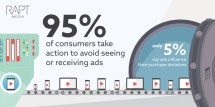
● 95% take action to avoid seeing or receiving online ads
● 5% say ads influence their purchase decisions
● 57% of millennials block ad content because it is too pushy
● 43% say online ads are not personalized to their interests, but 62% say the content they discover on their own is personalized
● 61% say that even if content is customized, they still prefer to find it on their own
● 46% say content they find on their own influences their purchase decisions

I especially like this quote: “Programmatic push messaging is implicit personalization perceived by consumers as irrelevant and inauthentic.” Yep. The findings confirm that consumers have come to expect content personalization along with the opportunity to shape their own experience, so why are we spending time and resources on doing anything that delivers an experience other than that? Maybe we need to make our business behavior more like our cocktail party behavior (and who has ever pondered THAT before?)?

Leave a comment

Filed under Consulting, Helpful Hints