Tag Archives: Nielsen

Can You Trust Your Customers?

It’s not news to any of you who are paying attention to media but we’re at a tipping point.

1898 advertising poster

(Photo credit: Wikipedia)

The cracks in the traditional patterns of media consumption have widened to a point where the foundations of those patterns are falling down. Need proof? How about this morning’s piece is the Wall Street Journal:

Hopes that TV advertising will rebound this fall are beginning to dim. TV networks have been banking on a surge in ad spending in coming weeks, ever since an anemic second quarter reported by media companies and a weaker-than-expected “upfront” advance ad-sales market for the new season. The new season doesn’t kick off until next week but already sentiment is starting to change. On Monday, Jeffries analyst John Janedis lowered his estimates for advertising revenue growth in the second half of the year for most of the biggest media companies

Or this from Kantar Media:

“Four of the nation’s five biggest advertisers,” including Procter & Gamble and AT&T, “cut ad spending on traditional media and online display in the first half of the year.”

So now what?

Millennials spend 30 percent of their time with content created by their peers. This means they’re spending more time with peer-created content than traditional media combined (print, TV, and radio).  Nielsen’s most recent study indicates that Americans aged 18-24 watched a weekly average of 19 hours of traditional TV during Q2 2014. That was a substantial 2-and-a-half-hour drop-off from Q2 2013, which in turn had been down by an hour from the year before.  Spending more heavily in those channels isn’t going to happen.  The impact of most digital display is negligible.  Where is the light at the end of the tunnel?

The answer might just be in the audience itself.  Putting consumers and their messages about the brand front and center – probably through social channels – might just be the way forward.  That’s where is the audience is spending time and the messages are from trusted sources.  As Nielsen found:

Word-of-mouth recommendations from friends and family, often referred to as earned advertising, are still the most influential, as 84 percent of global respondents across 58 countries to the Nielsen online survey said this source was the most trustworthy

The real question is do you trust your consumers enough to hand over your brand?  Can you get on board with them creating content that you’ll push for them?  Are you willing to provide tools – images, logos, whatever – or to promote the products that consumers choose, not those slated for promotion in the marketing plan?

Interesting times.  What’s your take?

Leave a comment

Filed under Consulting, digital media, Reality checks

Where Are The Kids?

Suppose you produce something that is widely consumed.

Braun TV

(Photo credit: Wikipedia)

One day you notice that your customer base is getting older in composition. “Duh,” you’re saying – people age. Of course, but if there continues to be an influx of newer and younger consumers, and if product usage remains steady in the younger segments, there isn’t a problem.

So you do a little digging and find out that use of your product by younger people has dropped off. In fact, use among 18-24 year olds is declining at a fairly rapid pace and over the last 3 years it’s down 18%. What now?

This isn’t a hypothetical case.  Welcome to the world of television.  Nielsen put out their quarterly viewing report and here is how one post summed up the results:

In the space of 3 years, Q1 TV viewing by 18-24-year-olds dropped by a little more than 4-and-a-half hours per week. That’s equivalent to roughly 40 minutes per day, says the report. In percentage terms, traditional TV viewing among 18-24-year-olds in Q1 2014 was down by almost 7% year-over-year. Between Q1 2011 and Q1 2014, weekly viewing fell by almost 18%.

I suspect that if you took sports out of the mix the declines would be even larger.  The younger segments haven’t stopped consuming some of the content but they do so using on-demand video both on the traditional TV screen and alternate screens such as their phones, tablets, and computers.  They’re also off playing games and watching others do the same.

I recognize that the TV business in which I grew up is dead.  How can you sell audiences that don’t exist?  Without the dual revenue stream of payments from cable and satellite operators for the programming I suspect we would have seen some TV companies go dark.  Interesting times just keep getting more interesting in the media business (he said echoing the old Chinese curse).  What’s your take?

Leave a comment

Filed under What's Going On

Headlines And Half Empty

Part of how we approach business – and life, for that matter – is the spin we choose to put on things.  Some of how we make up our own minds is from the words others use to describe things.  For example, if I won the lottery, the headline might be “Man Wins Lottery, Set For Life.”  The headline could also be “Man Hit With Enormous Unexpected Tax Bill, Owes Millions.”  Far fetched?1379508733538

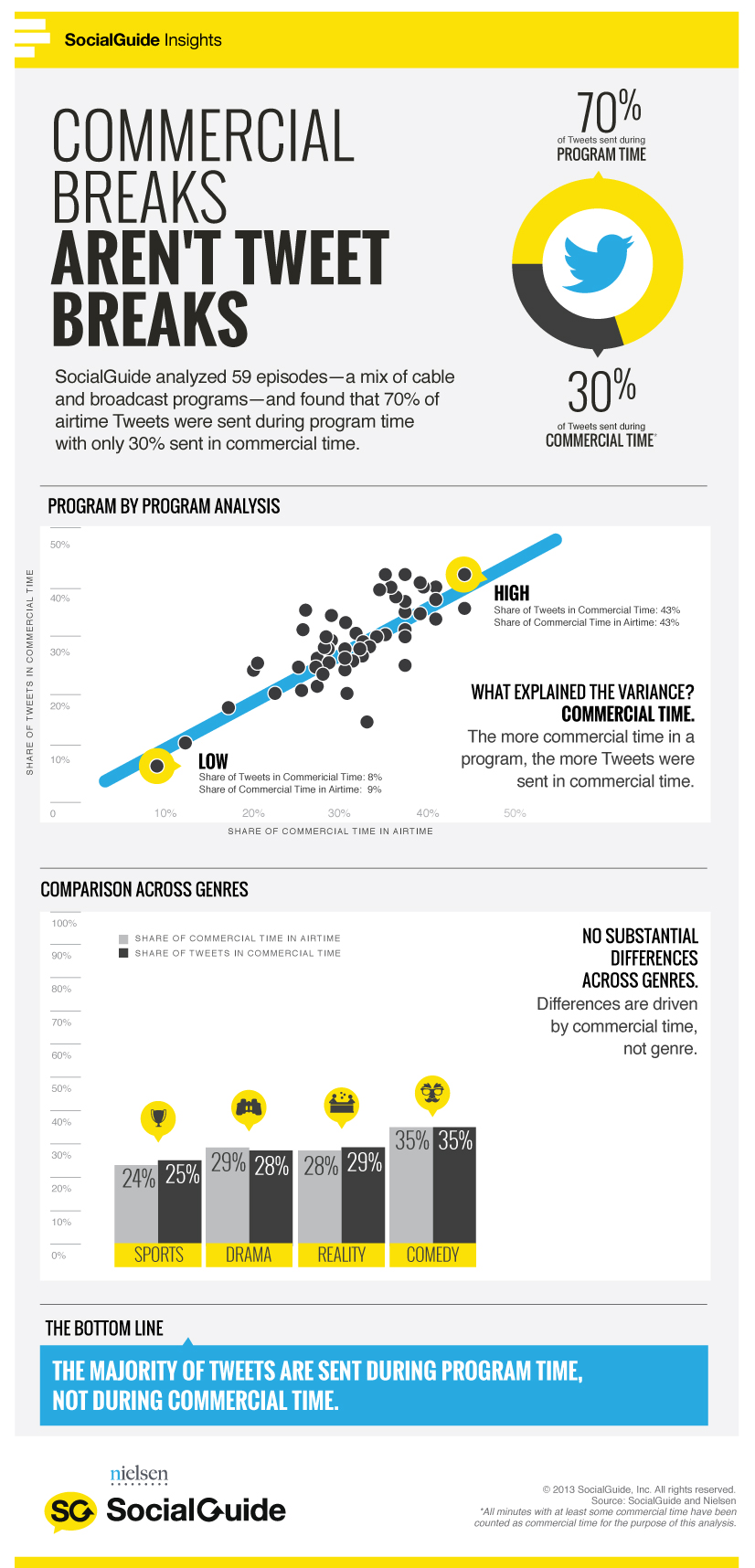
Let’s take how a single publication handled the reporting of one piece of information in two different articles.  I should state upfront that I have no issue with either of these headlines nor with the articles.  I’m using them to illustrate a point.  The publication is MediaPost, and I read almost a dozen of their newsletters each day – they provide great information.  The story was a study Nielsen did on viewers using Twitter while they’re watching TV.  You can read Nielsen’s own release on the topic by clicking through on this link.  You might be able to tell from the graphic how Nielsen portrayed their findings.

On to the two articles.  One was headlined “Tweeting Doesn’t Spike During Commercials” while the other stated “TV Viewers Use Twitter During Ads.” Same study, same publication, same day.  A quick glance at the headlines might make you think that viewers don’t break away during commercial breaks; the other might lead you to believe the opposite.  One article says

Good news for TV programmers: TV viewers use Twitter during their TV programming — showing lots of engagement, according to analysts. The bad news? Many are also tweeting during commercials.

while the other says

The takeaway is that viewers using Twitter as a second-screen platform are tweeting consistently throughout the airtime for programming and ads alike. TV advertisers might still prefer that viewers’ attention was fixed on the larger screen during breaks, but it’s not as if they signal the start of a tweeting blitz. All airtime is tweet time.

My point is that we always need to dig a little deeper into the facts before we draw conclusions and we should always get to the source material when we can.  In this case, the Nielsen study.  In other cases a sales report, a deal memo, or other things about which we often learn from others who will bring their own point of view as they report the “facts.”   Needless to say, the principle applies outside of the business world as well.

Make sense?

Enhanced by Zemanta

Leave a comment

Filed under Helpful Hints, Reality checks