Never Never Land

I paid my cable TV bill the other day.  It’s a lot of money each month but the fact that the amount also covers my high-speed internet access and office phone mitigates the expenditure, I guess.  I know my kids don’t see it the same way, and from a lot of the numbers that researchers are reporting, neither do their peers. 

Consumers are shutting off their cable and satellite TV connections in droves.  Nearly half a million subscribers did so in the second quarter, according to the folks at  Leichtman Research Group Inc.  The cable guys will tell you that it’s really a drop in the bucket and they’re right.  49 million folks still have those cable connections and another 34 million have satellite dishes.  So what’s the big to-do?  Those drops have the potential to run into a flood if you look inside the numbers and at how people are watching as well.

Take a look at some information put forward by the Forrester folks in their recent study of cord-nevers.  As explained by this piece in Digital Trends:

Based on a recent survey of 32,000 adults conducted by data analysis firm Forrester Research, roughly 18 percent of Americans have never actually subscribed to premium TV service through a cable or satellite company. While the majority of those respondents were at least age 32 and over, about seven percent of ‘cord-never’ Americans are between the ages of 18 and 31; a prime marketing demographic for advertisers.

Furthermore, the growth rate of cord-nevers suggests that roughly 50 percent of Americans under the age of 32 will have never subscribed to a premium TV service by the time we reach 2025. That’s a massive segment of the population that will be turning to digital delivery services rather than calling up their local cable company for a stack of set-top boxes and a hefty monthly bill.

I’ve stated before that I believe the TV distributors we have will trade the program pipes they have today for internet pipes tomorrow.  Rather than spending money paying fees to the program distributors, they’d be far better served spending the money to upgrade their pipes and building better connections to move video to their subscribers.  While today’s college kids (and tomorrow’s consumers) don’t know a world without high-speed internet access, as cord-nevers they won’t miss the cable subscription.  They might also just be the customers today’s marketers think have gone missing unless they rethink their use of traditional TV.

Cable and satellite subscriptions aren’t going away any time soon, but the one size fits all bundle of program services is.  It will have to in order to retain the consumers who now program their own viewing.  With a minority of viewing to entertainment programs happening live, the operative word will be choice and control.  Consumers expect that along with their monthly bill, and it will be interesting to see if the cable and satellite guys are listening.

Leave a comment

Filed under Consulting, digital media

Myth Busting

When my brother was born, I’m told that he was to be named Mickey. Upon being informed of this, my response was “don’t be silly – Mickey is on television.” The “Mickey” in question, of course, was Mickey Mouse, and I was an avid viewer of his afternoon club. TV Mickey was very real to me. Brother Mickey was renamed Michael. 

I’m sharing that story because it speaks to the power of myths that have become real. You might think that business is the last place we would find such things, but you’d be wrong. Most prominent in my mind, of course, is the shared myth that drives billions of dollars of media spending: Nielsen ratings. Putting aside the obvious issues with sample error and lack of reporting from out of home viewing, read any ratings book and Nielsen will tell you that what’s inside is only accurate within certain limits. They are a shared myth, one that allows both sides of the advertising transaction to negotiate against some standard, even if it’s dead wrong.

The ratings field is instructive because some folks finally decided to challenge the myth by providing another, more accurate look at audiences. It’s having a double effect – Nielsen is improving their service and there is a second “currency” that can be used in negotiating ad placements (sometimes you would rather buy in Swiss Francs than dollars). Someone challenged the myth and both they and business is better for them having done so.

Another example: a taxi medallion in NYC is worth lots of money. Uber challenged the myth by making every car owner a potential taxi service, and Google and others are challenging it even further by negating the need for drivers at all. Until recently, a car needing a driver was a shared myth, and when we can simply call for a driverless car, day or night (no drivers means no sleep needed!), the nature of car ownership changes as well. How will car dealers and resellers be impacted in 20 years? I suspect the myth of fossil fuels will be blown up in the next decade too.

The point is this. Nodding one’s head at myths that have the force of reality instead of seeing them for what they are can impede progress and obscure opportunity.  Sometimes the emperor really is naked and you need to be that kid saying so.  It won’t make you popular, but it just might make you very profitable.  Any myth busters out there?

Leave a comment

Filed under Thinking Aloud

Let’s Cure This Epidemic

I had another topic on my mind this morning, but I’m going to go on a rant about carelessness instead. I’m sure that many of you read as many, if not more, articles and emails as I do. Have you noticed that we are in the midst of an epidemic of carelessness? I don’t mean with the “facts” many writers pass off as gospel. I’m talking about something far more basic: spelling and grammar.

I know English is a difficult language, even for those of us who are native speakers. Spelling, however, isn’t. Of course, one needs to take the time to check not just the spelling of a word but also if the correct homonym is being used. It’s not just individuals either. I see lots of corporate “content” that contains errors of the same sort. Social media, white papers, blogs and tweets are overrun with misused and misspelled words.  As a former broadcaster, I wince at every graphic that contains a typo.  You just know that more than one person looked at it (or should have) before the error ever saw the light of day.

I hope it’s carelessness and not ignorance. I’m pretty sure it is – what politician would spell “education” as “edutation” or “America” as “Amercia” out of anything other than carelessness? That carelessness makes me think you’re careless about everything, including how you will protect my data, my credit card information, and how you will service your customers.  I’m fed up with “it’s” being used as a possessive (it’s a contraction!).  I hate “your” preceding “welcome” (it should be a contraction – you’re!).

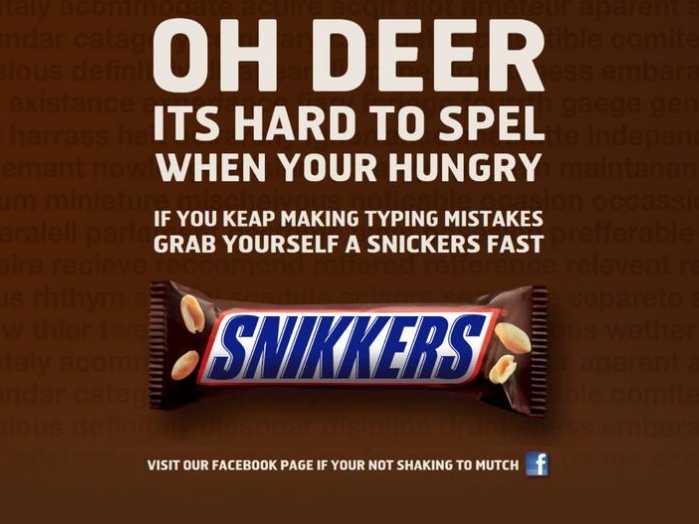
I admit to being an optimist, so I’m assuming we’re not all just idiots.  Most of us feel a time crunch and sometimes rush to meet a deadline.  It’s not a new sickness, as you can see from the clever 2013 Snickers ad, but it’s time we cured it.  Let’s be careful out there!

1 Comment

Filed under Huh?, Reality checks, Thinking Aloud