Bursting The Bubble

Would you buy from you? Knowing what you know about your product/service and the team behind it, would you invest your hard earned capital in your company? Hopefully, the answer is yes, and it’s just as important that your response is based on real-world experience and not some vision you conjured up of your business as seen through a Vaseline-coated lens.
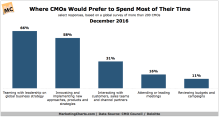
I raise this today because I read the chart you can see over there which summarizes the results of a study as reported by Marketing Charts. 200 Chief Marketing Officers were asked, by the CMO Council and Deloitte, how they prefer to spend their time:

When respondents were asked where they would prefer to spend their time as marketing leaders, a leading two-thirds said they’d rather team with leadership on global business strategy (66%), while a majority would also want to innovate and implement new approaches, products, and strategies (58%). Just 1 in 6 would prefer to spend their time in meetings and only 1 in 10 would want to review budgets and campaigns.

How this relates to the question I asked initially is simple. My questions put you in the position of the consumer. They imply that you’ve actually used your product or service and have done so as a consumer would (sort of like a secret shopper). The survey responses feel to me as if the CMO’s would prefer to live in a bubble, dreaming up new strategies and products while not particularly wanting to get their hands dirty in the real world activity of listening to customers.

You might wonder how any CMO can strategize without keeping the customer front and center. What’s interesting is that only 6% report that they are tasked with driving routes to revenue across all facets of the business globally. That reads like life in a bubble to me.

Each of us needs to burst whatever bubbles keep us away from our markets and our customers. Planning new products is fine but they can’t be solutions to problems that don’t exist or for which there won’t be demand once consumers realize they have a need (and hopefully they already do). You with me?

Leave a comment

Filed under Huh?, Reality checks

Hashing It All Out

This Foodie Friday, the subject is hash. Not the kind you smoke (although there are smokey kinds of hash made from leftover barbecue) but the kind you’d have for a hearty start to your day. The most common kind is hash made from corned beef, potatoes, and onions, but as with most food things, there are endless variations. Ever heard of red-flannel hash? It featured beets along with corned beef. Has your has ever been bound together with a white sauce? It may have been if you live in the mid-west. The aforementioned use of barbecue in southern hashes, the use of meats other than corned beef, and different types or preparations of potatoes can offer up nearly endless varieties of what is a very basic dish.

Corned beef hash at the Creamery (Nina's break...

(Photo credit: Wikipedia)

I’m a fan of crispy corned beef hash made with home fries and caramelized onions. Add a couple of poached eggs which will create an unctuous sauce when pierced and I’m in breakfast heaven. Unfortunately, many of us have been presented with a plate of “corned beef’ in a form that’s unrecognizable and that often prejudices our view of what can be an elevated experience with something quite humble. As it turns out, it happens in business too.

Every culture has a variation on hash. In each of those, the dish emerged from a desire to conserve resources and not waste food. At the same time, we all know it can be boring to eat the same thing over and over again. Hash (from the French word, hacher, to chop) is nothing more than transforming resources that might have been tossed aside into something new and wonderful.

That’s a great goal for any of us in business. Maybe a product or a project has become boring, both to you and to your customers. How can it become hash – something new and wonderful? Maybe a valuable employee has been in the same role for a while and the level of productivity is beginning to drop as boredom sets in. How can you and the employee make hash together out of the ingredients that made the employee great in the first place?

Ultimately, one reason I’m a fan of hash is that it takes things that might be tossed aside and makes them great again. Isn’t that a great goal for any of us in business?

1 Comment

Filed under food, Thinking Aloud

Fighting About Data

I think everyone knows that a lot of data is collected as we conduct our daily digital activities. Google and the other search engines know what we’re looking for, Amazon and other commerce sites know what we’re shopping for, Facebook knows what we like, LinkedIn knows who we know, etc., etc., etc. These data footprints are collected and in many cases sold to marketers and their agents to allow them to serve ads to you. If any of that comes as a shock to you, I’m not sure where you’ve been for the last decade or more.

What you might not have thought about, however, is that the ads themselves collect data. How many times has someone seen it? What kind of person (that pesky data that the aforementioned guys have) has responded to an ad, and how well do the ads translate to sales (lovingly called the conversion rate as if someone is changing religions…). As it turns out, there is a bit of a controversy about who actually owns that data: the advertiser or the agency. The marketers believe that they are the rightful owners while the agency folks believe just as strongly that they are. Neither side feels that the publishers who serve the ads and, therefore make data collection possible, have much of a claim to it. Of course, even publishers came out ahead of one other group as the rightful owners in the survey: consumers.

As you can see in the chart, only 10% of advertisers and 15% of agency respondents believed that consumers had a claim to their own information. That’s tragic. Why? Because it represents a mindset that is ultimately self-defeating. It can lead to legal problems at worst and consumers opting out (if they can figure out how) at best. What have the advertiser or the agency done to give the consumer value for the data? Nothing, in my mind. One could argue that the ads they serve make possible the content the consumer enjoys, but those very ads make that enjoyment nearly impossible given the state of ad-serving today, particular in mobile.

Unless and until we on the marketing side see the consumer as at least an equal partner in our business and not as a bunch of rubes or just as “data”, the problems with ad blocking, anti-spam rules, and other protective measures aren’t going to go away. What will go away are the people represented by the very data over which the agencies and marketers are fighting. You agree?

Leave a comment

Filed under Uncategorized