Category Archives: What’s Going On

Protecting Your Brand With Common Sense

The Olympic Games are almost upon us. Like most major sporting organizations, the Olympic Committee and the US Olympic Committee protect their commercial marks aggressively. That intellectual property is a huge piece of the value they sell to official sponsors and keeping non-sponsors from doing ambush marketing is a big part of any sports organization’s daily life. It becomes front and center during marquee events. 

Companies find ways around this enforcement, of course. You’ve probably seen dozens of ads about “The Big Game” every January. You know they reference The Super Bowl even though it’s never said, don’t you. It’s a term the NFL tried to protect but was unable to.  The USOC and IOC are just as aggressive about terminology ranging from the obvious (Olympics, Games, Medal, Rio) to the less obvious (Effort, Performance, Challenge).

Today isn’t about whether that’s a good thing or a bad thing. Having spent much of my career selling and protecting commercial sponsorships of sporting events, you can imagine where I come out on ambushing. I do, however, have a bone to pick from the other side of my career, which is digital. I think it’s instructive for all of us.

Social media is social. Sharable. A conversation. More importantly, social media has become how many people learn and stay in touch with what’s going on in the world. Not in the USOC’s eyes, apparently. They sent a letter out last week which reinforces all of the aforementioned commercial restrictions around the upcoming games, especially with respect to athletes who may be sponsored by non-USOC or Olympic sponsors. But the letter went further.

“Commercial entities may not post about the Trials or Games on their corporate social media accounts. This restriction includes the use of USOC’s trademarks in hashtags such as #Rio2016 or #TeamUSA.”

It doesn’t stop there. The same letter sent by the USOC reminds companies (except for those involved in news media) that they can’t reference any Olympic results or share or repost anything from the official Olympic account. I think that’s pretty far over the foul line. Social media by definition is meant to be circulated and almost any sponsor will mention “going viral” as one of their goals. How can you tweet or mention anything about the games without using a tag that’s discoverable? Why wouldn’t you want broader attention drawn to your event if it’s not otherwise a commercial message? Yes, I understand (better than most!) how sponsors try to share the brand equity of the event without authorization, but if all they’re doing is retweeting your own post, how are they sharing brand equity?

Protecting intellectual property is one of the most important things any brand or business can do. There are limits, however, and that protection should hardly ever interfere with common sense and the world of social sharing. You certainly don’t want to be seen as a bully. Do you agree with that?

Leave a comment

Filed under sports business, What's Going On

Mass Markets And Mass Media

I’ve written a number of times over the last few years about the changing patterns of content consumption and how those changes are affecting the media business. I read some statistics last week that make me think we’re almost at the tipping point where we’ll see some irreversible things happening that affect not just media but marketing as well.

First, the statistics. The report is GfK‘s The Home Technology Monitor and while there wasn’t much “new” in it, the acceleration of some trends is interesting:

New findings from GfK show that US TV households are embracing alternatives to cable and satellite reception. Levels of broadcast-only reception and Internet-only video subscriptions have both risen over the past year, with fully one-quarter (25%) of all US TV households now going without cable and satellite reception. TV households with a resident between 18 and 34 years old are much more likely to be opting for alternatives to cable and satellite; 22% of these homes are using broadcast-only reception (versus 17% of all US households), and 13% are only watching an Internet service on their TV sets (versus 6% of all TV homes). Overall, 38% of 18-to-34 households rely on some kind of alternative TV reception or video source, versus 25% of all homes.

Why this is meaningful has to do with the symbiotic relationship between mass marketing and mass media. As Ben Thompson put it in a Stratechery post:

The inescapable reality is that TV advertisers are 20th-century companies: built for mass markets, not niches, for brick-and-mortar retailers, not e-commerce. These companies were built on TV, and TV was built on their advertisements, and while they are propping each other up for now, the decline of one will hasten the decline of the other.

As you can see from the chart, viewing of traditional TV by young people in the first quarter of this year (traditionally a high-viewing quarter as many people stay inside during winter) dropped precipitously. There aren’t many mass markets and there really aren’t mass media. Why, then, are we focused on measuring things that are no longer really relevant? Anyone?

1 Comment

Filed under digital media, What's Going On

Ali And Me

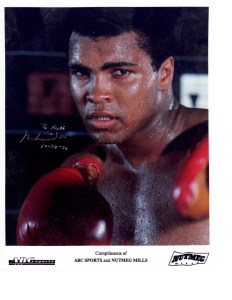
The passing of Muhammad Ali happened over the weekend. Another one of my boyhood idols gone, except this one was also a hero well into my later years. Those of you who know me in the offline world know that I’m rarely speechless but when I met Ali for the first time I found myself unable to utter even a single word for a few minutes. I was working at ABC Sports at the time and we had done a deal with Ali to license his name to a clothing line. He came to the office and the photo you see is the one he signed for me. I can still feel the man’s overwhelming aura.

Like most young sports fans of the late 60’s and early 70’s, I grew up watching Ali fight on free TV. I also watched as he stood up for his beliefs even at the expense of his career. We can argue about the Vietnam war or Ali’s commitment to nonviolence (odd for a boxer, perhaps) but there is no arguing about the man’s deeply held beliefs and his influence on society. The man was an artist in every sense and his legacy can be seen in nearly every modern athlete’s training and swagger.

I met Ali for the second time a few years later when I was at CBS Sports. Ali decided he wanted to come to the Final Four and even though he was now very visibly suffering from Parkinson’s, the brightness in his eyes hadn’t dimmed a bit. He hadn’t fought in a very long time and yet walking him through the dome where the games were taking place was like walking with Moses through the Red Sea. The crowd parted as “Ali, Ali” was whispered everywhere. I have walked through crowds with many other famous people.  No response was anything like the palpable adoration I felt the people had for Ali that evening.

Others have written about his influence on society as well as the large number of humanitarian acts he performed. I’d just like to add two things – what he taught me and what I think any business can learn from him. I learned when it’s wrong to keep quiet from him. Ali risked his name and his freedom to do what he felt was the right thing.  When he was vindicated, he continued his career but also continued to speak out and to do good works, not letting the adversity which had robbed him of the prime of his career to diminish his drive to be the best both in the ring and outside of it.  The final struggle of his life, Parkinson’s, which lasted for the last three decades also didn’t diminish his presence in the world nor his desire to help his fellow-man.

How many of us in business think the way Ali did?  How many of us speak up when we see wrongdoing?  How many of us use the bully pulpit of our business to change the world in a positive way for all of humanity and not just for our shareholders?  I’m quite aware that we have a responsibility to those shareholders but we also have a responsibility to our planet and the people who inhabit it, don’t we?   Maybe Ali’s memory can serve to inspire us to fulfill that responsibility.  He was the best in his business, winning the heavyweight title three times, but he was also the best in so many other ways.

Thanks, Champ.  You’ll be missed.

Leave a comment

Filed under Growing up, Thinking Aloud, What's Going On