Category Archives: Reality checks

No Good Deed…

English: McDonalds' sign in Harlem.

(Photo credit: Wikipedia)

Foodie Friday fun time, and this week it’s fast food. Oh, sorry – Quick Service Restaurants. No, this isn’t going to be a polemic on the horrors of what’s served in many of these places. Instead, I’d like to focus for a moment on what the category leader has announced and some of the responses to it.

I find it instructive and you might as well. You might be aware the McDonald’s is going to give away books as toys with their Happy Meals which are targeted to kids.  The books will replace the usual toy and I think giving away 20,000,000 books instead of a like number of toys is a good thing.  However, that’s where much of the positive energy stops.  As USA Today reported:

…this new series of four kids books is hardly comprised of Caldecott Medal winners. Rather, the four books are based on McDonald’s own animated animals, including a goat, ant, dodo bird and, yes, a dinosaur.

Now McDonald’s had given out books at least 15 times previously but this is the first time the books have been created by their ad agency.  The cynics would say that since the books try to tell the kids about healthy eating from characters associated with the McDonald’s brand, kids might think McDonald’s is healthy food.  NY Times food writer Mark Bittman asked this:

If McDonald’s wanted to be on the right side of history, it would announce something like this: ‘Starting tomorrow, we’re not offering soda with Happy Meals except by specific request. And starting Jan. 1, at every McDonald’s, we’ll be offering a small burger with a big salad for the price of a burger and fries to anyone who asks for it; we’re also adding a chopped salad McWrap. We challenge our competitors to follow us in making fast food as healthful as it is affordable, and we dare our critics to say we’re not changing.

What’s the business point?  We can’t say one thing and appear to do another.  Simple, right?  Maybe to say, but we have to examine the entirety of our activities – both marketing-based and otherwise – to make sure that our words and our actions are aligned.  There are many people who look at everything companies do with a cynical eye and they have the tools and platforms to make their feelings known.  Anything associated with making money is subject to that skeptical review and the above is a good demonstration of how our good intentions can be undercut.

Does that make sense?

Enhanced by Zemanta

Leave a comment

Filed under food, Reality checks

My Reunion – Part 2

Today is TunesDay and for our song today I’m using the tune I had as my quote under my senior picture from high school.  I’m going to use it as the jumping off point from which to finish yesterday’s thoughts about attending my 40th high school reunion.  The song – a very brief one – is Simon and Garfunkel‘s Bookends:

Time it was, and what a time it was, it was
A time of innocence, a time of confidences
Long ago, it must be, I have a photograph
Preserve your memories, they’re all that’s left you

Way back in 1973 this was music (from 1968!) that was a quiet reflection on old age and loss that was very much NOT on the minds of my generation at that time.  It sure was the other night as we read off and remembered the names of our classmates who had passed since we graduated.  It will probably take a lot longer to do so at the next reunion…

The song tells us to preserve our memories and as we discussed yesterday, technology has made that incredibly easy, as it has to do so in a collaborative way.  The hundreds of photos snapped Saturday are already all over Facebook and I’ve exchanged messages with some folks with whom I really didn’t get to spend enough time.  But there are some business points I thought about as well.

First, customers’ memories are being preserved.  More importantly, they’re out there for everyone to see so you want them to be really good memories.  Just as I was able to improve the quality of my exchanges with people I hadn’t seen but knew about from the web, customers coming to you will probably have expectations that are created in large part by the memories of others.

Second, the conversations at this reunion were different.  Most of us were parents at the last one; now some of us are grandparents.  While we used to talk about our new jobs and our aspirations, the conversations now turned to  other topics:  health and retirement being among the top ones.  Your relationship with your customers changes over time as well, so the manner in which you interact as well as the nature of the conversation needs to morph.

I had a few other thoughts but I want to leave you with this one.  Some of the people I saw over the weekend were close friends then.  Some were people I barely knew and rarely spoke with outside of a classroom.  A very few were even people I didn’t particularly like back then.  Now, my close friends are closer and the other crap is long forgotten.  The 100 people in the room Saturday night had way more in common than any of the millions of other folks we’ve encountered in our lives no matter what differences we may have had 40 years ago.  I think many of us appreciated that.  As we gathered for photos with our elementary school class, we hugged people we’d known literally for over 50 years.  A time of innocence indeed, and we’d all transitioned out of it together.  I didn’t know at the time I chose that quote how spot on it was to be.  I sure do now.

Oh – are you waiting for the business point?  OK – it’s this: business is transitory.  You can change careers and companies over night.  You can’t, however, change the people with whom you grew up.  Your shared history is what makes you what you are.  Preserve those memories – you have the tools and the collaborators.  You’ll regret it if you don’t.

Enhanced by Zemanta

2 Comments

Filed under Growing up, Music, Reality checks

Headlines And Half Empty

Part of how we approach business – and life, for that matter – is the spin we choose to put on things.  Some of how we make up our own minds is from the words others use to describe things.  For example, if I won the lottery, the headline might be “Man Wins Lottery, Set For Life.”  The headline could also be “Man Hit With Enormous Unexpected Tax Bill, Owes Millions.”  Far fetched?1379508733538

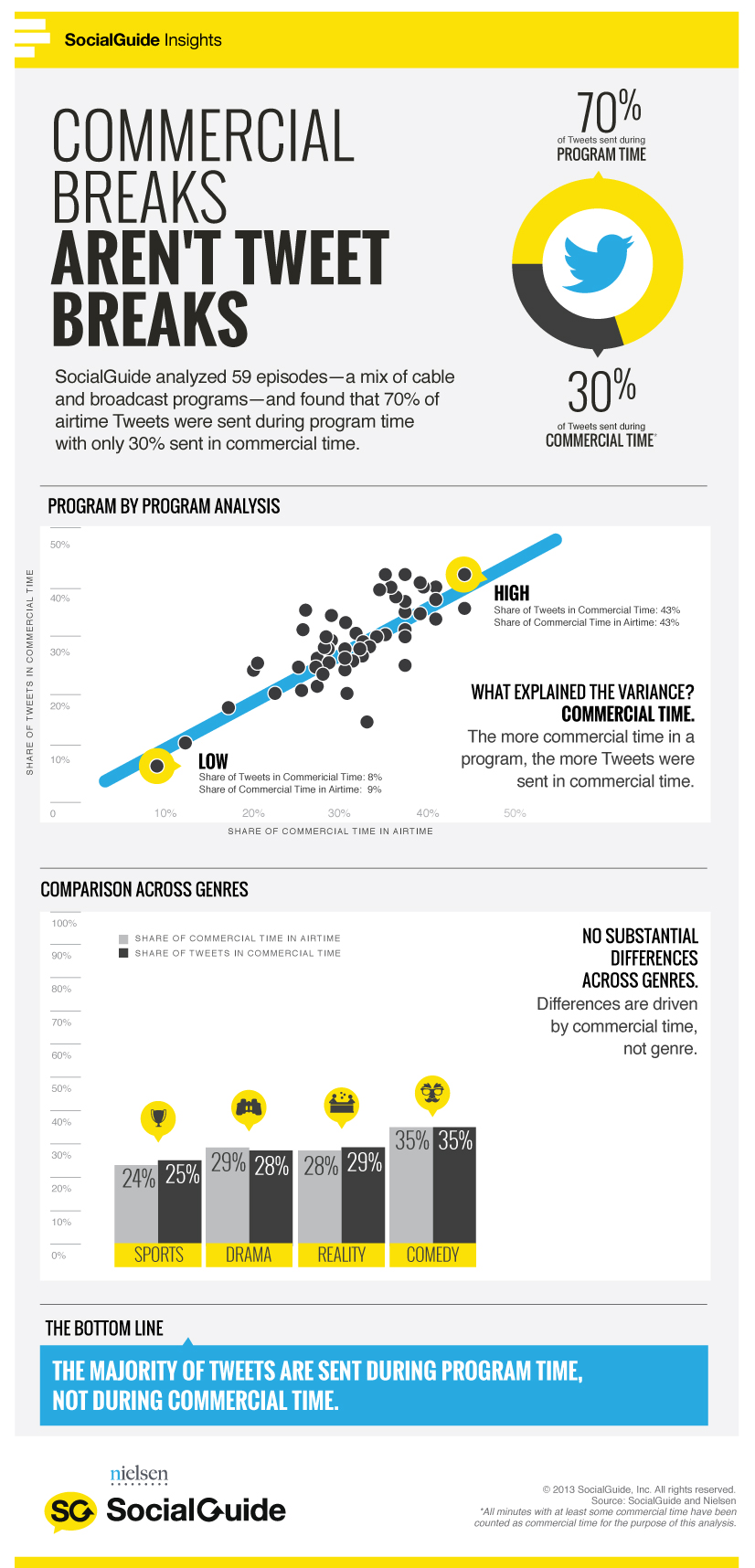
Let’s take how a single publication handled the reporting of one piece of information in two different articles.  I should state upfront that I have no issue with either of these headlines nor with the articles.  I’m using them to illustrate a point.  The publication is MediaPost, and I read almost a dozen of their newsletters each day – they provide great information.  The story was a study Nielsen did on viewers using Twitter while they’re watching TV.  You can read Nielsen’s own release on the topic by clicking through on this link.  You might be able to tell from the graphic how Nielsen portrayed their findings.

On to the two articles.  One was headlined “Tweeting Doesn’t Spike During Commercials” while the other stated “TV Viewers Use Twitter During Ads.” Same study, same publication, same day.  A quick glance at the headlines might make you think that viewers don’t break away during commercial breaks; the other might lead you to believe the opposite.  One article says

Good news for TV programmers: TV viewers use Twitter during their TV programming — showing lots of engagement, according to analysts. The bad news? Many are also tweeting during commercials.

while the other says

The takeaway is that viewers using Twitter as a second-screen platform are tweeting consistently throughout the airtime for programming and ads alike. TV advertisers might still prefer that viewers’ attention was fixed on the larger screen during breaks, but it’s not as if they signal the start of a tweeting blitz. All airtime is tweet time.

My point is that we always need to dig a little deeper into the facts before we draw conclusions and we should always get to the source material when we can.  In this case, the Nielsen study.  In other cases a sales report, a deal memo, or other things about which we often learn from others who will bring their own point of view as they report the “facts.”   Needless to say, the principle applies outside of the business world as well.

Make sense?

Enhanced by Zemanta

Leave a comment

Filed under Helpful Hints, Reality checks