Category Archives: food

Sweets Trolley

It’s Foodie Friday, and this week I’m already looking forward to next week and the Passover and Easter holidays. As you might expect, it’s because of the food. There are a few things that seem only to make an appearance around this time – Easter Pie (pizza rustica) and bilkies (like a knish without a crust) being two of my favorites. Most of these foods, however, are desserts. Macaroons, cakes made with ground nuts instead of flour, Simnel cakes, hot cross buns, and yes, even Peeps are sweets that are now eaten year-round but were originally only eaten around Passover or Easter. That’s why desserts are on my mind.

Desserts began as a “thing” in the 17th century. As a host, you were expected to leave your guests filled to the brim. The word “dessert” comes from Old French “desservir,” “cleaning the table,” and that’s what it did—it filled people up to the brim. I look at it as the “something extra” that takes a good meal and makes it special. If you’ve dined in some restaurants (or are a Harry Potter fan), then you’re aware of the sweets trolley – the cart that comes around after the meal with the desserts. It always makes me feel the way that the sound of the Good Humor truck did as it came around when I was a kid.

So my question for you this Foodie Friday is what’s on your sweets trolley? What desserts have you created to complement and enhance your main meal? How are you filling your customers to the brim? Is your product great but your customer service the dessert? Is your online experience first-rate but the experience of unboxing what you send an added joy? What are you doing that goes above and beyond?

I’m actually not a dessert person – I avoid sweets. This week is one exception because the desserts are so unique and wonderful. What are you doing to entice people who might avoid you to change their mind?

Leave a comment

Filed under Consulting, food

It All Comes Out In The Wash

I’m not quite sure what to make of our Foodie Friday Fun topic this week. It’s a piece I saw that discusses how someone invented a bag that you can use to cook dinner in your washing machine. Not, it’s not from The Onion. Apparently, the person who invented it was moved by a piece he saw about homeless people using the laundromat as a sanctuary of sorts. There, the homeless get water, clean up, do laundry, charge devices, etc. He wanted to add cooking to the list.

한국어: 유럽향 드럼세탁기 (모델명_F1047TD)

(Photo credit: Wikipedia)

The thinking behind this is that a washing machine is like a sous vide like environment in that it’s a water bath. The problem is that it really isn’t. An immersion circulator holds the sous vide bath at a constant temperature for any period of time required to cook the food. I did steak in mine last night holding the food for one hour at 126 degrees. A typical washing machine uses water that’s somewhere around 110 degrees, nowhere near hot enough to cook anything beyond very rare, if at all. The time a load of laundry is fully immersed in the hot water isn’t long enough either.

Putting aside the obvious problems, what I like about this is that it demonstrates outside of the box thinking. People cook on their car engines (mmmm – is that cylinder head in the potatoes?) and bake their lasagna in a dishwasher. Grilled cheese using your clothes iron? Why not! How often have you sat down to solve a problem and immediately discounted some of the more bizarre solutions out of hand? That’s something that happens a lot in group brainstorming sessions. My feeling is that no idea is terrible and no idea is great until they’ve been thought through and explored. In the case of the sous video laundry bags, I’d probably not have kept going, but the fact that they now exist has me asking myself are there any other purposes for which the technology can be used?

Ever used a microwave oven? It was a mistake, the by-product of radar research. Played with a Slinky? Another mistake. So were potato chips, chocolate chip cookies, and penicillin. While you may have some great ideas that turn out to be not so great, how can they be repurposed? Maybe the bad stuff will come out in the wash, leaving you with something brilliant?

Leave a comment

Filed under Consulting, food, Thinking Aloud

Sampuru

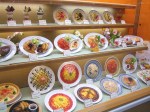
This Foodie Friday, the topic is sampuru. No, you probably don’t call anything by that name but you’ve seen it. It’s the fake food you often see in the lobby or window of Japanese restaurants. Great sampuru is incredibly realistic and can negate the need even to look at a menu. Like many seemingly simple things (such as making the rice for sushi), sampuru artists require years of training.

Typically for this space, as I was thinking about sampuru, a business thought came to me. Fake, plastic food has its business counterpart although they’re not called sampuru. I call them empty suits, but I’m not sure we should limit the term to people.

Your typical empty suit, like great fake food, gives the appearance of being real and nourishing. The reality is that they look great but can be toxic if ingested. In fact, I think they’re easier to spot than great sampuru. Ask an empty suit for an opinion and it will either be the same as either the boss’s or of whomever in the room they’re trying to please if they have an opinion at all. You see, empty suits rarely have enough knowledge about a topic to give a well-reasoned opinion about anything. They may rattle off a number of industry buzzwords but if you try to dissect what it is they’re saying it becomes obvious that, as Gertrude Stein said about Oakland, there’s no there there.

Oddly enough, I think entire businesses can be sampuru. Coincidentally, I ate at a Japanese restaurant the other evening that I would call an empty suit. It looked fine – a sushi bar, teppanyaki tables, etc., but the food was nondescript, the service was lackadaisical, and the teppan chef I saw was just barely going through the motions. It was a sampuru – a plastic model of a business that looked like the real thing but wasn’t even close to being it.

We need to make sure our businesses don’t fall into the trap of being sampuru – of looking like we’re fresh and flourishing when, in fact, we’re dead and toxic. As executives, we need to stay informed and not be afraid to offer our own opinions about things. We’ll be wrong sometimes but by being true to ourselves maybe we’ll also advance the conversation to new, more profitable ground. You with me?

Leave a comment

Filed under food, Thinking Aloud