Category Archives: food

What Restaurateurs And Founders Share

It’s Foodie Friday, and this week an article on a restaurant trade site caught my eye. It’s all about the things restaurant owners wished they’d known when they decided to open a place. Having spent a lot of time working with startups, what I find interesting is that many of their statements are not unique to the restaurant business. In fact, I’m willing to bet that you will nod your head in agreement with these if you’ve even started a business or worked with one in its early stages. You can read the entire piece by clicking through here.

Photo by Bank Phrom

First and foremost, the time involved. One owner said she wished she’d known “That I was going to spend the first couple months basically living in the store and two years married to the business. 86 my social life!” I’m often amused at the founders who still have side gigs, especially if those gigs are not consulting positions that are very flexible. One startup with which I’m working has two founders who don’t seem to be able to focus enough time on their company, and as a result, their progress is very slow. What should have taken them several months has taken them a couple of years. In part it’s a financial decision – the gigs help fund the startup – but I sometimes feel as if they don’t really get that you need to be married to the business, as this owner says.

Another owner wishes he’d known “To have enough money reserved to be able to wait to open the doors to the public.” There is something to be said for throwing a lot of tests out there and iterating, but I’m a believer in making sure you’re putting your best foot forward. That doesn’t mean every beta has to be perfect but it does mean, to paraphrase the words of the old Paul Masson commercial, not selling any product before its time. The world is too cluttered and I’m not sure any business gets multiple chances after a bad customer experience (think about how many apps you’ve deleted recently or a restaurant at which your first meal was your last).

Then there is the point never underestimate the value of private dining. As the owner put it, people wanted a place where it was quiet and personal. I think that makes it as much about the experience as it does the product. Personalization is key!

Finally, I love another owner’s point: “To build your squad. We always knew that having good people was important, but I’m not sure we realized how important.” As any business grows, the founders can only do so much and your success is in the hands of the people you’ve brought in and trained. Your job as a manager is to help your team to do their jobs, but it’s also to be sure that every person is carrying their load. Nothing will bring a business down faster than a weak link in the chain that causes resentment among the rest of the team. Hire well, don’t be afraid to admit you’ve made a mistake with a hire if you have, and do everything in your power to retain great talent.

Yes, the food service business is different in many ways (you probably don’t have the health department visiting nor do you deal with many cuts and burns), but as the piece demonstrates, every startup faces many of the same challenges, don’t they?
Leave a comment

Filed under Consulting, food, Thinking Aloud

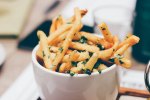
Offer Fewer Fries

This Foodie Friday, I want us to think about less being more. Specifically, it’s the balance between quality and quantity. I’m of the opinion that when it comes to food, high-quality ingredients expertly prepared are more satisfying than a large portion of bland, low-quality food.

Photo by Stephanie McCabe

For example, think about a bread basket that arrives at your table. Rich, dense bread slathered in high-quality butter is not something you’d eat much of. Compare that with a bunch of Wonder Bread and store-brand butter that you might have at home. The latter is tasteless and not satisfying and I’ll bet you eat more of it.

McDonald’s proved this point in 1990 when they stopped frying their fries in beef tallow. It was a knee-jerk reaction to people believing that trans fats were better than natural fats (turned out to be totally wrong). The fries never tasted the same and, more importantly for our discussion today, were not as filling. I’m convinced that the reason we have supersized portions is that the current fries are so unfulfilling. It’s probably why we have an obesity problem as well. I suspect there were cost-savings too, but are those savings worth ruining the reputation of your signature product?

Look at Europe. France and Italy, two fantastic food cultures, don’t serve you big portions and yet it’s hard to walk away from a meal in either place still hungry. The dishes are rich and tasty. High fat? Sure. Caloric? Yes, but you don’t eat as much. For the restaurant, this can mean lower food costs (smaller portions) which might be taken as higher margins or passed along to customers. You can’t really eat a huge portion of fries cooked in duck fat, believe me.

This is a principle which I believe any business can use. Consumers don’t want (or need) tons of low-quality products. Sure, they might be duped into thinking of them as great values (“Look at that portion!”), but over time your customers realize that they’re not really satisfied.

Example: think of Word or Excel. They are extremely complex products and yet most users take advantage of a tiny amount of that complexity. Why not offer a simpler product to the masses that cost less and save the complex version for those people who really need it (and charge them accordingly?). You can find articles dating back over a decade complaining about Word’s complexity and yet it wasn’t made simpler.

Less can be a lot more. Think about offering fewer, but much better, fries. People can be satisfied with less as long as it’s top quality at an affordable price. I’d rather be sated and healthy than hungry and sick. You?

Leave a comment

Filed under food, Huh?

Does Your Business Serve Pu-Pu Platters?

This Foodie Friday, I’m inspired by the memory of a long-closed (by the Health Department as it turns out) restaurant called South Seas. It served very large “exotic” drinks – Zombies, Scorpion Bowls, the full range of tiki bar delights – and the first pu-pu platter I’d ever encountered.

My high school friends and I would often meet up at South Seas to gather in front of a glowing pu-pu platter. The center was a grill, fueled by Sterno I think, on which we could cook something from the mound of delights surrounding it. Of course, everything had been fried and I was never quite sure why one would want to further cook an egg roll, but it was very foreign and wonderful. Of course, since they would serve both the food and the drinks to anyone (the drinking age was 18 but our 18th birthdays were a few years away – sorry Mom), I might be misrecalling how good the food was, but I really loved it.

It’s the pu-pu platter that triggered the business thought. While most of us had after-school or weekend jobs of some sort, none of us really had a ton of disposable income for food. The Pu-pu platter solved that problem by being a cost-effective alternative to having to order several different plates. We could graze as we saw fit without having to commit to one dish. As I think about it now, many other types of cuisine offer their version of a pu-pu plater: the mixed antipasto (hot or cold) most Italian places serve, the popularity of tapas places  (you’re sort of constructing your own pu-pu platter as your order many different little plates), heck, even the canape platters they pass around a cocktail parties are pu-pu platters in my mind. And I think there’s something your business can take away from that.

The pu-pu platter or antipasto plate lets the customer sample multiple facets of your kitchen. It lets them understand the quality and variety of what you offer without their having to make a major commitment. That’s not a bad idea for any business. Free consultations and low- or no-cost trial periods are one way to deliver this. Offering a little bit of everything, much like a country store does, might be another. I hasten to add that anything you do offer needs to be of the same high-quality as your main product or service offerings.

When I see a pu-pu platter on a menu these days, I’m still tempted to order one so I can have a little taste of everything. Keeping a pu-pu platter mindset might just be a way to grow your business, don’t you think?

Leave a comment

Filed under Consulting, food, Growing up