Tag Archives: Television

First Impressions

I almost called today’s missive “Don’t Shoot The Messenger.” As a person who has had hundreds of meetings in which the efficacy of advertising is discussed at length I’ve noticed an ongoing theme.  Clients (or their agencies) sometimes complained that they weren’t getting any sort of decent return on their media investment.  In their minds, maybe TV or the Web or (now) Mobile just aren’t worth the investments and perhaps they’d be better served trying something different.  My response usually involved a reminder not to shoot the messenger.

A “medium” (and I’m not writing about psychics here) is an intervening substance, as air, through which a force acts or an effect is produced.  TV is a medium, as are radio, the Web, and others.  Their job is to deliver the advertising message.  To be blunt about it, if the message – the ad – is crap, so will be the response.

In the digital world, there is a lot of literature on the size of ads – size, format, content, design and type – and not surprisingly they generally find that bigger advertisements are more effective in attracting attention which increases response.  On the other hand, other research found that design and content of the
advertisement have an impact on Click-Through Rate (CTR) and increases the interest in Advertising.  The reality is if advertisements, regardless online or offline, don’t catch your attention within seconds they are considered to have failed.  I’d add to that if the intrusiveness of the ad pisses off the consumer, it’s failed as well regardless of the brilliance of the creative.

There is a movement in the digital ad world to move towards a “Cost Per Viewable Impression” model which I’ve said before I think is dumb on web sellers’ parts to encourage unless TV, radio, and other media can fall into the same model (good luck with that).  Regardless of impressions or medium, bad creative equates to bad responses.

You agree?  What creative have you seen lately – good or bad – that really got your attention?

Enhanced by Zemanta

Leave a comment

Filed under digital media

Getting Authenticated

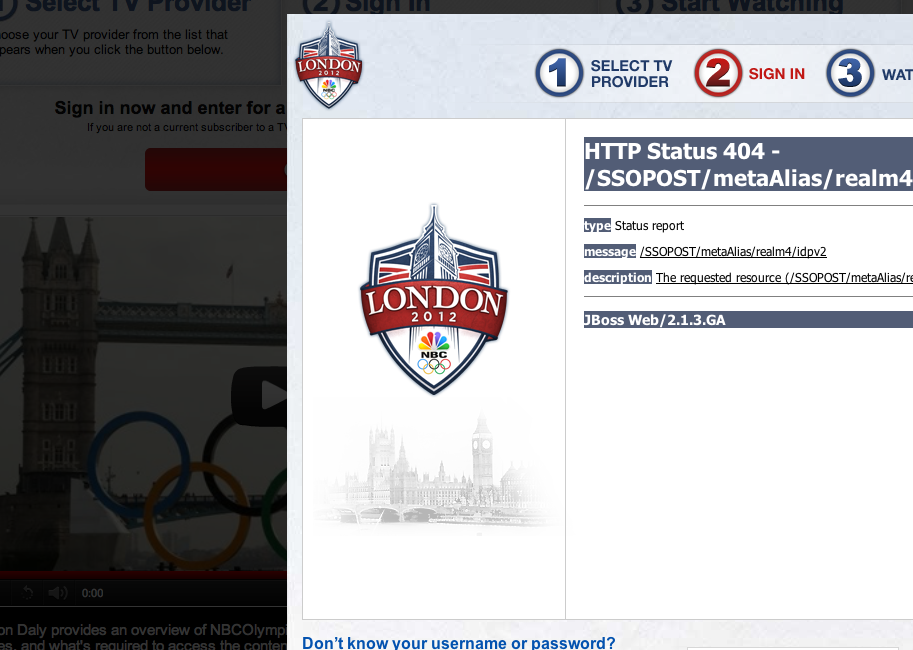
I spent a good part of the weekend watching the Olympics (can I use that word without IOC permission?). Authentication FailNBC is wall to wall with them across all of their networks and it’s great. It’s truly the smorgasbord of sports – a grand buffet with a little something for everyone. Just in case you’re still hungry, NBC is also streaming everything to anyone who can prove they have a cable TV subscription. Seems fair – why have to pay for the same content a second time?

As an aside, that availability of this streaming has me confused about why people are complaining via social media about NBC’s TV coverage – what they choose to air  on which networks, etc.  You can be your own producer, and if you’re tech savvy enough to complain in the Twittersphere about it you’re probably savvy enough to figure out how to hook a computer up to a TV screen to watch the streaming as if it was TV.

I tried to get myself authenticated to do exactly that and found out that the weak link in the chain is actually the cable operator.  Well, specifically MY cable operator.  Every time I went through the process, which involves going to the NBCOlympics.com site and entering your cable user ID and password via your own provider’s site, I got a weird server message.  Not an error message as if I had the wrong information – a message you see in the graphic that’s indecipherable.  I finally emailed Cablevision support.  To their credit, they emailed me back within the hour that I was now authorized.  I wasn’t – same message when I went to sign in.  I used an online chat link they sent me to try to resolve it.  The very nice person (named Keith, coincidentally) let me know after a few minutes that he was a TV support guy and I needed to chat with the Internet guy.  Start a new chat.  Kevin (the new rep) asked if I had Cablevision’s internet service, which I don’t.  I reminded him that as long as I had TV I was supposed to be able to watch the streams.  He checked (5 minutes) and discovered I was right.  The issue turned out to be Chrome on a Mac – I was authorized instantly on a PC using Firefox.  Once I installed Flash into Safari, it worked on my Mac as well.  Strangely, it now works on Chrome too.

I suspect we’ll see a lot more of this as the pipe we use to access content becomes less important than the content itself.  I’m hoping the bumps will vanish and that rather than a great product such as this surfacing once every four years, we can use it every day.  What about you?  Have you tried the streaming?  What do you think?  Any issues getting it to work?

Enhanced by Zemanta

3 Comments

Filed under sports business, Thinking Aloud

Changing Media Dynamics

A couple of pieces of research this morning that confirm and clarify what many folks have been observing independently but which also made me a bit more confused.  In this case, it has to do with how our media habits are changing with respect to television.

Google TV

Google TV (Photo credit: Wikipedia)

Frankly, I’m not even sure what TV is any more despite many years working in the industry.  A “TV” is a screen, and we’re surrounded by screens of that sort and many others, the use of which is reflected in the research.  In any event, the data are interesting and even more so when one considers the changes that are happening to the businesses behind the screens.

Let’s start with information from a TV industry group – CIMM.  The released a study which you can access here about How Multi-Screen Consumers Are Changing Media Dynamics:

Studying 10 broadcast network and cable brands over a five-week period, the research found that an average of 90% of consumers who engaged with brand did so on TV, and 25% did so online, and 12% via online video. In addition, comScore and CIMM found that 60% of a media brand’s consumers accessed both TV and the web during simultaneous 30-minute increments, and 29% accessed Facebook while watching TV. To the researchers, this suggests that digital platforms may be used to support the TV-viewing experience and drive multi platform engagement.

So multi platform is here.  What I think is lost a bit is that it may not necessarily mean multi-screen:

21% of consumers now have their TVs hooked up to the internet, a 5% increase from last year’s levels.The Magid Media Futures report says gaming consoles (Nintendo’s Wii, Sony’s PlayStation3 and Microsoft’s Xbox 360) are currently the “primary means” of connecting a TV to the internet, followed by “smart-TVs,” Blu-ray players, and then OTT devices like Roku, AppleTV or GoogleTV. The firm says early adopters skew toward men, as 56% of male respondents between the ages of 18-44 say they have their TVs connected to the web vs. 44% of females.

There’s also research from The NPD Group which finds that 66% of all big screen (50+inches) HDTVs are made with the ability to connect to the internet without a separate device, while only 1% of TVs smaller than 32 inches have the same technology.  Yes, we’re watching a mash-up of difference sources, brands, and technologies but no, it might not be through a TV, an iPad, and a phone.

So what’s it called?  TV?  Enhanced video?  A mess?  Let’s hear your thoughts.

Enhanced by Zemanta

Leave a comment

Filed under digital media