Tag Archives: Food

Fresh Picked

A little bit of a detour this Foodie Friday. Instead of talking about how food is prepared and served, this week I want to tell you a bit about where some of my food comes from, and it’s not a supermarket.

One of my favorite things about having moved to NorthCarolina is that I live in the middle of many farms. Most of them produce corn and soybeans and tobacco, but there is also a fairly local farm that offers fruits and vegetables. Each week I go online and can order a box of whatever is in season as well as some fantastic canned goods such as pickled okra or salsa made at the farm. They deliver the box to my house, and most of what’s in it has been picked earlier that day or the day before. That’s a serious flavor upgrade from what you get at the store, which might have been picked a week ago. 

While not organic, the farm is a GAP certified farm (Good Agriculture Practices) and is very careful to maintain a safe and healthy farm. The majority of their plants are started from seeds in the greenhouse. They purchase expensive hybrid seeds, which means they get good quality plants to grow the vegetables. The use of any pesticides or fungicides is closely monitored with all the crops. They use as little as possible, in part for health reasons and in part because chemicals are expensive. While not inexpensive, the produce is less expensive than buying organic produce ar the store and the quality is a huge upgrade.

I’m not alone in my thinking about supporting smaller farms. Maybe you’ve joined a CSA – Community Supported Agriculture – near you. If not, you can learn more about it here and search for one near you. It points us to a broader business point as well. There’s often a tendency to focus on the easy and less expensive in business as well as on the “big guys” (you’ve probably heard the expression that no one ever gets fired for buying IBM, ATT, etc.). Now – especially now as we’re beginning to come out of an economic disaster – is a great time to look at smaller options. Maybe the product isn’t as uniform as what the big guys produce, maybe it’s a little more expensive, but it might also taste better and be better for you. It’s almost certainly made with more care.

Something to chew on this weekend!
1 Comment

Filed under food, Thinking Aloud

That Tonnato Sauce

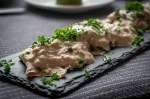
This Foodie Friday, I want to write about one of my favorite summer dishes, vitello tonnato. When I first had it at some fancy lunch many years ago, I thought it was something thought up by a clever chef. As it turns out, it isn’t a new dish at all. One can find it in the 130-year-old Italian cookbook Science In The Kitchen and the Art Of Eating by Pellegrino Artusi (it’s on page 271 of my edition).

The dish is veal, generally a shoulder or rump portion, that’s been boiled and thinly sliced. It’s topped by a sauce that’s basically a tuna and caper-infused mayonnaise. Trust me – it tastes a lot better than it sounds. The veal is really just a canvas for the sauce in my book.

I was pleasantly surprised when one of my friends emailed my a recipe for a vegetable plate of crudites that was served with a sauce that wasn’t called tonnato sauce but absolutely was the same as what one would put on the veal down to the capers and anchovies in the sauce. The chef described it as a “garlicky aioli bolstered with oil-packed tuna.” Uh, yes, please.

It got me thinking about special sauces since the tonnato sauce is clearly special to me. Every business needs a special sauce if it’s not going to be a commodity. If you’ve not done a competitive set analysis, that’s a great place to start to see how you’re different. Then ask yourself why you exist. What’s the problem you’re solving and why is your solution unique/better? Check your assumptions against what your customers and employees think. 

Is your sauce really yours? Can it be duplicated or is it unique and defensible? Back in the day, we used to call something that you marketed around a USP – Unique Selling Proposition but I think your secret sauce is more than that. It gets to the heart of what your business is, including the culture. It’s what makes you you!

You can put tonnato on sliced pork tenderloin, vegetables, and of course veal. I suspect it’s great on grilled foods – veggies and proteins. As I’m thinking about it, it’s not far from a Caesar Salad dressing but with tuna. You see? Once you have a secret sauce, you can’t really tell how far it will take you!

Leave a comment

Filed under Consulting, food

Not Delivering At All

If it’s Friday, the topic is food here on the screed. This week, it’s the food delivery services I suspect many of you have been using to support your favorite restaurants during the time we’re supposed to stay at home. Food delivery is not a new phenomenon. I know a lot of folks, myself included, who used it before all of this when they had nothing planned or bought for dinner and couldn’t bear the thought of pulling themselves together to go out.

What’s different with these services is that they’re third parties. One of my first jobs back in the day was as a food delivery guy (before I graduated to cook) for a local pizza place. Who hasn’t ordered Chinese food and had it delivered? But I worked for the pizza place and the kid making the Chinese food delivery was generally the owner’s son from the place I frequented. These services – Grubhub, Seamless, and others – are a relatively new business. For restaurants that didn’t do a large enough takeout business to hire a delivery person, they opened up new revenue streams. Of course, they come with a cost.

First, there is a human cost. These services pay very low wages and don’t make tipping mandatory (don’t be that guy – tip well, ok?). Then they charge exorbitant, often hidden fees to the restaurants. You might have read about one restaurant owner’s experience. In March, she got 93 orders through Grubhub, totaling to $6,626 in revenue. From that, GrubHub took $1,208 in commission, a $592 delivery fee, and $230 in processing fees, totaling to over 30% of the revenue. In an industry where margins are often low double digits, that’s not sustainable.

We could continue the discussion beginning with why restaurants don’t hire their own delivery people but the point I want to make today which might just apply to your business is about using third parties, especially third parties who end up owning the customer relationship. What is to stop Grubhub from promoting another restaurant to someone who is looking at your menu? Do a search on Yelp for a specific restaurant and you’ll usually see a couple of other promoted alternatives first in the listings. I don’t know what data the restaurant sees when an order comes in via one of these services but at a minimum someone else is privy to a portion of your customer base, their preferences, addresses, etc.

You might have heard of third-party cookies. Third-party cookies are created by domains other than the one you are visiting directly, hence the name third-party. They are used for cross-site tracking, retargeting, and ad-serving. They’re what makes it possible for you to see an Amazon ad for a product you just searched Amazon for on another, unrelated website. They’re going away, in part because of privacy concerns and, I believe, in part because marketers are waking up to the fact that having someone else own data that you help to generate so that they can sell it back to you as well as to your competition is silly.

Industries outsource all the time. Generally, this is because they don’t want to deal with solving a particular problem themselves for whatever reason and it becomes easier to let someone else deal with it. That’s often shortsighted, particularly when it ends up with someone else owning the customer relationship. After all, in business, that’s probably the most important relationship you have, right?

Leave a comment

Filed under food, Huh?