Tag Archives: Digital marketing

Counting On Social

I can’t think of a single company with which I’ve had contact in the last year or two that isn’t somehow engaged in social media marketing. Maybe it’s a Facebook page or an Instagram account or maybe it’s just executives posting on LinkedIn. It’s always surprising when I inquire about the other end of that content funnel. How is social working? What are your goals? The surprise has to do with the lack of a coherent plan to track and measure the social media efforts these companies are making. I’d like to provide a little food for thought on that today.

First, it goes without saying that however you’re measuring social it should also integrate into whichever analytics platform you’re using. It’s really pretty easy to tag, for example, any URL with the parameters needed by Google Analytics to report social activity beyond the defaults offered along with any supporting ads you’re running or email campaigns. It’s a little more effort but possible even to track “dark social” that way using a combination of custom segments and/or third party tools. Dark social, by the way, is the term used to refer to all that wonderful content you produce that’s shared among readers via email or text messages or some other non-public platform. Some folks have figured that as much as 85% or more of content is shared that way, so you shouldn’t ignore it.

Back to our topic. Analytics measure “how much”. In addition, you need to be measuring how readers feel. It’s not a great situation to have a lot of consumers posting and sharing negative things about your brand. If you’re only measuring how much activity, that might look like a win. At the most simple level, you should be paying attention to comments and posts. There are free tools available to locate and compile this information. You can then do your own sentiment analysis or use a tool to do so if the volume is just too great (a good problem to have!).

Finally, you should try to understand how many of the people who follow you on one platform are also tracking you on others.  These “superfans” are probably your best targets and the ability to identify them in order to reward their loyalty is a massively impactful bit of research.  You can’t ignore the analytics most platforms offer as well.  They can help in understanding not only who your audience is but what resonates with them (and that’s really true if you can add the dark social shares discussed earlier).

Wha to measure?  I’m not going to tell you since whatever it is needs to reflect your business goals and the tactics you’ve taken.  There is a pretty good list in this article to help your thinking but I’d urge you to get beyond the quantitative things such as “likes” or “followers” and more into the qualitative things such as engagement.  What’s important is that you not just throw your social efforts out into the digital ozone.  OK?
Leave a comment

Filed under Consulting, digital media

Ignoring 9 Out Of 10

I realize I’ve spent the first couple of posts this week on the topic of companies being less than responsive to customers. I was chatting about this with someone yesterday and they asked me if I really thought the two cases I cited were the norm.  After all, he said, how can companies really expect this kind of behavior to remain quiet when every person is a publisher?

Sprout Social

Sprout Social

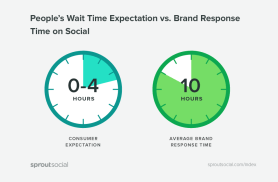
Precisely my point, but since when does common sense prevail?  In fact, companies are getting worse at being responsive.  Maybe it’s just the increase in volume, maybe it’s the ease with which customers can reach out, but the common sense solution of staffing up and training to handle the increased load is nowhere to be found.  Since we believe in fact-based statements here, these facts are from Sprout Social:

90% of people surveyed have used social in some way to communicate directly with a brand. What’s more, social surpasses phone and email as the first place most people turn when they have a problem or issue with a product or service, according to Sprout’s consumer survey. Following this trend, The Sprout Index shows that the number of social messages needing a response from a brand has increased by 18%over the past year. In spite of the high volume of messages that require a response, brands reply to just 11% of people (a number that’s been stuck in neutral since 2015).

11%, meaning brands are ignoring 89% of the messages sent to them as consumers reach out. I guess they’re too busy misusing social media and other responsive channels as megaphones (so 1995) since the research found that brands send promotional messages out 23 times as often as they respond to a customer message. It’s not just social that requires our attention.  August 2015 research from Nice Systems and Boston Consulting Group (BCG) found that internet users in major metro areas worldwide used an average of 5.6 customer service channels.

I can hear you rubbing your temples as the headache comes on.  How will you support your customers in those places when you might be ignoring 9 out of 10 customer interactions now?  Beats me, but the question needs to be answered, and the organizations that do so will be the ones that win.  Make sense?


Leave a comment

Filed under Consulting, Huh?

Girl Talk

As our girls were growing up, I tried very hard not to speak in gender-specific terms. There were no “firemen” or “policemen” or even “postmen.” In part, I guess I wanted to send a subtle message that anyone can do anything – boys or girls, men or women. The other part was just a feeling that taking on a tone of talking to girls in a language more specific to girls (which I have no clue about) was silly.

English: Gender neutral toilet sign at departm...

(Photo credit: Wikipedia)

I bring this up because I was reminded both of that and of David Ogilvy‘s famous quote this morning as I read about some research from the Fluent people. Ogilvy is known for reminding us that “The customer is not a moron. She is your wife.” You can get the full report here, but the Fluent research talks about how many of us are speaking to our female target audiences and how they want us to do so:

Women overwhelmingly prefer gender-neutral ads. 73% of women say they sometimes receive marketing messages directed specifically to women…74% say they prefer marketing messages to be gender-neutral.

Fluent surveyed 1,443 US female internet users ages 18 and older to come up with that number and the study was designed to better understand the impact of online and offline marketing channels on their purchasing decisions and how engagement varies across different age groups.  So while only 26% of respondents said they preferred marketing messages directed specifically to women, almost three-quarters of female internet users said they prefer marketing messages to be gender neutral. A little out of touch, no?

Smart marketing these days isn’t about selling anything.  We need to understand our customers and the problem they have which our product or service solves.  Explaining that you’re there to help with that – being a resource – is like talking to your friends and not to a mark. Speaking in clear, gender-neutral language is generally how I speak with my friends.  You?

Leave a comment

Filed under Huh?, Reality checks