Tag Archives: Advertising and Marketing

Calling Customers Stupid Is…

I love it when some company makes my life a little easier and provides the fodder for a post here on the screed. This time it was a car dealer here in town that provided that for us today.

You callin' me stupid?

You callin’ me stupid?

If you’ll look over at the graphic you’ll see what was in my email yesterday.  This was just the graphic part of the email – there was quite a bit of copy that dug the hole a little deeper.  It read:

Drop by our dealership any time during our regular service hours, even without an appointment, and we’ll adjust your vehicle’s clock for you — free of charge. While you’re here, make sure your vehicle weathered the winter and is ready for warm-weather excursions, with an optional multi-point inspection (please call for availability). Don’t waste any more time; visit our dealership and let us help you prepare for the days ahead. We look forward to serving you!

In other words, you’re too dumb to know how to change the clock on the car we sold you.  Let’s put aside the fact that the real purpose of bringing you in is that “multi-point inspection” which may or may not be free.  If you’re going to reach out to your customer base, shouldn’t the  basis of that offer be something of real value to the customer?  Maybe the email should have been instructions on how to change the clock over to daylight savings with an offer to do it for the customer if they’ll bring the car in?  That is providing value – this is an obvious ploy to get people to the service department.  Giving the instructions lets the customer solve the problem (to the extent there really is a problem) in a matter of a few minutes.  This way means the customer needs to take the time to go to the dealer and wait for a service person – a longer process.  The first solution helps the customer; the second is designed to help you.

If we’re going to be helpful to our customers, we should do so in a way that’s customer focused.  My immediate response here is that they think I’m stupid and calling customers stupid is…well…dumb!  Of course, these guys are pretty dumb themselves.  I sold the car they want me to bring in (back to them so they’re very aware) years ago.  They’ve obviously not updated their customer mailing list into “past” and “current” owners in quite some time (I sold the car seven years ago).  Who’s calling whom stupid now?

Enhanced by Zemanta

Leave a comment

Filed under Helpful Hints, Huh?

Native Speakers

Think back to when you first learned English.  If English is your first language you probably can’t remember learning the rudiments of it.

english language

(Photo credit: Wikipedia)

Oh sure – when you got to school you learned to improve your grammar and spelling, but you could already speak the language pretty well.  You think in English too.  You’re a native speaker.

Compare that with any other languages you might speak.  I speak a few and it took me a long time to learn them.  OK, maybe not to learn a bunch of words and basic grammar, but a long time to learn which version of a word was appropriate and to develop an accent that sounded more natural for the language.  The hardest part is getting to the point where you can think in the language so you’re not constantly translating, in my case, from English.

Think about communicating with a non-native English speaker in English:  you can hear the unsure vocabulary and the accented speech.  Now think about your business.  Odds are if you’re using digital channels for communication, you’re not a native speaker.  You probably are translating many of the marketing or other business lessons you’ve learned into digital.  As with other languages, you might be speaking with an accent or using the wrong word.  In fact, unless you’re under the age of 15 or so you’re not what some folks call “digital native.”  That notion is having some big impacts and many more are on the way.

One example is the Google Chromebook.  These inexpensive computers are making their way into schools and kids are learning to live with cloud-based software.  No hard drives, no program updates, no ongoing software expense.  If you’re Microsoft that’s a killer.  There are other things digital natives do that are changing things over time.  Cord-cutting is one we’ve discussed quite often.  Traditional TV is based on programming and counter-programming to draw in the biggest number of eyeballs all at once so you can sell advertising against broad demographic targets.  What happens when the cord is cut and people are their own programmers?  They’re very comfortable doing this – how has the language they’re speaking changed your business?  How has the technology of programmatic media buying and advanced behavioral targeting changed the need to aggregate those broad demographics?  If you’re trying to get women 18-49 and the market demand is for people who have looked at a mommy-blog in the last week, aren’t you speaking a different language?

The point is this: digital natives speak technology just as you speak English.  They grew up with it and don’t know a world that existed before it.  If your business model isn’t taking that into account or if you’re not becoming fluent in that language, you’re heading for failure.  Maybe you need a great translator but do not assume that this is the equivalent of going to a place on vacation where they speak enough English for you to slide by for a little while.  The digital natives are restless – have you learned enough of their language to address them in an understandable manner?

Enhanced by Zemanta

Leave a comment

Filed under Consulting, digital media

Is Social Commerce For Real?

It’s Monday and it’s time to get our brains revved up for the week.  Let’s start with some thinking about Social Commerce.  This is a term used to describe marketing strategies that incorporate social media to make online buying and selling of products and services happen.  It’s actually what I write about a fair amount here on the screed since it’s separate and apart from the click to buy marketing (Free shipping this hour only!  50% off mukluks!) we see so often.  It’s really the more “conversational” part of marketing.   If you check in here from time to time you know that I’m a big advocate of that sort of stuff.  Then again, I could be terribly wrong and it might all be a waste of time.

Turns out that the good folks at UMass Dartmouth looked into it.  As they said:

This study, conducted by the Center for Marketing Research at the University of Massachusetts Dartmouth, is an in-depth look at current purchasing habits and trends of Millennials using three of the most widely used social media platforms (Facebook, Twitter and Pinterest).  In an effort to discern what turns a like, follow or pin into a sale, this study explores and analyzes lead conversion tactics as identified by Millennials themselves.  Also included is a look at mobile technology and its role in online purchasing by measuring percentage of sales conducted through smart phones versus tablets.

So what did they find?  They focused on Millennials.  For those of you unfamiliar with the term, Millennials, also known as Generation Y, are defined as the folks born between 1980 and 2000.  Not surprisingly, they found that social media did drive purchase.  62% of respondents currently like at least one brand on Facebook.  Twitter has 23% of respondents following a brand and Pinterest has 11% of Millennials pinning a brand (Nike is the most liked/followed brand).  But those actions can lead to revenue and not just online.

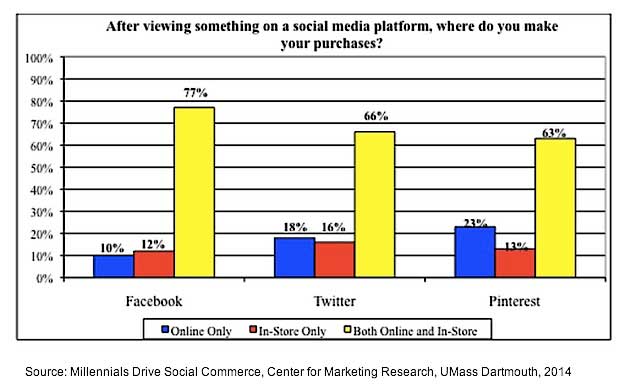
  • Facebook, Twitter and Pinterest contribute to both online and in-store purchasing.  Seventy-seven percent of Facebook users, 66% of Twitter users and 63% of Pinterest users are multi-channel shoppers.
  • Of those who reported they had never purchased something after liking, following or pinning it online, offering a coupon or discount was the most frequently cited lead conversion tactic for Millennials.  Respondents indicated this is the top motivator leading to a sale.  Similarly, Millennials indicated that companies giving exclusive offers or appealing to their interests were more likely to see an increase in sales as a result of online interaction.

You can read more about this study here but the “news” is this:

Millennials are leading the social commerce movement.  They are more likely than any other group to like/follow/pin companies and brands.  They are enticed by coupons and discounts, purchase hair/beauty products and apparel, often using mobile phones and tablets.  They are multi-channel shoppers, buying both online and in-store.  This cohort is active online in ways that allow them to connect, organize, stay informed and shop.  They spend more money on Facebook, Twitter and Pinterest than other groups making them the ones to watch as social commerce surges forward.

In other words, engaging your audience, particularly your younger audience, is a valuable antecedent to making a sale.  So yes, Social Commerce does exist.  Aren’t you relieved?

Enhanced by Zemanta

Leave a comment

Filed under Consulting, digital media