Tag Archives: Advertising and Marketing

Hitting The Bullseye

I spend a lot of my day working with clients on tech.  If it isn’t about how to implement the latest and greatest platform in other marketing efforts, it is about using the data we’ve gathered via web, social, and other business analytics to improve tactics and guide strategies.  We look at a lot of numbers and at a lot of methods with which to gather more.

One of the things I feel it’s critical for me to do is to play the role of a Cassandra of sorts – to see the future but to hope I’m believed a lot more than was the figure from mythology.  The one thing I keep “prophesying” to them is that we can stay on course and out of trouble if we keep our eyes focused on the customer.  They can’t become just aggregations of data.  They’re not just numbers.  They are the reasons why we’re in business.  They have names, faces, significant others and maybe even children.  They’re us!

Much of the ad and marketing technology today has little to do with the customer.  You might think that odd since much of it is based on getting to know the customer on a very granular level.  That’s true, except the focus is on the technology and data, not on the customer.  Thinking about social media is important but only after we’ve spent time thinking about the customer.  Are they on social platforms?  Why?  What are their expectations when they use them?  How do they want to interact with brands in that space, if at all?  Sure mobile is important but a discussion of mobile apps needs to begin with an investigation of how your consumer base behaves on that platform.  “Build it and they will come” is tech centric, not human centric.

Start with your business objectives and your consumer needs.  Move to technology and data after that.  The consumer is the bullseye, not the platform.  Thoughts?

Leave a comment

Filed under Consulting, digital media

Getting A Chance

English: Food2u running on an Android phone. E...

(Photo credit: Wikipedia)

Anyone who has played sports has had the thought about getting a chance to prove their worth.  If I could only get a few more at bats, I know I could show what I can do.  I need more shifts on the ice. Throw the ball my way.  I suspect many of us hold the same thinking when it comes to our products or services.  If I can only get a sample in the consumer’s hand, they’d be a convert and a customer for life.  How do I get their attention?

The odd thing is that marketers are getting those chances more now than ever.  The sad thing is that many of us haven’t adjusted our strategies and tactics to take advantage of it.  It’s almost like the coach says “get in the game” and we are taking a nap on the bench.  Here is what triggered my thought.

The Harris Interactive poll discovered years ago in a survey of US adult smartphone owners that 63% of female respondents and 73% of male respondents don’t go an hour without checking their phone.  Much of it is messaging as Pew found that cell phone users between 18 and 24 exchange an average of 109.5 messages on an average day, more than 3,200 per month.  A lot of it is in apps.  An academic study of Android users’ app-habits revealed that while users spend nearly one hour on their devices a day, the average app session lasted only just over a minute.  Both messaging and apps hold the potential for communication to consumers.  The issue is that many marketers ignore those opportunities or use them badly.  You only get so many strikeouts before the coach decides the bench is a better place for you.

Example.  Ever see ads on your phone?  Most are cheap-looking banners reminiscent of the web in 1999.  Others interrupt your experience and as the above data points out these user sessions are brief, implying a time sensitivity.  We need to embrace the micro-experience and add value.

The above is easier said than done, I’m well aware.  The thing we can’t do is complain that we’re not getting any chances.  Instead of complaining about micro-segmentation and new technologies/platforms, let’s embrace them.  Consumers are more connected to one another and to us than ever.  How are we going to use that opportunity?


Leave a comment

Filed under Thinking Aloud

Reviewing Reviews

Now that the shopping season is over, you might be getting emails from stores to leave reviews for the products you bought.  Reviews are part of what should be a virtuous circle – consumers need information about a pending purchase, read reviews, select and buy the product, and leave reviews for the next person.  I certainly use them when making purchases and I suspect you do as well.

We’re not alone.  According to a YouGov study:

The majority of Americans rely on online reviews. 78% check out the review section before making a purchase and nearly half of Americans (44%) are active contributors, actively writing reviews if only occasionally. Americans rely heavily on online review ratings and comments despite believing that many ratings are untrustworthy.

Huh?  We think reviews are bogus and use them anyway?  Apparently so.

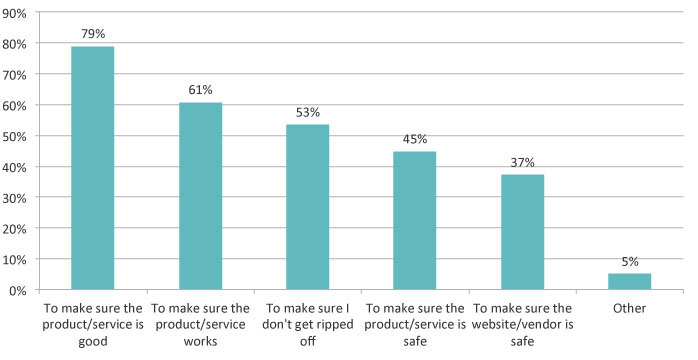
Overall 87% of Americans who read any online reviews find reviewer star ratings important, and 34% find them very important as an aid to decision making. Slightly more Americans find the written reviews to be important (90%) with 41% finding them very important. The main reasons given for using reviews are to ensure the product or service is of good quality (79%), that it works (61%) and to make sure that the purchaser doesn’t get ripped off (53%).

It’s easy to think that the only folks that leave reviews are those who wish to complain and that positive reviews should be taken with a grain of salt since it may be the company itself writing it.  Not so.

American reviewers generally write positive (74%) or neutral (32%) reviews, motivated to help others make better purchasing decisions (62%), or because they think it is polite to leave feedback (35%). Around a quarter want to share positive experiences (27%) and to help good vendors get business (25%). Only 12% are trying to expose poor vendors.

So what’s the business point?  Of all the forms of “content marketing” a brand might be considering, the review space is not one in which we want to play:

  • 90%, believe that some people review products and services without trying them and many believe that businesses manipulate reviews
  • 89% believe that businesses write negative reviews of competitors.
  • 91% believe businesses write their own positive reviews (36% believe that this happens often).
  • Only 13% believe online reviews are very trustworthy.

In other words, not only are the risks of being caught pretty high due to consumers’ natural suspicions but the value of the content is minimized both by the volume of other reviews and reviews seem to be only one of a multitude of sources from which consumers derive research.  Word of mouth and recommendations from informed friends are pretty important too.  Much better might be to monitor all reviews and respond to those which are off the mark in terms of product features, etc. as a comment and not a review.  It shows you care.

You do, right?

Leave a comment

Filed under Consulting, digital media