Category Archives: Consulting

GIGO

The Memorial Day weekend gave me a little time to get caught up on some reading. Some of what I was reading were analytics reports (I know – get a life) and while I very much appreciate the cycle of continual improvement Google fosters within their analytics product, that cycle yields a continuously growing amount of data. The problem that I have isn’t so much understanding what I’m reading but trying to figure out why any of it matters to my clients. I also spend time figuring out which of the numbers are lying to me. 

It’s no secret that there are an awful lot of bad actors in the digital world. Once it becomes clear how fraud is detected those bad actors move on to another form. If viewability is important, they create sites where there is 100% viewability but no content of any value. I had a client get all excited about an increase in referral traffic until I pointed out that most of that traffic was coming as a result of referrer spam. When we filtered it out, traffic was flat. Another prospect got excited by the large “stickiness” – time on site and pages viewed – that her site has. They were impressive until you filtered out the IP addresses of her employees, who spent hours a day on the site.

Silly things, I know, but it points to a common problem. An IDG study of a couple of years ago pointed out that nearly half of marketers said they struggle to make sense of the vast amount of data they get. The other half thinks they know what the numbers mean, yet many of their plans are built to achieve unrealistic metrics. The problem is compounded by what the paper identifies as the accuracy problem I mentioned above:

Why is data accuracy still such a big issue? One possible reason is a lack of investment in a defined data management process that includes ongoing, consistent data migration, data maintenance, quality control and governance. Too often data is held and managed in multiple organizational silos. This results in inconsistency, duplication, gaps and errors.

So while “garbage in, garbage out” isn’t a particular revelation, it does serve as an excellent reminder to take out the trash as best you can while compiling all of that data.  You with me?
Leave a comment

Filed under Consulting, Reality checks, Thinking Aloud

Ignoring 9 Out Of 10

I realize I’ve spent the first couple of posts this week on the topic of companies being less than responsive to customers. I was chatting about this with someone yesterday and they asked me if I really thought the two cases I cited were the norm.  After all, he said, how can companies really expect this kind of behavior to remain quiet when every person is a publisher?

Sprout Social

Sprout Social

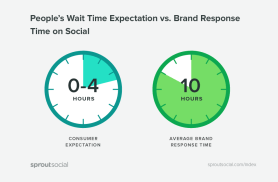
Precisely my point, but since when does common sense prevail?  In fact, companies are getting worse at being responsive.  Maybe it’s just the increase in volume, maybe it’s the ease with which customers can reach out, but the common sense solution of staffing up and training to handle the increased load is nowhere to be found.  Since we believe in fact-based statements here, these facts are from Sprout Social:

90% of people surveyed have used social in some way to communicate directly with a brand. What’s more, social surpasses phone and email as the first place most people turn when they have a problem or issue with a product or service, according to Sprout’s consumer survey. Following this trend, The Sprout Index shows that the number of social messages needing a response from a brand has increased by 18%over the past year. In spite of the high volume of messages that require a response, brands reply to just 11% of people (a number that’s been stuck in neutral since 2015).

11%, meaning brands are ignoring 89% of the messages sent to them as consumers reach out. I guess they’re too busy misusing social media and other responsive channels as megaphones (so 1995) since the research found that brands send promotional messages out 23 times as often as they respond to a customer message. It’s not just social that requires our attention.  August 2015 research from Nice Systems and Boston Consulting Group (BCG) found that internet users in major metro areas worldwide used an average of 5.6 customer service channels.

I can hear you rubbing your temples as the headache comes on.  How will you support your customers in those places when you might be ignoring 9 out of 10 customer interactions now?  Beats me, but the question needs to be answered, and the organizations that do so will be the ones that win.  Make sense?


Leave a comment

Filed under Consulting, Huh?

I Got Trucked

I rented a cargo van and that’s when the fun started. I mentioned in another post that we’re preparing to sell Rancho Deluxe and part of the process is cleaning out 30 years of stuff. I booked a cargo van through Enterprise, a company from which I’ve rented cars in the past without issue. They confirmed my reservation but just to be safe I went to the local lot and examined the vehicle I was renting a week ahead of time to be sure it would serve my needs. It was fine.

At 2pm the day of the rental I got a call from Enterprise asking if I was indeed coming to pick it up. I said yes, the reservation is for 5:30 and that’s when I’ll be there. I asked if there was an issue. The guy on the phone said no, we have a van, it’s just not the one you saw. Hmm. Is it the same size? “No, it’s a little shorter.” “You mean less tall because I need height to get some items in?” “No, the length is less.” OK, not an issue.

5:30 comes and I go to get the van. It is quite nice but a miniature version of what I rented. It was no bigger than a minivan or large SUV, and not at all satisfactory for my needs. The customer service rep was very apologetic, informing me that the person who rented it last hadn’t brought it back, they’d been working all day to find me another one, etc. All well and good, but it’s 5:40, most other rental places have closed or will close in the next 20 minutes, and I need a van.

What’s the business lesson? First and foremost, be honest with your customers. Obviously, they knew there was an issue at 2 when they called. Why not be honest? I’ve been on the other end of this, running the NHL’s online commerce. One year we were completely out of hockey jerseys and the inventory system failed to turn off new orders. I told the customer service reps to be honest – we would not be able to fulfill the orders by Christmas and if the customers didn’t want a credit then a full refund should be offered. More than that, I asked our commerce folks to be proactive and contact the people immediately, since it is unacceptable that some kid wouldn’t get a gift due to our faulty inventory management.

Had they been open about the problem at 2, it would have given me 3 hours to find a replacement. They were also dishonest about the size of the replacement. It had nowhere close to the cargo capacity of what I rented. No, I didn’t take the replacement Enterprise offered me. I scrambled and was lucky enough to convince a U-Haul dealer to stay open an extra 15 minutes to rent me something like what I rented in the first place. It will cost me a few bucks more but at least I got what I needed.

I’m hoping this was an aberration on Enterprise’s part. As I said above, I’ve rented cars from them before without a hitch. Customers don’t expect perfection but they do expect to be told when there is a problem and to be told what you’re doing to solve it. I wasn’t told there was a problem until it was too late, and what they had done was to throw up their hands when they couldn’t find a replacement in their own inventory (ever hear of an airline rebooking you on another airline? Maybe get one from someone else?). The goodwill you’ll generate by doing so will outweigh the negative of the moment.  You with me?

Leave a comment

Filed under Consulting, Huh?, What's Going On