Category Archives: Consulting

Self-driving

You might have seen some news stories about CES over the course of the last week.  It’s a huge tech trade show that starts every year off with a glimpse of what technologies are down the road.  In many cases, not very far down the road either.  One of the tech area that was most prominent last week was automotive; specifically, autonomous cars.  While you might have heard about Google’s work in the area of self-driving vehicles, many other automakers – Audi, Mercedes, and others – are quite far along in developing this technology and Audi even let a car drive itself to Las Vegas from San Francisco to show how well their prototype works.

Honda-like steering wheel vector graphic

 (Photo credit: Wikipedia)

Maybe you find that creepy.  Maybe the thought of sitting down in a vehicle that moves along pretty quickly and letting that vehicle control itself scares you.  I guess you haven’t flown lately, since most airplanes do exactly that.  Some even land themselves.  So what is the business point?

This thinking isn’t new.  Way back in the 1990’s engineers were re-thinking the automobile and the way in which humans interact (or don’t) with it.  The Saab folks designed and built a car without a steering wheel.  The driver used a joystick instead. As the Wired folks reported:

It turns out that the steering wheel is an excellent way to steer a vehicle, and really tough to improve upon. That’s why they’ve been used on ships for centuries. The key to controlling any vehicle is to make smooth adjustments to keep it going where you want to. Steering wheels allow this. Most turn 1,260 degrees—3.5 turns—from lock-to-lock, that is, from all the way left to all the way right. That allows the driver to make very precise corrections to get the car pointing the right way, or quickly make big corrections to, say, avoid hitting something.

There were other problems too but the business point is this.  All of us need to constantly challenge our paradigms.  Maybe we don’t need people to drive the cars, or even BE in the cars.  BMW showed a car that you could “call” to you and which would go find a parking space for itself and park once you were done with it.  That redefines how a designer might think about the vehicle.  So the real question is this:

How have you challenged your paradigms today?

Leave a comment

Filed under Consulting, Thinking Aloud

Wine And Winning

Foodie Friday! I don’t know about you but I enjoy a glass of wine with my meals when I dine out. Unfortunately, there is no faster way to run up a restaurant bill than to order wine. I’m pretty familiar with many of the better low-cost wines from around the world and I tend to seek them out when I’m dining out. Usually they cost anywhere from 2 to 3 times what I know I would pay at retail.

This image shows a red wine glass.

(Photo credit: Wikipedia)

This sets up a classic problem. Restaurants make a good amount of profit on selling wine and liquor and I certainly don’t begrudge them that. I would rather, however, pay them a lot for a really great dish that I know I can’t possibly make at home or for spectacular service. Paying $35 for a $12 bottle offends me, frankly.  The restaurant’s priorities are out of sync with mine and that’s never good in any business.  As a result I (and a number of my wine-loving friends) have made it a habit to seek out BYOB restaurants.  We bring our own wine and spend our money on food.  That’s a missed profit opportunity for the establishment, especially since we avoid “corkage” charges religiously.

Lately, quite a few nearby restaurants have done a very smart thing.  On what are their slow nights they offer half-price bottles.  Has this enticed us out on a Wednesday night?  Yes it has.  Which points to how we all need to solve business problems no matter what our business.

In this case the restaurant is selling the wine at a small markup, nothing like the 100%+ they usually charge.  More importantly, they have more covers on slow nights, and their overhead doesn’t change if they restaurant is full or empty.  As a customer I think of it as a big win, and going out Monday or Wednesday is fine with me, especially since it is generally slower, the service is better, and the kitchen usually more attentive.  I might even buy a much better bottle than usual which helps the turn over the wine stock or order an additional dish.  In other words, it’s a big win for everyone.

Isn’t that how every business dilemma need to be resolved?

Leave a comment

Filed under Consulting, food

Reviewing Reviews

Now that the shopping season is over, you might be getting emails from stores to leave reviews for the products you bought.  Reviews are part of what should be a virtuous circle – consumers need information about a pending purchase, read reviews, select and buy the product, and leave reviews for the next person.  I certainly use them when making purchases and I suspect you do as well.

We’re not alone.  According to a YouGov study:

The majority of Americans rely on online reviews. 78% check out the review section before making a purchase and nearly half of Americans (44%) are active contributors, actively writing reviews if only occasionally. Americans rely heavily on online review ratings and comments despite believing that many ratings are untrustworthy.

Huh?  We think reviews are bogus and use them anyway?  Apparently so.

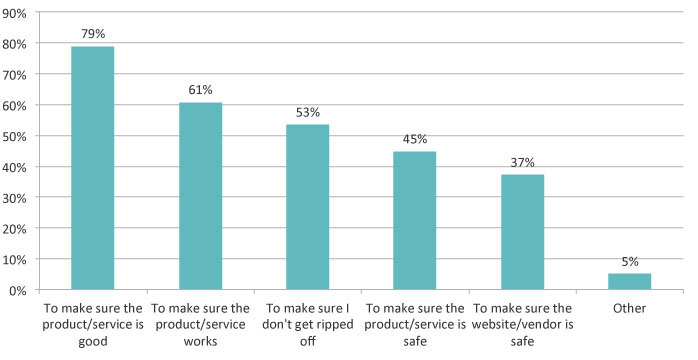
Overall 87% of Americans who read any online reviews find reviewer star ratings important, and 34% find them very important as an aid to decision making. Slightly more Americans find the written reviews to be important (90%) with 41% finding them very important. The main reasons given for using reviews are to ensure the product or service is of good quality (79%), that it works (61%) and to make sure that the purchaser doesn’t get ripped off (53%).

It’s easy to think that the only folks that leave reviews are those who wish to complain and that positive reviews should be taken with a grain of salt since it may be the company itself writing it.  Not so.

American reviewers generally write positive (74%) or neutral (32%) reviews, motivated to help others make better purchasing decisions (62%), or because they think it is polite to leave feedback (35%). Around a quarter want to share positive experiences (27%) and to help good vendors get business (25%). Only 12% are trying to expose poor vendors.

So what’s the business point?  Of all the forms of “content marketing” a brand might be considering, the review space is not one in which we want to play:

  • 90%, believe that some people review products and services without trying them and many believe that businesses manipulate reviews
  • 89% believe that businesses write negative reviews of competitors.
  • 91% believe businesses write their own positive reviews (36% believe that this happens often).
  • Only 13% believe online reviews are very trustworthy.

In other words, not only are the risks of being caught pretty high due to consumers’ natural suspicions but the value of the content is minimized both by the volume of other reviews and reviews seem to be only one of a multitude of sources from which consumers derive research.  Word of mouth and recommendations from informed friends are pretty important too.  Much better might be to monitor all reviews and respond to those which are off the mark in terms of product features, etc. as a comment and not a review.  It shows you care.

You do, right?

Leave a comment

Filed under Consulting, digital media