Monthly Archives: February 2014

B.B. And Your Business

TunesDay, and today it’s a visit from the King Of The Blues, Mr. B.B. King.  Anyone who has picked up a guitar in the last 60 years that has been influenced by his playing, even if indirectly. Number 6 on Rolling Stones’ 100 Greatest Guitarists Of All Time, B.B. King would be cited by each of the 5 ahead of him as critical in their learning. A member of the Rock & Roll Hall Of Fame (1987), he is one of the most influential musicians of all time.  Having seen him dozens of times I can also tell you he puts on a great show.  Today, we’re going to learn a little bit about business from him.

In 1969, he recorded an old (1931!) song called “The Thrill Is Gone.  It was his biggest hit and remains his signature tune.  I’ll get to this in a second, but first I want to focus on the title track of an album he released in 1972 called “Guess Who.”  It’s a perfect marketing lesson in under a minute and a half:

This is exactly the message brands and businesses need to convey:

Someone really loves you
Guess who, guess who
Someone really cares
Guess who

So open your heart
Oh, then surely you’ll see
That the someone who really cares is me

We need to be asking ourselves if that’s the message we’re putting out there or is it all “buy this”?  Contrast that lyric with the message B.B. reminds us is on every customer’s mind:

The thrill is gone baby
The thrill is gone away
You know you done me wrong baby
And you’ll be sorry someday

Yes indeed.  Consumers have never had so many choices – and so many brands competing for their attention and dollars – as they do now.  As long as we keep those two songs in our minds, those choices will be made in our favor.  Ignore them and it’s you who’ll be singing the blues.  You with me?

Enhanced by Zemanta

1 Comment

Filed under Helpful Hints, Music

Is Social Commerce For Real?

It’s Monday and it’s time to get our brains revved up for the week.  Let’s start with some thinking about Social Commerce.  This is a term used to describe marketing strategies that incorporate social media to make online buying and selling of products and services happen.  It’s actually what I write about a fair amount here on the screed since it’s separate and apart from the click to buy marketing (Free shipping this hour only!  50% off mukluks!) we see so often.  It’s really the more “conversational” part of marketing.   If you check in here from time to time you know that I’m a big advocate of that sort of stuff.  Then again, I could be terribly wrong and it might all be a waste of time.

Turns out that the good folks at UMass Dartmouth looked into it.  As they said:

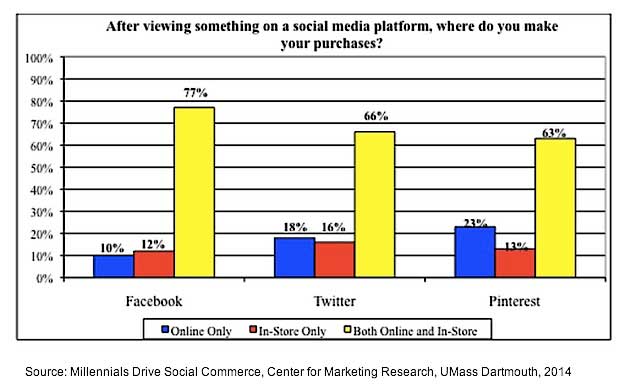
This study, conducted by the Center for Marketing Research at the University of Massachusetts Dartmouth, is an in-depth look at current purchasing habits and trends of Millennials using three of the most widely used social media platforms (Facebook, Twitter and Pinterest).  In an effort to discern what turns a like, follow or pin into a sale, this study explores and analyzes lead conversion tactics as identified by Millennials themselves.  Also included is a look at mobile technology and its role in online purchasing by measuring percentage of sales conducted through smart phones versus tablets.

So what did they find?  They focused on Millennials.  For those of you unfamiliar with the term, Millennials, also known as Generation Y, are defined as the folks born between 1980 and 2000.  Not surprisingly, they found that social media did drive purchase.  62% of respondents currently like at least one brand on Facebook.  Twitter has 23% of respondents following a brand and Pinterest has 11% of Millennials pinning a brand (Nike is the most liked/followed brand).  But those actions can lead to revenue and not just online.

  • Facebook, Twitter and Pinterest contribute to both online and in-store purchasing.  Seventy-seven percent of Facebook users, 66% of Twitter users and 63% of Pinterest users are multi-channel shoppers.
  • Of those who reported they had never purchased something after liking, following or pinning it online, offering a coupon or discount was the most frequently cited lead conversion tactic for Millennials.  Respondents indicated this is the top motivator leading to a sale.  Similarly, Millennials indicated that companies giving exclusive offers or appealing to their interests were more likely to see an increase in sales as a result of online interaction.

You can read more about this study here but the “news” is this:

Millennials are leading the social commerce movement.  They are more likely than any other group to like/follow/pin companies and brands.  They are enticed by coupons and discounts, purchase hair/beauty products and apparel, often using mobile phones and tablets.  They are multi-channel shoppers, buying both online and in-store.  This cohort is active online in ways that allow them to connect, organize, stay informed and shop.  They spend more money on Facebook, Twitter and Pinterest than other groups making them the ones to watch as social commerce surges forward.

In other words, engaging your audience, particularly your younger audience, is a valuable antecedent to making a sale.  So yes, Social Commerce does exist.  Aren’t you relieved?

Enhanced by Zemanta

Leave a comment

Filed under Consulting, digital media

Full Of Beans

Our Foodie Friday Fun revolves around stupid food labeling tricks.  It’s hard to believe some of the things food marketers do.  Some are just silly; others are downright deceptive by design.

From Alphaila.com

The latter is what I want to talk about today.  You really wouldn’t think that any smart brand manager would try this stuff in a time of massive social interaction among consumers.  You’d be wrong.  In fact, a bill was introduced last year (the Food Labeling Modernization Act of 2013) which seeks to change food labeling requirements as well as dealing with package labeling and allegedly misleading claims about what foods are “healthy,” “natural” or “made with whole grain.”   Now given the state of affairs in Washington, it’s not unlikely this bill will become law (oops, no politics here!).  However, the fact that the issue of deceptive packaging and marketing  is on the minds of both state and federal legislators doesn’t speak well of the industry.

Just because a package can say “No Trans Fat” if there is less than half a gram in the product doesn’t mean “no trans fat.”  If there is a half gram per serving and you eat two or three servings (as if you only eat the amount of snack foods that’s a single serving…), you’ve ingested an amount that should be identified.  “Natural” is sold as healthy when it’s can be anything but (see “high fructose corn syrup“).  Telling consumers that high-sugar products are good for them (Nutella) or how they’ll protect a kid’s immune system (Rice Krispies) is more dumb than dishonest.  But food brands aren’t the only ones.

Since it’s that diet time of year, false weight-loss claims are in vogue.  So much so that the FTC has issued Gut Check: A Reference Guide for Media on Spotting False Weight-Loss Claims, which is an update of a 2003 booklet on how media should treat weight-loss advertising.  We still saw ads for wearing sneakers that can make you skinny.  Let’s not even get started on airbrushing models.  It’s nice that someone is charged with verifying advertising claims but it does raise a very basic question.

Why would you lie?  Labeling lawsuits are skyrocketing.  Maybe in part because we live in a litigious world but maybe because it’s much easier for consumers to get information and to communicate.  Why would you feel the need to lie given those things?  Why does it take a lawsuit or governmental intervention or a social media blow-up when all that should be required to fix this is a brand manager’s common sense? Your ad may be for cereal but it often turns out the box is full of beans (as my Dad likes to say about people who are full of something else…).

Consumers are smart and getting smarter every day.  Treating them any differently is dumb, which you’re not, right?

Enhanced by Zemanta

Leave a comment

Filed under food, Huh?