Tag Archives: Television

Mass Markets And Mass Media

I’ve written a number of times over the last few years about the changing patterns of content consumption and how those changes are affecting the media business. I read some statistics last week that make me think we’re almost at the tipping point where we’ll see some irreversible things happening that affect not just media but marketing as well.

First, the statistics. The report is GfK‘s The Home Technology Monitor and while there wasn’t much “new” in it, the acceleration of some trends is interesting:

New findings from GfK show that US TV households are embracing alternatives to cable and satellite reception. Levels of broadcast-only reception and Internet-only video subscriptions have both risen over the past year, with fully one-quarter (25%) of all US TV households now going without cable and satellite reception. TV households with a resident between 18 and 34 years old are much more likely to be opting for alternatives to cable and satellite; 22% of these homes are using broadcast-only reception (versus 17% of all US households), and 13% are only watching an Internet service on their TV sets (versus 6% of all TV homes). Overall, 38% of 18-to-34 households rely on some kind of alternative TV reception or video source, versus 25% of all homes.

Why this is meaningful has to do with the symbiotic relationship between mass marketing and mass media. As Ben Thompson put it in a Stratechery post:

The inescapable reality is that TV advertisers are 20th-century companies: built for mass markets, not niches, for brick-and-mortar retailers, not e-commerce. These companies were built on TV, and TV was built on their advertisements, and while they are propping each other up for now, the decline of one will hasten the decline of the other.

As you can see from the chart, viewing of traditional TV by young people in the first quarter of this year (traditionally a high-viewing quarter as many people stay inside during winter) dropped precipitously. There aren’t many mass markets and there really aren’t mass media. Why, then, are we focused on measuring things that are no longer really relevant? Anyone?

1 Comment

Filed under digital media, What's Going On

An Hour More And Less

More and less? A typo right off the bat? Nope, not a chance. That’s a statement about time, which as I think we all know is a zero-sum game. Even if you don’t sleep there are still only 24 hours in a day. Why this is of note today is a report from the Nielsen folks and the implications the findings hold for you.

The results come from Nielsen’s Q1 2016 Total Audience Report, which you can read here. There is also an excellent summary on Adweek’s site. As the latter states: 

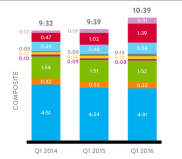
The total media consumption across all devices and platforms jumped one hour from the first quarter of 2015, to 10 hours, 39 minutes. (A year earlier, there had only been a seven-minute year-over-year jump in daily media consumption.) That’s mostly due to smartphone use, which has soared 37 minutes, and tablet use, which has increased 12 minutes. Internet on PC jumped 10 minutes, while multimedia devices, including Apple TV and Roku, were up four minutes. Video game consoles and DVR use was flat, while DVD use dipped one minute and live TV dropped three minutes year over year. Nielsen’s data indicates that consumers aren’t pulling away from linear TV, but instead are making additional time for these new devices.

An hour more each day with media sounds wonderful if you’re in the media business. The real question this raises with me is from where are consumers getting that extra hour? Do you think they’re sleeping less? Leaving work early? Maybe they’re watching on the job (so much for productivity). No, I suspect they’re just not doing something else. Shopping, dining out as much, going to other recreational activities. All this means is that as selective as consumers were in allocating their time to your non-media business they’re going to be even more so. That reinforces the need for all of us to provide value every time we have a consumer interaction or we won’t be having as many down the road.

As an aside, I’ll remind us that most of us, even if we make package goods, are now in the media business. Social sites, home base (your website!), and content we provide to others are all media, so it’s not a lost cause. Obviously, it’s fiercely competitive out there, and the hour more each day that consumers are spending in the space doesn’t mean they’re any less frugal with the time they spend. The job for each of us is to make up for the hour less they’re outside of media where we live and capture their attention within the extra hour they’re spending inside. We can do that through great content, content which is focused on providing value and solving their problems.  Make sense?

Leave a comment

Filed under digital media

You Always Hurt The One You Love

There is an old song made famous by The Mills Brothers. The first two lines are:

You always hurt the one you love
The one you shouldn’t hurt at all

Today’s screed is the unbelievable tale of a media entity that is doing just that. Why unbelievable? Because if I asked you to tell me the absolute dumbest thing any company could do you just might respond with exactly what this company is doing. Let me explain.

The Walking Dead is AMC’s (and maybe TV‘s) biggest show. Not unexpectedly, there are many fan groups that interact via social media. One of the biggest – about 400,000 strong – is a Facebook group called “The Spoiling Dead Fans.” As you might guess from the name, part of what the group does is to make predictions about what will occur in upcoming episodes, and lately, it’s about who was killed by a barbed wire coated baseball bat (named Lucille). These fans, as you might guess, would be classified as “hard-core.” They watch the show, the discuss the show, they pick apart every episode for clues. In short – they’re what every media entity wants: engaged, excited consumers.

So how has AMC rewarded these loyal fans? In their words:

In the past two years, AMC has filed several wrongful DMCA notices against us with full knowledge that we could not file counter-notices, hired investigators to intimidate our members, and threatened our local members with arrest, among other questionable acts.

Yep. They’re threatening to sue them. AMC believes “the predictions on the board are based on copyright protected, trade secret information about the most critical plot information in the unreleased next season of The Walking Dead”. If you’re not shaking your head about now, you should be. It’s not as if the fans have released footage or are torrenting purloined episodes. All they’re doing is keeping the show top of mind while it’s off the air between seasons. Is suing them for that really the best response?

If you’re over the age of 30, you’re old enough to remember when the music industry spent a lot of time and money suing consumers rather than using those resources to come up with a better business model (Steve Jobs did that for them). I think that alienation persists to this day.

I can’t imagine any instance where suing your best customers – hurting the ones who you shouldn’t hurt at all – is the best solution to a problem. Frankly, I’m not even sure that in this case there even is a problem. You?

Leave a comment

Filed under Huh?, Reality checks