Tag Archives: social media

Snapping Up Value

The hottest platform in social media these days is Snapchat. I’ve been a user for quite some time and I’m not sure I completely get how to use it yet. I’m amazed by the stories of those who do even if I’m discouraged that they all seem to be under 15.

As with all things eyeball related, advertisers are flocking to Snapchat because FOMO. Snapchat recently surpassed Twitter in terms of average daily users and even Facebook is feeling the heat as evidenced by their development of a Snapchat-like product. When you’re hot, you’re hot! Of course, heat has nothing to do with the success of a business unless it’s translated into revenue and profit, and so the Snapchat folks are actively selling themselves to marketers.  It’s therein where lies today’s business thought.

Advertisers are complaining about both the pricing and investment level needed to gain access to the Snapchat audiences. This from the Digiday folks:

Snapchat started selling ads in late 2014, and early products — one that went to every user and disappeared within 24 hours — cost about $750,000. In 2015, Snapchat brought down the price for video ads to 2 cents a view, or $20 for 1,000 views. This year, prices were back up with premium animated lenses that could cost millions depending on how many an advertiser bought in a given day, and interactive ads, where users can swipe up for more content, cost about $55 for 1,000 views.

I’ll agree that the level of investment required here is steep, even for big brands.  Other than special events, most unit investments in various media don’t require close to a million dollar outlay.  Obviously, and perhaps by design, the pool of advertisers becomes rather limited as well. Providing an API that will let marketers serve ads through third-party technology companies with a smaller outlay makes sense.  But that’s not the business point.

Where I disagree with Snapchat’s thinking is in dropping the CPM. We can’t ever allow price and value to become confused, whether we’re selling media or anything else. This platform has tremendous value – which I measure by both reach and engagement – and to drop pricing is a mistake. It’s the same thinking we faced in my TV days when trying to sell Super Bowl ads. High CPM? You bet. Tremendous cash outlay? Uh-huh. But the value of that exposure is unlike anything else in media, and in the nearly 20 years since I sold my last Super Bowl ad the value has only gotten higher.

The cost/value equation is one everyone in business needs to learn. Have you?
Leave a comment

Filed under digital media

An Hour More And Less

More and less? A typo right off the bat? Nope, not a chance. That’s a statement about time, which as I think we all know is a zero-sum game. Even if you don’t sleep there are still only 24 hours in a day. Why this is of note today is a report from the Nielsen folks and the implications the findings hold for you.

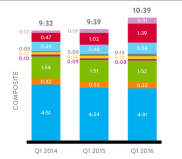
The results come from Nielsen’s Q1 2016 Total Audience Report, which you can read here. There is also an excellent summary on Adweek’s site. As the latter states: 

The total media consumption across all devices and platforms jumped one hour from the first quarter of 2015, to 10 hours, 39 minutes. (A year earlier, there had only been a seven-minute year-over-year jump in daily media consumption.) That’s mostly due to smartphone use, which has soared 37 minutes, and tablet use, which has increased 12 minutes. Internet on PC jumped 10 minutes, while multimedia devices, including Apple TV and Roku, were up four minutes. Video game consoles and DVR use was flat, while DVD use dipped one minute and live TV dropped three minutes year over year. Nielsen’s data indicates that consumers aren’t pulling away from linear TV, but instead are making additional time for these new devices.

An hour more each day with media sounds wonderful if you’re in the media business. The real question this raises with me is from where are consumers getting that extra hour? Do you think they’re sleeping less? Leaving work early? Maybe they’re watching on the job (so much for productivity). No, I suspect they’re just not doing something else. Shopping, dining out as much, going to other recreational activities. All this means is that as selective as consumers were in allocating their time to your non-media business they’re going to be even more so. That reinforces the need for all of us to provide value every time we have a consumer interaction or we won’t be having as many down the road.

As an aside, I’ll remind us that most of us, even if we make package goods, are now in the media business. Social sites, home base (your website!), and content we provide to others are all media, so it’s not a lost cause. Obviously, it’s fiercely competitive out there, and the hour more each day that consumers are spending in the space doesn’t mean they’re any less frugal with the time they spend. The job for each of us is to make up for the hour less they’re outside of media where we live and capture their attention within the extra hour they’re spending inside. We can do that through great content, content which is focused on providing value and solving their problems.  Make sense?

Leave a comment

Filed under digital media

Counting On Social

I can’t think of a single company with which I’ve had contact in the last year or two that isn’t somehow engaged in social media marketing. Maybe it’s a Facebook page or an Instagram account or maybe it’s just executives posting on LinkedIn. It’s always surprising when I inquire about the other end of that content funnel. How is social working? What are your goals? The surprise has to do with the lack of a coherent plan to track and measure the social media efforts these companies are making. I’d like to provide a little food for thought on that today.

First, it goes without saying that however you’re measuring social it should also integrate into whichever analytics platform you’re using. It’s really pretty easy to tag, for example, any URL with the parameters needed by Google Analytics to report social activity beyond the defaults offered along with any supporting ads you’re running or email campaigns. It’s a little more effort but possible even to track “dark social” that way using a combination of custom segments and/or third party tools. Dark social, by the way, is the term used to refer to all that wonderful content you produce that’s shared among readers via email or text messages or some other non-public platform. Some folks have figured that as much as 85% or more of content is shared that way, so you shouldn’t ignore it.

Back to our topic. Analytics measure “how much”. In addition, you need to be measuring how readers feel. It’s not a great situation to have a lot of consumers posting and sharing negative things about your brand. If you’re only measuring how much activity, that might look like a win. At the most simple level, you should be paying attention to comments and posts. There are free tools available to locate and compile this information. You can then do your own sentiment analysis or use a tool to do so if the volume is just too great (a good problem to have!).

Finally, you should try to understand how many of the people who follow you on one platform are also tracking you on others.  These “superfans” are probably your best targets and the ability to identify them in order to reward their loyalty is a massively impactful bit of research.  You can’t ignore the analytics most platforms offer as well.  They can help in understanding not only who your audience is but what resonates with them (and that’s really true if you can add the dark social shares discussed earlier).

Wha to measure?  I’m not going to tell you since whatever it is needs to reflect your business goals and the tactics you’ve taken.  There is a pretty good list in this article to help your thinking but I’d urge you to get beyond the quantitative things such as “likes” or “followers” and more into the qualitative things such as engagement.  What’s important is that you not just throw your social efforts out into the digital ozone.  OK?

Leave a comment

Filed under Consulting, digital media