Tag Archives: Social media marketing

Reviewing Reviews

Now that the shopping season is over, you might be getting emails from stores to leave reviews for the products you bought.  Reviews are part of what should be a virtuous circle – consumers need information about a pending purchase, read reviews, select and buy the product, and leave reviews for the next person.  I certainly use them when making purchases and I suspect you do as well.
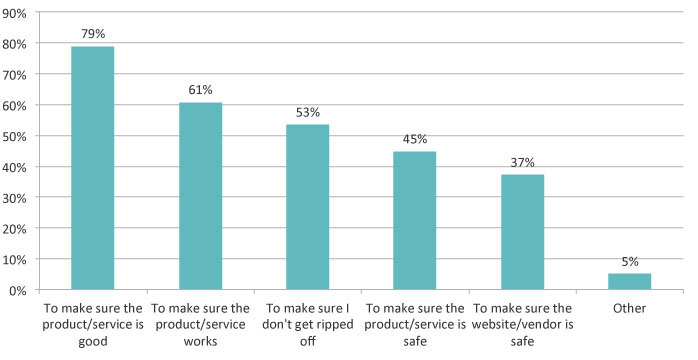
We’re not alone.  According to a YouGov study:

The majority of Americans rely on online reviews. 78% check out the review section before making a purchase and nearly half of Americans (44%) are active contributors, actively writing reviews if only occasionally. Americans rely heavily on online review ratings and comments despite believing that many ratings are untrustworthy.

Huh?  We think reviews are bogus and use them anyway?  Apparently so.

Overall 87% of Americans who read any online reviews find reviewer star ratings important, and 34% find them very important as an aid to decision making. Slightly more Americans find the written reviews to be important (90%) with 41% finding them very important. The main reasons given for using reviews are to ensure the product or service is of good quality (79%), that it works (61%) and to make sure that the purchaser doesn’t get ripped off (53%).

It’s easy to think that the only folks that leave reviews are those who wish to complain and that positive reviews should be taken with a grain of salt since it may be the company itself writing it.  Not so.

American reviewers generally write positive (74%) or neutral (32%) reviews, motivated to help others make better purchasing decisions (62%), or because they think it is polite to leave feedback (35%). Around a quarter want to share positive experiences (27%) and to help good vendors get business (25%). Only 12% are trying to expose poor vendors.

So what’s the business point?  Of all the forms of “content marketing” a brand might be considering, the review space is not one in which we want to play:

  • 90%, believe that some people review products and services without trying them and many believe that businesses manipulate reviews
  • 89% believe that businesses write negative reviews of competitors.
  • 91% believe businesses write their own positive reviews (36% believe that this happens often).
  • Only 13% believe online reviews are very trustworthy.

In other words, not only are the risks of being caught pretty high due to consumers’ natural suspicions but the value of the content is minimized both by the volume of other reviews and reviews seem to be only one of a multitude of sources from which consumers derive research.  Word of mouth and recommendations from informed friends are pretty important too.  Much better might be to monitor all reviews and respond to those which are off the mark in terms of product features, etc. as a comment and not a review.  It shows you care.

You do, right?

Leave a comment

Filed under Consulting, digital media

It Ain’t Me Babe

You might think from the title of today’s screed that I’m going to get into another Dylan rant. Nope. I’m just borrowing a song title from him because it was the first thing that popped into my head when I read something.

twitter fail image

(Photo credit: Wikipedia)

I realize that research can be boring but here is the factoid that blew my mind: 40% of Facebook accounts and 20% of Twitter accounts claiming to represent a Fortune 100 brand are unauthorized. That comes out of a research report from the good folks at Nexgate. They analyzed the 32,000 social media accounts associated with the Fortune 100 between July 2013 and June 2014 to compile their State of Social Media Infrastructure, Part 2 report. The findings are disturbing, at least to me, and should be a warning to anyone in business who manages a social media account.

It found that the average firm had 320 accounts on various platforms, but that many were false. How exactly any company, even these very big ones, can keep up with 320 accounts is beyond me although I suppose you could convince me of the need for very granular Twitter accounts, for example, with which to do customer service. 2.29 accounts per firm indicated that they had probably been hijacked, while social spam on accounts grew a staggering 658% since mid-2013.  Links to porn, malicious software, and worse are rampant.  I suspect that using the excuse that “it wasn’t us; it was an evil person using our good name” isn’t going to cut it.

Obviously the first thing any smart business should do is to  create an inventory of legitimate accounts.  From that you find the other accounts and ask that they be taken down.  It’s also important not to just “set and forget” what’s going on within the real accounts.  People do manage to hack their way in and spammers have figured out ways to hijack threads.  In other words part of “listening” is hearing yourself as part of the conversation and taking action when your own voice seems inauthentic.

Make sense?

Leave a comment

Filed under Consulting, digital media

Whistling In The Dark

When we’re afraid of something but want to put on a brave face, we’re said to be whistling in the dark.  I suspect that many marketers are, or should be, doing exactly that.  It seems, you see, that the level of mistrust of what brands are putting out there is so high that a significant portion of online users trust a stranger’s opinion on public forums or blogs more than they trust branded advertisements.

source: images.jupiterimages.com

The Forrester folks found that nearly a third – 32% – of people feel that way.  One response, therefore, might be to consider a shift to content marketing.  As I’ve written before, since much of that sort of marketing is what one might term “sneaky” I think it compounds the mistrust situation.   Maybe the right answer is to find and engage brand advocates – someone who enjoys your product or service so much that they’re eager to tell others about it.  It’s not hard to find them – see who is engaging with the social content you’re putting out there for starters.  Maybe offer them a discount.  Maybe give them “insider” access or let them know what’s in the product pipeline.

Most of what you’re trying to do is to make them feel special because they are.  They are a trusted resource to their networks and what they say is more believable to many than what you have to say as a brand.  Of course that also means you can’t lie to them or mislead them.  The stakes become higher since they can tear you down just as quickly as they can help you grow.  Then again, since we’re always trying to be consumer-focused, open and honest in our marketing, this should not be an issue.

We can whistle in the dark and pretend all is well or we can think about improving what we’re doing every day without hanging on to legacy thinking.  Your call.

Leave a comment

Filed under digital media, Thinking Aloud