Tag Archives: digital media

Why Free Data Is A Bad Thing For You

Everyone likes “free.” Heck, there are plenty of marketing tomes that say “free” might just be the most powerful word in marketing. Well, as usual, I’m here to burst your bubble about one particular aspect of something free which I find detrimental to us all. It’s something aggressively marketed by T-Mobile and Verizon but others do it as well. It’s called Zero-rating of data. Their “Binge On” and “FreeBee Data 360” offerings provide subscribers with free streaming media that doesn’t count against their data plans.

The basic concept is that ISP‘s – in this case the two aforementioned wireless carriers – don’t charge consumers for data used when the consumers use specific sites or services. That’s pretty appealing. In fact, T-Mobile reports that mobile subscribers who sign up for their “zero-rated video” offering immediately double their consumption of video. So why is this a bad thing?

Verizon bought Yahoo this morning. They previously bought AOL. One might expect that those two companies and their services will become zero-rated for Verizon customers. While T-Mobile has yet to buy a competitor, one can easily imagine them assembling their own lineup of content and service providers. Cable providers have been doing the same thing for a long time with fledgling cable networks. They take equity in these companies and, in return, provide carriage on a better tier (meaning it’s more widely available). These cable providers are also ISP’s.

The reason our digital ecosystem is flourishing is that until recently there was no one picking losers and winners. Zero-rating does exactly that. Think about the food court at a mall. There are two restaurants side by side, but one serves free food which is paid for by the mall landlords. Which one do you think will have the longer line, regardless of the quality of the food served? If a new streaming service enters the market but there is no data charge to visit their entrenched competitors, what chances do they have to succeed?

So yes, everyone likes free but in this case free is a bad thing. It will restrict the development of new companies. It will give more power to the gatekeepers. It enables internet providers to gain a significant advantage in the promotion of in-house services over competing independent companies, especially in data-heavy markets like video-streaming. Does that make sense?

Leave a comment

Filed under digital media, Reality checks

Mass Markets And Mass Media

I’ve written a number of times over the last few years about the changing patterns of content consumption and how those changes are affecting the media business. I read some statistics last week that make me think we’re almost at the tipping point where we’ll see some irreversible things happening that affect not just media but marketing as well.

First, the statistics. The report is GfK‘s The Home Technology Monitor and while there wasn’t much “new” in it, the acceleration of some trends is interesting:

New findings from GfK show that US TV households are embracing alternatives to cable and satellite reception. Levels of broadcast-only reception and Internet-only video subscriptions have both risen over the past year, with fully one-quarter (25%) of all US TV households now going without cable and satellite reception. TV households with a resident between 18 and 34 years old are much more likely to be opting for alternatives to cable and satellite; 22% of these homes are using broadcast-only reception (versus 17% of all US households), and 13% are only watching an Internet service on their TV sets (versus 6% of all TV homes). Overall, 38% of 18-to-34 households rely on some kind of alternative TV reception or video source, versus 25% of all homes.

Why this is meaningful has to do with the symbiotic relationship between mass marketing and mass media. As Ben Thompson put it in a Stratechery post:

The inescapable reality is that TV advertisers are 20th-century companies: built for mass markets, not niches, for brick-and-mortar retailers, not e-commerce. These companies were built on TV, and TV was built on their advertisements, and while they are propping each other up for now, the decline of one will hasten the decline of the other.

As you can see from the chart, viewing of traditional TV by young people in the first quarter of this year (traditionally a high-viewing quarter as many people stay inside during winter) dropped precipitously. There aren’t many mass markets and there really aren’t mass media. Why, then, are we focused on measuring things that are no longer really relevant? Anyone?

1 Comment

Filed under digital media, What's Going On

Killing It At The Source

Suppose you sit down at a restaurant and look over the menu.  Seeing a few things which seemed appealing, you place your order.  How would you feel if you found out that while the main course was cooked in-house, the starters and desserts were all made across the street and brought it?  I’d feel kind of cheated.  My expectation is that when I order off a place’s menu that they’re making what I’m served. They’re certainly taking credit for it.

As it turns out, that’s exactly what’s happening in the online publishing world and I think it’s suicidal. It’s called “sourced traffic” and this is an excellent definition:

The practice of sourcing traffic is essentially any means by which digital media publishers or vendors acquire audience (visitors) through third parties.  So, this is audience being sold by the vendor which is not occurring in the traditional advertising model (by which a publisher puts out content which attracts an audience and then sells ads to reach that audience).  In other words, sourced traffic is by definition not organic traffic to the publisher’s site.

In other words, publishers are selling audiences they don’t have just to add some audience to their delivery stats. The first issue I have is much the same as I might have with the aforementioned restaurant – taking credit for something that’s not yours. My guess is that most publishers – like most buyers – are very much focused on the numbers and not at all focused on the quality of what’s being delivered. I would be quite upset if I paid for a prix fixe meal and the quality of the parts not made in-house were substantially lower.

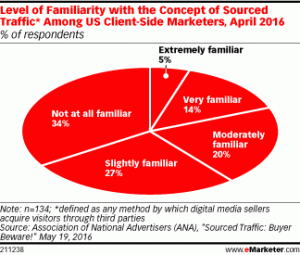
The bigger issue brings us right back to our old friend, fraud. A White Ops and ANA study of non-human traffic from 2014 found that while a direct audience is mostly human, sourced traffic is almost 90% attributable to bots. eMarketer reported this the other day about an ANA study:

According to the data, 34% of respondents—also ANA members—said they were not at all familiar with sourced traffic. Meanwhile, 19% said they were very or extremely familiar. But perhaps more interestingly, the majority (54%) of those surveyed, said weren’t sure if any of their digital media buys included some form of traffic sourcing.

And we wonder why digital doesn’t receive as much weight in media buying as the audiences warrant?  All players – publishers, buyers, and clients – need to step up their game here and fix the sourced traffic problem.  Otherwise, who is going to want to eat in this restaurant?

Leave a comment

Filed under digital media, Huh?