Tag Archives: digital media

57 Channels

Anyone with whom I speak these days has a lot to say about competition. Every business seems to have many more players going head to head for customers, and I suspect that nowhere is that more true than in the media business. The Boss wrote about “57 Channels And Nothing On” a couple of decades ago. He characterized it as having been “Shot back in the quaint days of only 57 channels and no flat screen TVs”, and 25 years later the average home can receive nearly 206 channels, according to Nielsen. What is instructive to anyone is business, however, is that they watch fewer than 20, or under 10% (19.8 channels, to be precise).

Obviously, consumers are spending just as much, if not more, time with video content. It’s not a matter of the video business being imperiled. What is a problem, however, is the manner in which the traditional business model operates. Video providers have bundled together dozens (hundreds!) of channels and sold them to consumers who really had very limited choices in breaking the bundle of channels apart. You’re beginning to see “skinny bundles” which focus on a few popular channels. Although I’m not aware of any “roll your own” packages in which a consumer can choose any channels and create their own bundles, they aren’t far off. Rest assured that if the cable and satellite guys don’t offer them, someone will.

Consumers aren’t rejecting TV – they’re rejecting a business model which forces them to pay for TV they don’t watch. That’s something that isn’t unique to cable and satellite. Fast food does it. You might end up paying more for something if you don’t want the fries or soda and, therefore, buy ala carte. Software companies do it. The music business did it (an album was always cheaper than buying the best songs on that album as singles). 5 years ago, researchers found that consumers might actually value a bundle less than they would value the individual component products. There was a “negative synergy” associated with the bundle. The key to successful bundling it seems is to provide an option to buy the individual components or the bundle. When that option isn’t there, sales actually declined significantly.

We can’t sit on existing business models anymore no matter what business we’re in. We certainly can’t force consumers to pay for things they don’t really want to get those things they do want. I’m watching the changes in the video business with great curiosity (and some degree of thanks that I’m no longer in it!). You?
Leave a comment

Filed under Consulting, digital media

Quit Pushing Me

We discuss engagement in this space fairly often. I’ve made no bones about the fact that I’m a believer in The Cluetrain Manifesto and that markets are conversations. Think about a conversation you’d have at a bar or a party. You would listen at least as much as you spoke and you probably wouldn’t keep tossing random lines at people, especially if those lines are only about you. Now let’s look at a piece of research.

According to The Future of Content: Rethinking Content Consumption, a national survey report, consumers want to discover digital content on their own and are skeptical of brands pushing online ads through interruptive channels. Rapt Media, recently surveyed an audience of more than 1,000 consumers to understand how content discovery is driving the content personalization trend.

Insights reveal consumers want personalized content experiences that are meaningful, helpful and valuable to their specific needs and interests. But equally important is their empowerment in discovering it on their own. The younger millennial generation is especially mistrusting of brands pushing interruptive online ads.

Key findings from the survey include:

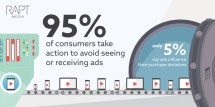
● 95% take action to avoid seeing or receiving online ads
● 5% say ads influence their purchase decisions
● 57% of millennials block ad content because it is too pushy
● 43% say online ads are not personalized to their interests, but 62% say the content they discover on their own is personalized
● 61% say that even if content is customized, they still prefer to find it on their own
● 46% say content they find on their own influences their purchase decisions

I especially like this quote: “Programmatic push messaging is implicit personalization perceived by consumers as irrelevant and inauthentic.” Yep. The findings confirm that consumers have come to expect content personalization along with the opportunity to shape their own experience, so why are we spending time and resources on doing anything that delivers an experience other than that? Maybe we need to make our business behavior more like our cocktail party behavior (and who has ever pondered THAT before?)?

Leave a comment

Filed under Consulting, Helpful Hints

How Not To Get Fired By Consumers

When one of my managers would hire a new person, I always tried to sit that new person down for a few minutes in the middle of their busy (and probably scary) first day. The purpose was to welcome them aboard and to let them know that there was only one thing they could do (other than to break the law or the HR rules, obviously) that would cost them their job. That one thing was lying. In my mind, lying – to me, to their manager, to their co-workers – causes a lack of trust, and that mutual trust is what sees the team through all the challenges of the workplace.

That sort of thinking is what makes me wonder why marketers seem happy to lie all the time. I’m not talking about violating the law and mislabeling products. I’m talking about something much more common which is branded content. Now you might moot thing of branded content as lying, but your customers do. This from the folks at Citi (via Business Insider):

Looking at branded content — specifically as it relates to Facebook‘s opportunity in the space — Citi found that 48% of US internet users felt deceived upon realizing an article or video was not a piece of news or commentary, but was in fact a commercial.

I’m not talking about something like a review guide that was funded by a brand being reviewed as long as it was truly an independant work and properly identified as having been funded by a brand. That is content that is created for the audience and has value. I mean a glowing review, seemingly from a reputabile source,  that is clearly created to promote a single brand. Most of the time there is a little label someplace that mentions it’s an ad, but not always and not always prominent enough for a consumer to notice.

Are you creating content for the consumer or for yourself? Is the content deceptive in any way? Ads disguised as content is lying, and lying will get you fired, even if you’re a brand. You agree?

Leave a comment

Filed under Helpful Hints, Huh?