Category Archives: Helpful Hints

Measuring What Matters

English: A business ideally is continually see...

(Photo credit: Wikipedia)

I read an interesting report from the Forrester folks this morning. It is about business-to-business marketing but I think it’s instructive to any of us who are in marketing. It’s called “Metrics That Matter For B2B Marketers” and you can read it here. I’m a big fan of the premise:

B2B marketers must do more than measure activities like click-through rates and event attendees; they need to show how their activity directly affects business results. This report shows marketers how to provide insight on the things that matter most to their executive peers and the board — growth in revenue, profit, and customers. While marketers need to capture a wide range of metrics, this report focuses on measuring marketing’s contribution to revenue as a function of customer acquisition and installed base growth.

When I was in TV and marketing (which probably should have been called business development) was a relatively new concept (as opposed to sales which was there from day one), I always felt that part of my role as “the marketing guy” was to demonstrate that marketing was part of the revenue-generating part of the team. The only way to do that was to quantify how what I was doing was driving sustainable business.

Fast forward a lot of years. All of us in marketing are deluged with data. The problem, as the report points out, is that many folks take the easy way out and measure the easy to find stuff while ignoring the pieces of information that may be more impactful to the business but harder to discern. As the report says:

Marketers need to measure a lot of things to understand what is working and what isn’t. Unfortunately, most get stuck measuring activity, not value: More than half (61%) of the marketers we surveyed admitted that most of their data work went into reporting on how they did, not showing how marketing drives better business results.

Measure what matters. Measure quality over quantity. Don’t “manage to metrics rather than performance.” OK?
Leave a comment

Filed under Consulting, digital media, Helpful Hints

Quit Pushing Me

We discuss engagement in this space fairly often. I’ve made no bones about the fact that I’m a believer in The Cluetrain Manifesto and that markets are conversations. Think about a conversation you’d have at a bar or a party. You would listen at least as much as you spoke and you probably wouldn’t keep tossing random lines at people, especially if those lines are only about you. Now let’s look at a piece of research.

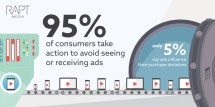
According to The Future of Content: Rethinking Content Consumption, a national survey report, consumers want to discover digital content on their own and are skeptical of brands pushing online ads through interruptive channels. Rapt Media, recently surveyed an audience of more than 1,000 consumers to understand how content discovery is driving the content personalization trend.

Insights reveal consumers want personalized content experiences that are meaningful, helpful and valuable to their specific needs and interests. But equally important is their empowerment in discovering it on their own. The younger millennial generation is especially mistrusting of brands pushing interruptive online ads.

Key findings from the survey include:

● 95% take action to avoid seeing or receiving online ads
● 5% say ads influence their purchase decisions
● 57% of millennials block ad content because it is too pushy
● 43% say online ads are not personalized to their interests, but 62% say the content they discover on their own is personalized
● 61% say that even if content is customized, they still prefer to find it on their own
● 46% say content they find on their own influences their purchase decisions

I especially like this quote: “Programmatic push messaging is implicit personalization perceived by consumers as irrelevant and inauthentic.” Yep. The findings confirm that consumers have come to expect content personalization along with the opportunity to shape their own experience, so why are we spending time and resources on doing anything that delivers an experience other than that? Maybe we need to make our business behavior more like our cocktail party behavior (and who has ever pondered THAT before?)?

Leave a comment

Filed under Consulting, Helpful Hints

How Not To Get Fired By Consumers

When one of my managers would hire a new person, I always tried to sit that new person down for a few minutes in the middle of their busy (and probably scary) first day. The purpose was to welcome them aboard and to let them know that there was only one thing they could do (other than to break the law or the HR rules, obviously) that would cost them their job. That one thing was lying. In my mind, lying – to me, to their manager, to their co-workers – causes a lack of trust, and that mutual trust is what sees the team through all the challenges of the workplace.

That sort of thinking is what makes me wonder why marketers seem happy to lie all the time. I’m not talking about violating the law and mislabeling products. I’m talking about something much more common which is branded content. Now you might moot thing of branded content as lying, but your customers do. This from the folks at Citi (via Business Insider):

Looking at branded content — specifically as it relates to Facebook‘s opportunity in the space — Citi found that 48% of US internet users felt deceived upon realizing an article or video was not a piece of news or commentary, but was in fact a commercial.

I’m not talking about something like a review guide that was funded by a brand being reviewed as long as it was truly an independant work and properly identified as having been funded by a brand. That is content that is created for the audience and has value. I mean a glowing review, seemingly from a reputabile source,  that is clearly created to promote a single brand. Most of the time there is a little label someplace that mentions it’s an ad, but not always and not always prominent enough for a consumer to notice.

Are you creating content for the consumer or for yourself? Is the content deceptive in any way? Ads disguised as content is lying, and lying will get you fired, even if you’re a brand. You agree?

Leave a comment

Filed under Helpful Hints, Huh?