Tag Archives: social media

Data, Data Everywhere (Part 2)

Yesterday I discussed finding a couple of articles that didn’t make sense in the context of one another.

Image representing IBM as depicted in CrunchBase

Image via CrunchBase

The first was about a lack of data from digital media and how that medium needs to be more accountable.  Today’s article is about a study conducted by IBM.  As they said in their release:

The study, entitled “Stepping up to the challenge: How CMOs can start to close the aspirational gap,” is based on findings from face-to-face conversations with more than 500 CMOs from 56 countries and 19 industries worldwide. Conducted by IBM’s Institute for Business Value (IBV), the study reveals that 94 percent of CMOs believe advanced analytics will play a significant role in helping them reach their goals. However, an increased number of CMOs say their organizations are underprepared to capitalize on the data explosion – 82 percent compared to 71 percent three years before.

In other words, there is already too much information crossing the desks of the folks in marketing and the people in charge can’t make sense of what they have now.  It’s only going to get worse as the marketing information generated from mobile and social continue to grow.  Is digital media not accountable as claimed by the head of the ANA or is it TOO accountable and overwhelming as found by this study?

These two pieces taken together point out the reality of marketing these days.  We are awash in an ocean of data and it’s no longer about “do we have the information?” but “can we find the right information among all of the data we have?”  I’ve had clients who told me they had little transparency into what was going on with their customers but because they didn’t have a thorough understanding of data systems they already had in place – web analytics, social media measures, etc. – they were wrong.

The claim that digital isn’t accountable and lacks data is a negotiating position, similar in my mind to the dance that goes on each year before the networks begin to sell in their upfront season.  If anything, the fault with digital is that it’s still relatively new and old ways of thinking about media and data are changing (or should be).  So yes, to paraphrase the Rime Of The Ancient Mariner, there’s data data everywhere but I think there’s plenty to drink. Maybe even too much. What’s your take?

Enhanced by Zemanta

Leave a comment

Filed under digital media, Huh?

Is Social Commerce For Real?

It’s Monday and it’s time to get our brains revved up for the week.  Let’s start with some thinking about Social Commerce.  This is a term used to describe marketing strategies that incorporate social media to make online buying and selling of products and services happen.  It’s actually what I write about a fair amount here on the screed since it’s separate and apart from the click to buy marketing (Free shipping this hour only!  50% off mukluks!) we see so often.  It’s really the more “conversational” part of marketing.   If you check in here from time to time you know that I’m a big advocate of that sort of stuff.  Then again, I could be terribly wrong and it might all be a waste of time.

Turns out that the good folks at UMass Dartmouth looked into it.  As they said:

This study, conducted by the Center for Marketing Research at the University of Massachusetts Dartmouth, is an in-depth look at current purchasing habits and trends of Millennials using three of the most widely used social media platforms (Facebook, Twitter and Pinterest).  In an effort to discern what turns a like, follow or pin into a sale, this study explores and analyzes lead conversion tactics as identified by Millennials themselves.  Also included is a look at mobile technology and its role in online purchasing by measuring percentage of sales conducted through smart phones versus tablets.

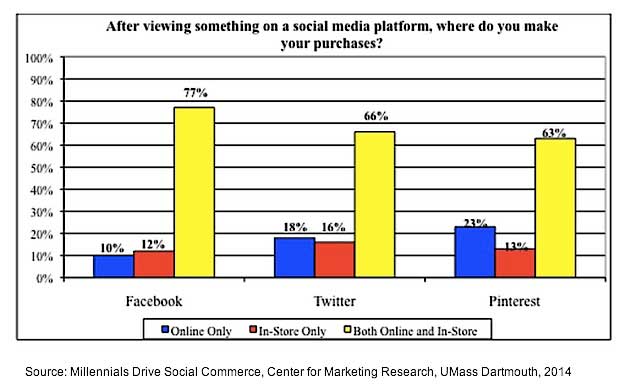
So what did they find?  They focused on Millennials.  For those of you unfamiliar with the term, Millennials, also known as Generation Y, are defined as the folks born between 1980 and 2000.  Not surprisingly, they found that social media did drive purchase.  62% of respondents currently like at least one brand on Facebook.  Twitter has 23% of respondents following a brand and Pinterest has 11% of Millennials pinning a brand (Nike is the most liked/followed brand).  But those actions can lead to revenue and not just online.

  • Facebook, Twitter and Pinterest contribute to both online and in-store purchasing.  Seventy-seven percent of Facebook users, 66% of Twitter users and 63% of Pinterest users are multi-channel shoppers.
  • Of those who reported they had never purchased something after liking, following or pinning it online, offering a coupon or discount was the most frequently cited lead conversion tactic for Millennials.  Respondents indicated this is the top motivator leading to a sale.  Similarly, Millennials indicated that companies giving exclusive offers or appealing to their interests were more likely to see an increase in sales as a result of online interaction.

You can read more about this study here but the “news” is this:

Millennials are leading the social commerce movement.  They are more likely than any other group to like/follow/pin companies and brands.  They are enticed by coupons and discounts, purchase hair/beauty products and apparel, often using mobile phones and tablets.  They are multi-channel shoppers, buying both online and in-store.  This cohort is active online in ways that allow them to connect, organize, stay informed and shop.  They spend more money on Facebook, Twitter and Pinterest than other groups making them the ones to watch as social commerce surges forward.

In other words, engaging your audience, particularly your younger audience, is a valuable antecedent to making a sale.  So yes, Social Commerce does exist.  Aren’t you relieved?

Enhanced by Zemanta

Leave a comment

Filed under Consulting, digital media

Small Guys, Big Voices

I spent part of the weekend getting caught up on everything going on across the various social networks to which I belong.

Facebook logo Español: Logotipo de Facebook Fr...

(Photo credit: Wikipedia)

It’s an impossible task, by the way.  It’s really the epitome of living in the moment because one can’t ever really get “caught up” – a post from a week ago is so…last week, I guess.  In any event, it got me thinking about how social media keeps changing and how what I tell clients about optimizing their use of that channel needs to change as well.

Sometimes I think the Internet should be called “The Great Equalizer,” since it puts the small guys on an even footing with the big guys.  It may seem to you as if every company/brand/retailer you know is on Facebook and you’re right: 92% of them use it.  The majority of them are on YouTube, Twitter, LinkedIn, and publish some sort of blog.  Unlike regular advertising, a bigger budget doesn’t assure you of bigger visibility.  If as a smaller business you’re going to be good at social media and conduct what some term “social commerce” it’s pretty obvious that you can’t outspend the big guys in your category.  You need to outsmart them with great content, and make wise choices about where to devote resources, both human and financial.

I’ll admit to have hardly ever clicked on an ad on a social site.  I do, however, read posts from brands all the time and once in a while I’ll click-through those to find something that’s piqued my interest.  I’ve even bought something as a result.  I’m not alone.  According to Internet Retailer 2014 Social Media 500, which ranks online merchants on the percentage of site traffic they receive from social networks:

  • Monthly referral traffic to e-commerce sites from Facebook, Twitter, Pinterest and YouTube increased 42% in 2013 to 51.5 million monthly unique visitors from 36.3 million.
  • Social commerce sales retailers raked in, that is, revenue derived from those visitors, jumped nearly 63% to $2.69 billion from $1.65 billion.
  • Spending on social ads by 40 retailers that supplied data increased 400% from 2012 to 2013.

It’s the small guys driving those numbers.  The challenge for them – and maybe for you – is to overcome the clutter in every user’s social landscape. That clutter in not the only issue. The fact that only a tiny fraction of what you post appears in your fans’ news feeds means that you must get the user to seek you out and to do so often enough that the algorithms see you as a close enough “friend” to put your news in those “top news” feeds.  You up to the task?

Enhanced by Zemanta

Leave a comment

Filed under Consulting, digital media