Tag Archives: media

An Hour More And Less

More and less? A typo right off the bat? Nope, not a chance. That’s a statement about time, which as I think we all know is a zero-sum game. Even if you don’t sleep there are still only 24 hours in a day. Why this is of note today is a report from the Nielsen folks and the implications the findings hold for you.

The results come from Nielsen’s Q1 2016 Total Audience Report, which you can read here. There is also an excellent summary on Adweek’s site. As the latter states: 
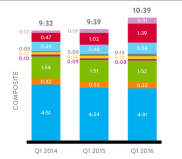
The total media consumption across all devices and platforms jumped one hour from the first quarter of 2015, to 10 hours, 39 minutes. (A year earlier, there had only been a seven-minute year-over-year jump in daily media consumption.) That’s mostly due to smartphone use, which has soared 37 minutes, and tablet use, which has increased 12 minutes. Internet on PC jumped 10 minutes, while multimedia devices, including Apple TV and Roku, were up four minutes. Video game consoles and DVR use was flat, while DVD use dipped one minute and live TV dropped three minutes year over year. Nielsen’s data indicates that consumers aren’t pulling away from linear TV, but instead are making additional time for these new devices.

An hour more each day with media sounds wonderful if you’re in the media business. The real question this raises with me is from where are consumers getting that extra hour? Do you think they’re sleeping less? Leaving work early? Maybe they’re watching on the job (so much for productivity). No, I suspect they’re just not doing something else. Shopping, dining out as much, going to other recreational activities. All this means is that as selective as consumers were in allocating their time to your non-media business they’re going to be even more so. That reinforces the need for all of us to provide value every time we have a consumer interaction or we won’t be having as many down the road.

As an aside, I’ll remind us that most of us, even if we make package goods, are now in the media business. Social sites, home base (your website!), and content we provide to others are all media, so it’s not a lost cause. Obviously, it’s fiercely competitive out there, and the hour more each day that consumers are spending in the space doesn’t mean they’re any less frugal with the time they spend. The job for each of us is to make up for the hour less they’re outside of media where we live and capture their attention within the extra hour they’re spending inside. We can do that through great content, content which is focused on providing value and solving their problems.  Make sense?
Leave a comment

Filed under digital media

Killing It At The Source

Suppose you sit down at a restaurant and look over the menu.  Seeing a few things which seemed appealing, you place your order.  How would you feel if you found out that while the main course was cooked in-house, the starters and desserts were all made across the street and brought it?  I’d feel kind of cheated.  My expectation is that when I order off a place’s menu that they’re making what I’m served. They’re certainly taking credit for it.

As it turns out, that’s exactly what’s happening in the online publishing world and I think it’s suicidal. It’s called “sourced traffic” and this is an excellent definition:

The practice of sourcing traffic is essentially any means by which digital media publishers or vendors acquire audience (visitors) through third parties.  So, this is audience being sold by the vendor which is not occurring in the traditional advertising model (by which a publisher puts out content which attracts an audience and then sells ads to reach that audience).  In other words, sourced traffic is by definition not organic traffic to the publisher’s site.

In other words, publishers are selling audiences they don’t have just to add some audience to their delivery stats. The first issue I have is much the same as I might have with the aforementioned restaurant – taking credit for something that’s not yours. My guess is that most publishers – like most buyers – are very much focused on the numbers and not at all focused on the quality of what’s being delivered. I would be quite upset if I paid for a prix fixe meal and the quality of the parts not made in-house were substantially lower.

The bigger issue brings us right back to our old friend, fraud. A White Ops and ANA study of non-human traffic from 2014 found that while a direct audience is mostly human, sourced traffic is almost 90% attributable to bots. eMarketer reported this the other day about an ANA study:

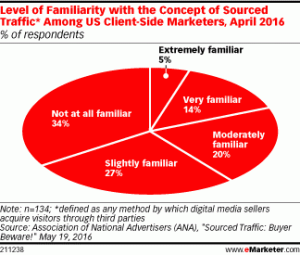
According to the data, 34% of respondents—also ANA members—said they were not at all familiar with sourced traffic. Meanwhile, 19% said they were very or extremely familiar. But perhaps more interestingly, the majority (54%) of those surveyed, said weren’t sure if any of their digital media buys included some form of traffic sourcing.

And we wonder why digital doesn’t receive as much weight in media buying as the audiences warrant?  All players – publishers, buyers, and clients – need to step up their game here and fix the sourced traffic problem.  Otherwise, who is going to want to eat in this restaurant?

Leave a comment

Filed under digital media, Huh?

This Is Disturbing

A little over a year or ago, Jon Mandel, who is a widely respected media maven, made a statement in front of an ad convention that kickbacks were rampant in the media and agency businesses. He alleged that agencies were receiving funds back from various media sources and these payments were never reported to the clients. It was such a widespread issue that he left a position as head of one of the biggest ad agencies in the US in part over it.

I worked with Jon in my past life and I’d certainly not cite him as one who is prone to rash groundless statements. Apparently, neither would the Association of National Advertisers (ANA), the trade group that represents marketers. They commissioned a security firm to conduct an investigation of the allegations and the report came out last Friday. It’s not pretty.

You can read the report here but some topline results found non-transparent business practices employed by agencies, some of which may or may not have been contract-compliant, included the following:

  • Cash rebates from media companies were provided to agencies with payments based on the amount spent on media. Advertisers interviewed in the K2 Intelligence study indicated they did not receive rebates or were unaware of any rebates being returned.
  • Rebates in the form of free media inventory credits.
  • Rebates structured as “service agreements” in which media suppliers paid agencies for non-media services such as low-value research or consulting initiatives that were often tied to the volume of agency spend. Sources told K2 Intelligence that these services “were being used to obscure what was essentially a rebate.”
  • Markups on media sold through principal transactions ranged from approximately 30 percent to 90 percent, and media buyers were sometimes pressured or incentivized by their agency holding companies to direct client spend to this media, regardless of whether such purchases were in the clients’ best interests.
  • Dual rate cards in which agencies and holding companies negotiated separate rates with media suppliers when acting as principals and as agents.
  • Non-transparent business practices in the U.S. market resulting from agencies holding equity stakes in media suppliers.

The response by the agency community?  Because the study did not name names, many of the big players seem to be denying there is a problem.  The 4A’s, which is the agency trade group said:

Without an opportunity for agencies to assess and address the veracity of information provided to K2, sweeping allegations will continue to drive attention-grabbing headlines; this does nothing to foster a productive conversation or to move our industry forward and could cause substantial economic damage to all media agencies.

It seems to me that the “productive conversation” needs to have happened quite a while ago.  When some media buying companies realized that they couldn’t make any profit executing buys, rather than have a heart to heart with the people paying their bills they chose, in essence, to cheat. Is it painting with too widespread a brush?  Probably, but one can imagine the lawsuits that would follow the publication of a list of the offenders.

It’s a good lesson for any of us in business.  Just as our clients’ problems become our problems, a healthy business relationship should foster open exchanges of the issues we face as well.  Labelling this problem as “unsubstantiated claims” and denying there is a problem doesn’t solve anything – ask the climate change deniers if ignoring the problem is making it go away. Transparency and good communication are high on any list of best business practices.  Are they on yours?

Leave a comment

Filed under Consulting, digital media, Huh?