Tag Archives: Marketing and Advertising

An Hour More And Less

More and less? A typo right off the bat? Nope, not a chance. That’s a statement about time, which as I think we all know is a zero-sum game. Even if you don’t sleep there are still only 24 hours in a day. Why this is of note today is a report from the Nielsen folks and the implications the findings hold for you.

The results come from Nielsen’s Q1 2016 Total Audience Report, which you can read here. There is also an excellent summary on Adweek’s site. As the latter states: 
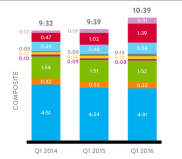
The total media consumption across all devices and platforms jumped one hour from the first quarter of 2015, to 10 hours, 39 minutes. (A year earlier, there had only been a seven-minute year-over-year jump in daily media consumption.) That’s mostly due to smartphone use, which has soared 37 minutes, and tablet use, which has increased 12 minutes. Internet on PC jumped 10 minutes, while multimedia devices, including Apple TV and Roku, were up four minutes. Video game consoles and DVR use was flat, while DVD use dipped one minute and live TV dropped three minutes year over year. Nielsen’s data indicates that consumers aren’t pulling away from linear TV, but instead are making additional time for these new devices.

An hour more each day with media sounds wonderful if you’re in the media business. The real question this raises with me is from where are consumers getting that extra hour? Do you think they’re sleeping less? Leaving work early? Maybe they’re watching on the job (so much for productivity). No, I suspect they’re just not doing something else. Shopping, dining out as much, going to other recreational activities. All this means is that as selective as consumers were in allocating their time to your non-media business they’re going to be even more so. That reinforces the need for all of us to provide value every time we have a consumer interaction or we won’t be having as many down the road.

As an aside, I’ll remind us that most of us, even if we make package goods, are now in the media business. Social sites, home base (your website!), and content we provide to others are all media, so it’s not a lost cause. Obviously, it’s fiercely competitive out there, and the hour more each day that consumers are spending in the space doesn’t mean they’re any less frugal with the time they spend. The job for each of us is to make up for the hour less they’re outside of media where we live and capture their attention within the extra hour they’re spending inside. We can do that through great content, content which is focused on providing value and solving their problems.  Make sense?

Leave a comment

Filed under digital media

Take Me Away

It’s Foodie Friday and I have a little blast from the past today.  I’m a fan of the animated movie Ratatouille, the story of a rat who loves to cook.  If you’ve never seen it, take a few minutes this weekend and do so (as of this writing I see it’s available for streaming rental). The whole thing is pretty wonderful but there is one scene in particular which speaks loudly to me and I think has some business inspiration for us all. 


I’m going to risk spoiling the movie here but I need to explain the scene of which I’m thinking. It’s when France’s top restaurant critic Anton Ego, whose previous review cost the restaurant in which Remy, the rat, cooks one of its stars. Without spoiling it too much, Remy and the chefs cook Ego a dish of ratatouille which brings back an astonished Ego memories of his mother’s cooking. The graphic you see on the right is the moment when Ego takes a bite and that’s our business inspiration.

Every time a customer partakes of our product or service, we have the opportunity to make a positive emotional connection. I’m sure you’ve had the sensation of recalling a memory when you experience a particular smell or taste something. We see this all the time with, for example, scented candles. There is a difference between recognizing the smell of a pine tree and experiencing the feeling of being out in a snowy woods standing among them.  We’re trying for the latter because that emotional connection binds the consumer and the product. Actors use this all the time via affective memory or sense memory.

As with many things we discuss here on the screed, it’s not an easy task. The benefits are worth the effort, though. You can see it even in something as simple as the “Calgon, Take Me Away” campaign. Maybe we’re all in the transportation business?

Leave a comment

Filed under food, Thinking Aloud

Killing It At The Source

Suppose you sit down at a restaurant and look over the menu.  Seeing a few things which seemed appealing, you place your order.  How would you feel if you found out that while the main course was cooked in-house, the starters and desserts were all made across the street and brought it?  I’d feel kind of cheated.  My expectation is that when I order off a place’s menu that they’re making what I’m served. They’re certainly taking credit for it.

As it turns out, that’s exactly what’s happening in the online publishing world and I think it’s suicidal. It’s called “sourced traffic” and this is an excellent definition:

The practice of sourcing traffic is essentially any means by which digital media publishers or vendors acquire audience (visitors) through third parties.  So, this is audience being sold by the vendor which is not occurring in the traditional advertising model (by which a publisher puts out content which attracts an audience and then sells ads to reach that audience).  In other words, sourced traffic is by definition not organic traffic to the publisher’s site.

In other words, publishers are selling audiences they don’t have just to add some audience to their delivery stats. The first issue I have is much the same as I might have with the aforementioned restaurant – taking credit for something that’s not yours. My guess is that most publishers – like most buyers – are very much focused on the numbers and not at all focused on the quality of what’s being delivered. I would be quite upset if I paid for a prix fixe meal and the quality of the parts not made in-house were substantially lower.

The bigger issue brings us right back to our old friend, fraud. A White Ops and ANA study of non-human traffic from 2014 found that while a direct audience is mostly human, sourced traffic is almost 90% attributable to bots. eMarketer reported this the other day about an ANA study:

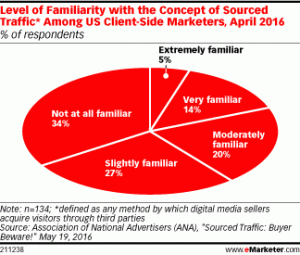
According to the data, 34% of respondents—also ANA members—said they were not at all familiar with sourced traffic. Meanwhile, 19% said they were very or extremely familiar. But perhaps more interestingly, the majority (54%) of those surveyed, said weren’t sure if any of their digital media buys included some form of traffic sourcing.

And we wonder why digital doesn’t receive as much weight in media buying as the audiences warrant?  All players – publishers, buyers, and clients – need to step up their game here and fix the sourced traffic problem.  Otherwise, who is going to want to eat in this restaurant?

Leave a comment

Filed under digital media, Huh?